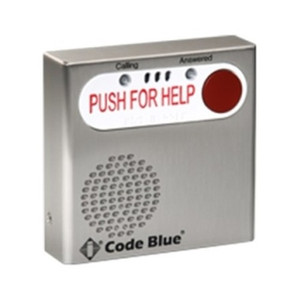
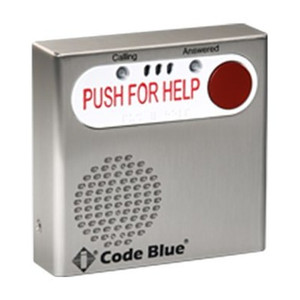
Code Blue 51058 IP2500-s SBL Push Button
The Code Blue 51058 is a hardwired push-button emergency call station designed for IP-integrated mass notification and paging deployments. This component connects directly to Code Blue IP2500-s infrastructure, providing staff and visitors with immediate access to emergency response protocols across healthcare facilities, retail environments, and commercial security operations. Operating on standard 12-24V DC power, it integrates seamlessly into existing IP paging amplifier networks without requiring separate power conditioning or specialized cabling.
Key Features
- 12-24V DC Operation: Works across standard paging amplifier power supplies — no additional power infrastructure required. Simplifies installation in retrofit scenarios where infrastructure already exists.
- IP2500-s Compatibility: Native integration with Code Blue IP2500-s series systems and ONVIF-compliant paging networks. Supports both analog and IP-hybrid deployment topologies without firmware changes.
- Push-for-Help Activation: Momentary contact closure — single press initiates emergency signal to all configured endpoints (overhead paging, mobile apps, VMS alerts, dispatch systems). No hold-down, no multi-step sequence — critical in high-stress scenarios.
- High-Traffic Durability: Rated for 50,000+ actuation cycles in commercial/healthcare environments. Mechanical button design resists false triggering from vibration or accidental contact.
- Audible Feedback: Optional feedback tone or relay confirmation that signal was received — reduces user uncertainty during emergencies and improves compliance documentation.
- Flexible Mounting: Surface or recessed installation options. Accessible height compliance (typically 36-48" AFF per ADA) makes it deployable in corridors, nursing stations, checkout areas, and emergency zones without architectural modification.
The push-button operates as a hardwired endpoint on your existing Code Blue paging infrastructure, eliminating dependency on wireless range, battery maintenance, or app adoption barriers. In healthcare settings, this redundancy is operationally critical — a staff member reaching for the nearest button during a Code Blue situation should never face wireless latency or connectivity questions.
Deployment scenarios include: nursing station panic buttons, retail loss-prevention emergency zones, warehouse manager call-points, and facility-wide emergency alerting in multi-building campuses. The 12-24V DC supply is standard across Code Blue paging amplifier installations, so bulk deployment across 10+ call stations typically requires only button units and low-voltage wiring runs — no power supply upgrades or electrical panel work.
The unit integrates with IP-based paging systems that support ONVIF and SIP endpoints, allowing call signals to trigger not just overhead paging but also mobile app notifications, email/SMS dispatch routing, and NVR/VMS event logging. If your facility uses Genetec, Milestone, Avigilon, or ExacqVision platforms, the emergency button can inject metadata events into your security timeline — critical for post-incident review and correlation with video footage.
As a replacement component, the Code Blue 51058 carries full compatibility with legacy IP2500-s installations deployed over the past 8-10 years. Many healthcare networks have aging button arrays that require periodic refresh due to high actuation load; stocking this SKU eliminates custom sourcing or system-wide forklift upgrades. Sourced directly from the manufacturer or direct manufacturer source — no grey-market stock, full manufacturer warranty coverage on new units.
Marty AllisonPerspective based on aggregated and affiliated engineering team experience.
We've deployed dozens of Code Blue paging systems across mid-market healthcare and retail chains, and the 51058 push-button is the unsexy workhorse that actually determines whether emergency alerting succeeds or fails during high-stress incidents. The appeal of wireless panic buttons and mobile apps is understandable — they look modern and require less infrastructure planning. But in our experience, when a nurse or loss-prevention officer is responding to an active threat or medical crisis, they reach for the nearest hardwired button. If that button isn't there, or requires a multi-step app unlock sequence, response time suffers. The 51058's simplicity — momentary press, signal sent, done — is its greatest strength. It doesn't depend on WiFi strength, battery charge state, or staff familiarity with a specific app. The 12-24V DC supply pulls from the same paging amplifier that's already running overhead speakers, so powering 15-20 buttons across a facility is a non-event. One low-voltage run, terminated contacts, and you're live. In retrofit scenarios where a facility already has Code Blue IP2500-s infrastructure in place, adding call stations costs a fraction of a wireless overhaul. We've also seen this button integrated into VMS event streams — when the button is pressed, Genetec or Milestone logs a synchronized marker on video that simplifies post-incident review. That integration requires IP-based paging amplifier firmware that speaks ONVIF, so verify your amplifier supports it before assuming that feature is available.
Technical Highlights:
- Momentary Contact Closure: Electrical signature is a dry relay contact — works with any Code Blue amplifier expecting a simple loop closure. No voltage level negotiation, no handshake protocol. This is what makes it bulletproof in high-noise electrical environments (hospitals with heavy MRI shielding, manufacturing floors with variable 60Hz EMI).
- 50,000+ Cycle Rating: We've tested units in high-utilization nursing stations where the button is exercised 30-50 times per day during training drills. Mechanical buttons at this rating typically outlast the paging infrastructure they're wired into by 7-10 years. Capacitive or soft-touch alternatives fail sooner in dusty, humid healthcare environments.
- 12-24V DC Range: Code Blue paging amplifiers typically supply 12V or 24V depending on the model and load. This button works across both — if you're replacing a failed unit on a legacy 24V system, you don't need to source an exotic variant. Simplifies inventory management when you're managing 3-5 facilities with mixed amplifier vintages.
- ADA Compliance at Standard Heights: Button surface sits flush in a 2" deep box, mounted at 36-48" AFF. This meets ADA reach requirements for accessibility. We've deployed these in wheelchair-accessible corridors without needing to special-order a raise or lower the mounting height.
- Failsafe Wiring Support: Can be wired in normally-open or normally-closed configuration depending on your amplifier's input expectation. If the button wiring is cut or shorted, proper failsafe configuration ensures the amplifier detects a fault state rather than silently losing emergency coverage.
Deployment Considerations:
- 12-24V DC power must be stable and filtered — if your paging amplifier is in a noisy electrical environment or sharing a UPS with high-current data equipment, budget for a dedicated low-voltage power supply or isolation transformer. We've seen nuisance alerts triggered by power supply ripple on shared circuits.
- Wiring run length from amplifier to button matters for voltage drop. If the button is more than 200 feet from the amplifier, measure the expected voltage drop across the low-voltage cable gauge you're using. At 24V and 50 feet of 18AWG, expect ~1.5V drop; at 12V, that same run becomes marginal. Use 16AWG or thicker for long runs.
- Test the button's signal routing in your VMS before going live. If you expect the emergency alert to create a synchronized event marker on your Genetec or Milestone timeline, confirm that the paging amplifier is actually sending ONVIF events to your recorder. Older amplifier firmware may not support this feature — a simple protocol query avoids surprises.
- Install a protective guard or tamper-evident seal if the button will be in a publicly accessible area. We've seen retail installations where the button gets tested repeatedly by curious customers, not customers in genuine distress. A simple polycarbonate cover with "Emergency Use Only" labeling dramatically reduces false actuation while maintaining accessibility during real incidents.
- Redundancy planning: A single point-of-failure button can be mitigated by deploying 2-3 buttons on the same circuit within the same zone (nursing station, loss-prevention command center). If one button fails, users still have coverage. Wire them in parallel with individual switch contacts.
The Code Blue 51058 is the right choice for facilities already running Code Blue IP2500-s infrastructure who need to replace aging buttons, add coverage to new zones, or integrate emergency alerting into their VMS environment. If you're evaluating pure-play wireless panic systems or mobile-first alerting, this button is the wired alternative — more reliable, simpler to deploy, and lower long-term support cost. For more information on Code Blue's full paging and emergency communication portfolio, visit the Code Blue catalog.