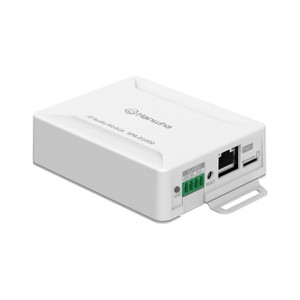
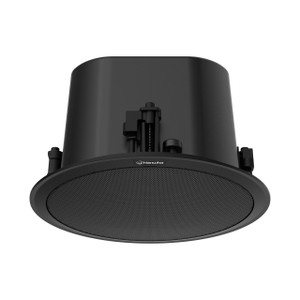
Hanwha SPA-B1000 IP Audio Bridge
The Hanwha SPA-B1000 is a dedicated IP audio bridge designed to convert line-level stereo analog audio into networked streams for integration with Hanwha IP surveillance systems, access control platforms, and facility management infrastructure. Purpose-built for system integrators, it eliminates the need for external encoders or separate amplification stages, reducing both deployment complexity and capital expense in mixed-media security installations.
Key Features
- Stereo Line-Level Audio Input (±6 dBV Maximum): Accepts analog audio sources up to ±6 dBV—standard for consumer and professional audio devices, mixer outputs, intercom feeds, and background music systems. This means you don't need signal conditioning or pre-amplification on most sources; connect directly from existing facility audio infrastructure and save cost and installation time.
- PoE-Powered (IEEE 802.3af Type 1 Class 3, 10W Max): Draws a maximum of 10W via standard PoE, which won't strain most managed switches and eliminates the need to run separate power cabling. Critical advantage in retrofit deployments where running new electrical to a remote location would add weeks and expense—audio and network travel on the same cable run.
- Integrated 10W Class D Amplifier: Drives small to medium speaker loads directly or controls downstream audio devices without requiring an external amplifier. Sufficient for single-zone announcements, intercom speaker groups, or background music in offices and small retail spaces. In larger multi-zone systems, it can trigger relay-controlled amplifiers or networked speakers downstream without adding hardware complexity.
- Onboard and Expandable Storage (1GB Internal + microSD up to 32GB): The 1GB internal memory caches audio files and system configuration; the microSD slot accepts SDXC cards up to 32GB. This enables offline audio playback—background music rotation, pre-recorded emergency messages, or event-triggered alerts—without cloud dependency or network streaming latency. Particularly valuable in facilities with intermittent WAN connectivity or stringent uptime requirements where local availability is non-negotiable.
- WAV and MP3 Format Support (64–320 kbps, 16–48 kHz Sampling): Flexible codec support lets you optimize storage and network bandwidth independently. Lower bitrates (64 kbps mono) save space for large audio libraries; higher bitrates (320 kbps stereo) preserve quality for critical announcements or music playback. The wide sampling range (16–48 kHz) accommodates both compressed voice-grade audio and music-quality files from the same device without format conversion.
- Network-Integrated Audio Control: Connects via standard Gigabit Ethernet to surveillance networks, enabling centralized audio scheduling, multi-zone distribution, and audio-visual correlation during security incidents. Integration with Hanwha NVR platforms allows audio to be logged alongside video, essential for forensic review in access control and intercom scenarios where you need synchronized playback of both channels.
Integration & Compatibility
The SPA-B1000 integrates natively with Hanwha surveillance and access control ecosystems. Its network interface allows the bridge to receive commands from management software, schedule audio playback across time zones, and stream audio streams to authorized users or recording systems. When paired with IP security infrastructure, it provides a unified control point for audio across campuses, retail chains, and mixed-use facilities without vendor fragmentation.
Deployment Scenarios
- Multi-Zone Background Music: Distribute stored or streamed audio across office floors or retail zones with local amplification at each bridge location and no dependency on centralized audio servers or continuous network streaming.
- Emergency Notifications: Integrate with access control or IP intercom systems to broadcast facility-wide alerts or zone-specific warnings during security events, with fallback to locally cached pre-recorded messages if network connectivity is lost.
- Intercom Integration: Replace standalone intercom amplifiers with SPA-B1000 bridges positioned at speaker groups, reducing hardware sprawl and centralizing audio routing through IP infrastructure.
- Audio Forensics: Record audio alongside IP camera video for synchronized playback during incident investigation or compliance review, with microSD backup for offline archival.
Frequently Asked Questions
Q: Can the SPA-B1000 power passive speakers directly?
A: The integrated 10W Class D amplifier can drive small passive speaker loads (typically 4–8 ohm) suitable for single zones or small rooms. For higher impedance loads or multi-zone distribution, use the audio output to control external amplifiers or powered speakers.
Q: What happens to audio playback if the network connection drops?
A: Audio files stored on the internal 1GB memory or microSD card can continue to play according to the schedule programmed into the device. Remote control and streaming from the NVR will not be available until network connectivity is restored.
Q: Is the SPA-B1000 compatible with non-Hanwha surveillance systems?
A: The SPA-B1000 is designed for tight integration with Hanwha NVRs and access control platforms via ONVIF-compatible network protocols. Compatibility with third-party systems depends on their support for standard network audio streaming and command protocols—consult your system integrator for cross-vendor feasibility.
Q: How much microSD storage do I need for background music?
A: A 32GB microSD card at 128 kbps MP3 (a reasonable compromise for background music) holds approximately 22–24 hours of continuous audio. For 8-hour daily rotation with redundancy, a 16GB card is typically sufficient.
Q: Can multiple SPA-B1000 bridges be synchronized for multi-zone playback?
A: Yes. Multiple SPA-B1000 devices can be managed through the same Hanwha NVR or access control platform, allowing synchronized scheduling and coordinated audio distribution across zones. Each bridge operates independently, so network latency between zones may cause minor timing drift—acceptable for background music, critical for tightly synchronized emergency alerts.
Ted PerryPerspective based on aggregated IP Security Depot and affiliated engineering team experience.
The SPA-B1000 (often searched as SPA B1000) solves a real gap in mixed-media integrations: you need audio in the security network, but most facilities already have analog audio infrastructure—intercom amplifiers, paging systems, background music mixers. Rather than rip and replace, the SPA-B1000 bridges the gap with minimal disruption. The ±6 dBV input spec is critical: it means you're accepting standard line-level audio without pre-conditioning, so a direct feed from a mixer or intercom control board works out of the box.
Technical Highlights:
- 10W PoE Budget (IEEE 802.3af): Under 10W means you won't trigger power-class issues on standard managed switches. On a typical 95W PoE switch, you can run 8–10 SPA-B1000 bridges plus cameras without negotiating with the facilities team about power upgrades.
- 1GB Internal + 32GB microSD: 1GB onboard caches your emergency message library and daily rotation schedules; 32GB microSD (fully supported) holds roughly 24 hours of 128 kbps MP3. The offline playback capability is not a nice-to-have in facilities with aging WAN links or backup power situations—it's a lifeline.
- 10W Class D Amplifier: Adequate for a single small-to-medium room or a small speaker array (4–8 ohm load). If you're driving a whole floor or multiple zones, this becomes a controller for downstream amplifiers, not a replacement for them. Know the difference or you'll get pushback from the audio contractor.
Deployment Considerations:
- The SPA-B1000 is designed for Hanwha NVR and access control integration. Cross-vendor integration is possible via ONVIF, but is not natively tested or supported—factor in extra validation time if your VMS is Milestone, Genetec, or Exacq.
- Audio sampling supports 16–48 kHz, but 48 kHz WAV files on a 32GB card deplete storage in ~6 hours. For emergency alerts, 16–24 kHz MP3 at 64–128 kbps is the practical sweet spot; reserve 48 kHz for short critical announcements you want to archive forensically.
Best fit: mid-market campuses, retail chains, and mixed-use facilities where you already have distributed intercom or background music and need to log audio alongside video for compliance or forensic correlation. Avoid if you need studio-grade audio quality or multi-zone synchronization with latency under 200 ms—you'll outgrow the SPA-B1000's capabilities and be forced to redesign.