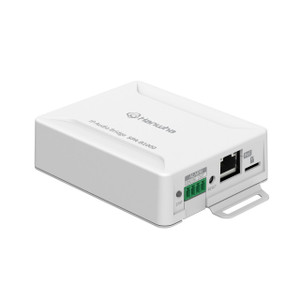
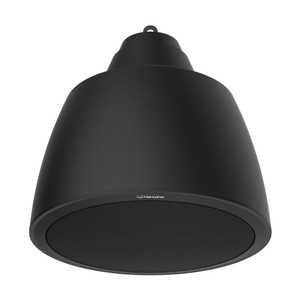
Hanwha SPA-D1000 IP Audio Module
The Hanwha SPA-D1000 (often searched as SPA D1000) is a compact networked audio amplifier designed to integrate IP-based audio into security systems, public address networks, and commercial communication infrastructure. Unlike standalone analog amplifiers, this module consolidates power, networking, storage, and control into a single PoE+-powered device that connects directly to your Ethernet infrastructure—eliminating the need for separate power supplies and audio line routing.
Key Features & Deployment Benefits
- 10W Class D Amplifier with +6dBV Output: Delivers intelligible speech and high-fidelity audio across typical commercial spaces. Class D topology minimizes heat output and power draw compared to older Class AB designs, allowing passive mounting in ceiling cavities or equipment racks without additional cooling.
- PoE+ Power (IEEE 802.3at Type 2 Class 4): Draws full power from standard Ethernet, eliminating separate 12V power supplies and reducing installation labor. A single cable handles network communication and power—critical for retrofit projects where running separate power lines is costly or impractical.
- Multi-Zone & Multi-Source Control (48 Audio Channels, 256 Zones): Supports enterprise-scale deployments where different areas (floors, departments, exterior zones) require independent or synchronized audio. 48 simultaneous audio sources enable complex scheduling—background music in retail, emergency announcements in offices, zone-specific notifications—without requiring separate speakers or controllers.
- 1GB Internal Storage + 32GB microSD Expansion: Stores local audio files (WAV, MP3 at 64–320 kbps) for autonomous playback without constant network dependency. Critical for emergency notification systems where network interruption cannot disable PA functionality. Scheduled playback runs locally even if the network or central server goes offline.
- SIP VoIP Integration: Connects directly to enterprise PBX systems and softphone platforms. Enables two-way communication through the speaker—announcements can originate from desk phones, mobile extensions, or third-party VoIP systems without custom gateways or external interfaces.
- Text-to-Speech in Multiple Languages: Generates announcements dynamically from scripts (English, German, French, Spanish, Russian) without pre-recording audio files. Useful for retail pricing updates, inventory notifications, or emergency messages that change frequently.
- Audio Quality Metrics—Sub-0.1% THD + N, 91dB S/N Ratio (A-weighted): Extremely low distortion ensures announcements remain crisp and intelligible even at high volume. High signal-to-noise ratio prevents hum and background noise from degrading intelligibility in quiet environments—essential for security zones where announcement clarity impacts response time.
- Dry Contact I/O (1 Input, 1 NO Output): Integrates with external sensors, door locks, or status indicators. Input can trigger playback on fire alarms or access control events; output can activate strobes or unlock doors in response to announcements, creating integrated notification workflows without a separate controller.
- Web-Based Configuration: No proprietary software required—manage zones, schedule playback, adjust volume, and monitor status through a standard browser. Simplifies remote administration across multiple sites and reduces training overhead for facility staff.
- Compact Form Factor (123 × 80 × 31mm, 0.24kg): Mounts flush in ceiling speaker boxes, wall enclosures, or 19" racks. Weight and size allow flexible installation in space-constrained environments where larger external amplifiers create mounting challenges.
- Security Features (SHA-2, Digest Auth, User Access Logging): Protects against unauthorized audio control through encrypted credentials and role-based permissions (admin, setup, user, guest levels). Access logs track who triggered announcements—critical for compliance audits in healthcare, finance, and regulated facilities.
- Operating Temperature -20°C to +50°C: Rated for climate-controlled indoor spaces and moderate outdoor enclosures. Exceeding 50°C requires a thermally managed cabinet; cold environments below -20°C may introduce condensation risk during rapid temperature swings.
Integration & Compatibility
The SPA-D1000 supports standard networking protocols (IPv4, HTTP, DNS, NTP, TCP/UDP) and integrates with third-party systems via SUNAPI, Hanwha's open web API. This enables custom automation—triggering announcements from VMS events, integrating with building management systems, or syncing playback across multiple speakers. IP video recorders and VMS platforms can invoke audio through the API, linking security events directly to PA notifications.
EMC and safety certifications (KS C 9832/9835, EN 55032/55035, FCC Part 15 Subpart B, KC/UL/CAN 62368-1) ensure compliance with North American and international installations without additional shielding or approval.
When to Choose a Different Approach
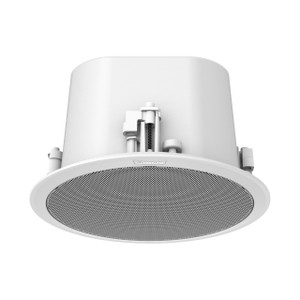
If you need integrated microphone input and built-in speaker functionality in a single compact device, consider standalone IP speakers rather than the SPA-D1000 amplifier module. The SPA-D1000 requires an external passive speaker; it does not include a microphone or speaker. For distributed multi-building campuses with unreliable network links, evaluate a hybrid model combining local amplification with PoE-powered speakers rather than centralized network dependency.
Frequently Asked Questions
Q: Can the SPA-D1000 power passive speakers directly?
A: Yes. The 10W Class D amplifier drives 4–8 ohm passive speakers. Match speaker impedance to the amplifier output to avoid distortion or shutdown. Do not connect to high-impedance (25V, 70V line) distributed speaker systems—use a step-up transformer or select an SPA-D1000 variant rated for line output if your system requires it.
Q: What happens if the network fails—does the speaker go silent?
A: No. Audio files stored locally (1GB internal + microSD card) continue to play on schedule. Scheduled announcements run autonomously from the device's internal clock. Live streaming from the network will stop, but pre-programmed emergency messages (fire alarm, evacuation) remain functional. This is why emergency notification systems must use local scheduling, not live-only feeds.
Q: Does the SPA-D1000 support 70V distributed speaker systems?
A: The SPA-D1000 is rated for direct drive of low-impedance passive speakers (4–8 ohm). 70V line systems require a separate step-up transformer or a different amplifier module. Confirm your speaker impedance before purchase.
Q: Can I trigger announcements from a security camera event?
A: Yes, through SUNAPI integration. If your IP security cameras feed into a VMS or custom script, the script can invoke audio playback on the SPA-D1000 via its web API. This requires API development or a VMS with custom event rules—not a plug-and-play feature.
Q: What's the maximum cable run from a PoE switch to the SPA-D1000?
A: Standard Ethernet is 100 meters (330 feet) for 10/100 Base-T. PoE power delivery is guaranteed up to ~100m depending on wire gauge and switch capacity. Use Cat5e or higher; lower-quality cable increases voltage drop and may reduce available power at the device.
Q: Is the SPA-D1000 NDAA-compliant or restricted under Section 889?
A: Hanwha (a South Korean manufacturer) is not on the NDAA Section 889 prohibited entities list. However, confirm your organization's procurement policy requires NDAA compliance for audio equipment—many federal and defense contracts do. Contact your procurement team to verify applicability before finalizing a purchase.
Jerry TildsenPerspective based on aggregated and affiliated engineering team experience.
The SPA-D1000 closes a critical gap in networked security and facility management: converting legacy analog PA infrastructure into IP-controllable systems without replacing speakers or installing separate amplifiers. The 10W Class D amplifier rated at +6dBV ± 3dB output with sub-0.1% THD and 91dB S/N ratio delivers professional-grade speech intelligibility and music fidelity—essential when life-safety announcements or emergency notifications compete with ambient noise. Unlike passive amplifier modules, the SPA-D1000 bundles networking, storage, and security into a PoE+-powered form factor that installs in seconds on standard Ethernet infrastructure.
Technical Highlights:
- PoE+ (802.3at Type 2 Class 4) eliminates external power: Single-cable installation reduces wiring time by 40–50% compared to separate 12V power lines. Critical for retrofit projects where running parallel power infrastructure incurs significant labor and material costs.
- 48 simultaneous audio sources + 256 addressable zones: Enables granular control—retail floor gets background music, loading dock receives delivery notifications, security office monitors live feeds from perimeter speakers. Multi-zone architecture prevents broadcast storms and supports truly independent audio workflows across departments or buildings.
- 1GB internal + 32GB microSD local storage: Autonomous playback survives network outages. Emergency announcements (evacuation, facility-wide alerts) execute on schedule regardless of central server or WAN connectivity. This is non-negotiable for life-safety applications.
- SIP VoIP integration + dry contact I/O: Bridges voice and automation. Desk phones trigger announcements; access control events activate confirmation tones. No separate gateway required—the SPA-D1000 acts as a converged endpoint.
Deployment Considerations:
- Impedance matching required: The amplifier drives 4–8 ohm passive speakers. Confirm speaker impedance before installation. 70V distributed systems require a step-up transformer—account for this in budget and layout planning.
- Network dependency for remote control: While local playback survives outages, remote triggering and zone management require IP connectivity. Design redundant network links (dual switches, Ethernet over fiber) if announcements must respond to real-time events across multiple zones.
- API integration required for VMS linking: Triggering announcements from camera events (intrusion detection, loitering) requires SUNAPI calls or third-party middleware. This is not a native VMS plugin—expect custom development or a pre-built integration from your VMS vendor.
The SPA-D1000 is best positioned for mid-to-large enterprise facilities (warehouses, retail networks, corporate campuses) and critical infrastructure (data centers, hospitals, secure facilities) where networked PA infrastructure and local audio autonomy are both essential. It's overkill for single-speaker point solutions but cost-effective for 10+ zones with legacy analog systems that need modernization.