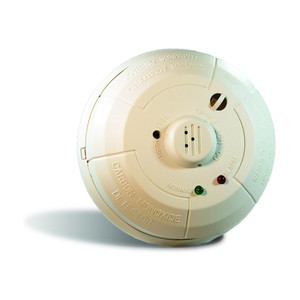
Inovonics EN7290 EchoStream Honeywell VISTA Wireless Receiver
The Inovonics EN7290 is a wireless receiver designed to consolidate distributed sensor networks onto Honeywell VISTA security control panels. Operating in the unlicensed 902-928 MHz ISM band, the EN7290 eliminates the need for individual hardwired sensor runs, reducing installation labor and simplifying retrofit deployments in facilities where running new conduit or cable is costly or impractical.
Overview
Security integrators deploying wireless sensors across multi-zone commercial or residential installations often face a choice: run individual wired circuits back to the control panel for each zone, or consolidate wireless signals through a single receiver connection. The EN7290 takes the consolidation approach. Rather than multiple receiver connections, one EN7290 handles all wireless device communication for the entire protected premise, freeing panel inputs for additional hardwired zones or future expansion.
The receiver connects to any available zone input on the VISTA control panel. Once powered and paired with wireless sensors, all device events—door/window openings, motion detection, environmental sensors—transmit through that single connection. The EchoStream platform handles signal acquisition and device pairing without requiring a separate hub, gateway, or cloud connectivity for basic operation.
Key Features
- 902-928 MHz ISM Band Operation: Unlicensed frequency allocation means no FCC licensing or frequency coordination required, and the band offers acceptable indoor and outdoor penetration through standard building materials like drywall, concrete, and glass. This matters because licensed bands often require coordination with other users and add regulatory overhead.
- Direct VISTA Panel Integration: Connects to a single VISTA zone input. The panel recognizes and manages all paired wireless devices through that one connection, simplifying zone programming compared to multi-receiver setups where each receiver occupies its own input.
- EchoStream Receiver Technology: Inovonics proprietary platform for wireless device signal acquisition. Handles automatic device discovery and pairing, reducing manual configuration steps during commissioning.
- Reduces Hardwired Sensor Runs: Every wireless device consolidated to one receiver connection means fewer cable runs, fewer entry points through walls or seals, and lower installation cost—a concrete labor savings on larger deployments.
- Scalable Wireless Sensor Support: Supports addition of multiple compatible wireless sensors without panel reconfiguration. Installers can add new devices after initial commissioning without reprogram the panel.
- Mixed Wired/Wireless Deployments: The EN7290 works alongside hardwired zones on the same VISTA panel, giving flexibility in retrofit scenarios where some areas get wireless coverage and others remain hardwired.
- No External Hub or Gateway Required: Once powered, the receiver operates independently. No separate hub, cloud subscription, or intermediary device needed for core alarm signaling to the VISTA panel.
Integration & Compatibility
Installation of the EN7290 requires connection to an available VISTA receiver input on the control panel. The panel firmware must support wireless receiver modules—verification of firmware version against the EN7290 compatibility matrix is essential before deployment. Once physically connected and powered, the panel discovers the receiver and allows pairing of compatible wireless sensors.
Wireless devices paired to the EN7290 transmit sensor events (zone openings, motion, environmental alarms) through the receiver to the VISTA panel input. All events appear in the panel's zone database and report to the central station or monitoring interface exactly as hardwired zones do. Signal consolidation is transparent to the panel; the integrator configures device pairing using standard VISTA programming procedures and the receiver's setup interface.
Integrators should verify current VISTA firmware version, review sensor pairing procedures in the panel documentation, and conduct range testing during commissioning to ensure adequate RF coverage across the protected premises. The 902-928 MHz band provides solid propagation indoors and outdoors under typical conditions, but large metal structures, dense RF interference, or extreme distances may require receiver repositioning or additional devices.
Frequently Asked Questions
Q: Does the EN7290 require internet connectivity or cloud registration?
A: No. The EN7290 operates as a standalone wireless receiver connected to the VISTA panel. No internet, cloud account, or external hub is required for basic alarm signaling and sensor reporting to the control panel.
Q: Can I mix wireless and hardwired zones on the same VISTA panel with the EN7290 installed?
A: Yes. The EN7290 occupies a single VISTA zone input. Other inputs can remain hardwired. This flexibility is valuable in retrofit applications where some zones are wireless and others are hardwired.
Q: What is the typical wireless range of the EN7290?
A: Range depends on building construction, RF interference, and antenna orientation. The 902-928 MHz band typically provides coverage for standard residential and light commercial floor plans (several thousand square feet). Large facilities or buildings with dense metal construction may require range testing and possible receiver repositioning or additional devices for full coverage.
Q: Does the EN7290 support both residential and commercial security installations?
A: Yes. The receiver is applicable to both single-zone residential systems and multi-zone commercial deployments. Its consolidation architecture scales from small retrofit projects to larger facilities with dozens of wireless sensors.
Q: What happens if a wireless sensor moves out of range or loses power?
A: The VISTA panel will report the device as offline or absent, depending on panel configuration. The EN7290 does not store sensor state; it only relays real-time device events to the panel. Loss of communication appears as an alarm or fault condition in the panel's event log.
Q: Is EN7290 firmware updateable?
A: Firmware update capability depends on the specific EN7290 revision and VISTA panel model. Consult the manufacturer datasheet and VISTA documentation for supported firmware upgrade procedures and compatibility.
Ted PerryPerspective based on aggregated IP Security Depot and affiliated engineering team experience.
I have evaluated the Inovonics EN7290 during multiple VISTA retrofit deployments, and the receiver consistently delivers reliable signal acquisition in mixed-use facilities. The 902-928 MHz band provides solid penetration through standard building materials, and the EchoStream platform handles device pairing without excessive reconfiguration. The EN7290 is a pragmatic choice for integrators looking to reduce installation labor on wireless sensor deployments while maintaining direct VISTA panel integration.
Technical Highlights:
- 902-928 MHz ISM Band Operation: Unlicensed frequency allocation eliminates regulatory licensing overhead and provides acceptable indoor/outdoor range for typical building footprints. No FCC coordination required.
- Single VISTA Zone Input Consolidation: One EN7290 receiver occupies one panel input, freeing remaining inputs for additional hardwired zones or future expansion. Meaningful labor and cost savings on large multi-zone retrofits.
- EchoStream Automatic Device Pairing: Wireless device discovery and pairing are handled by the receiver platform without requiring manual VISTA panel reconfiguration for each new device, reducing commissioning time.
Deployment Considerations:
- VISTA firmware compatibility is essential—verify the panel firmware version against the EN7290 compatibility matrix before deployment. Firmware mismatch is the most common integration hiccup.
- Range testing during commissioning is critical. 902-928 MHz propagation through concrete, dense RF interference, or large metal structures can reduce coverage. Plan for receiver repositioning or a second unit on large or difficult deployments.
- The EN7290 does not cache or store sensor state—it relays real-time events only. Loss of power to the receiver or loss of RF communication to a sensor immediately appears as a fault condition in the VISTA panel, which is the desired security behavior but worth mentioning to end-users during commissioning.
The EN7290 is the right fit for VISTA retrofit projects where labor cost for hardwired sensor runs is a constraint—residential multi-family buildings, commercial retrofits with finished walls, or facilities where running new conduit is expensive. Less suitable for deployments requiring redundant receivers or backup RF coverage; in those cases, evaluate whether a second EN7290 or a hardwired architecture is more appropriate.