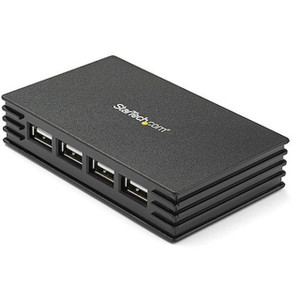
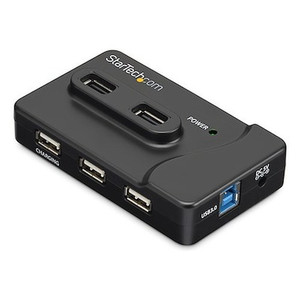
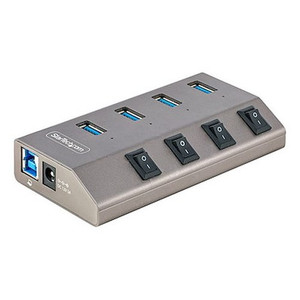
StarTech HB20A4AME Industrial 4-Port USB 2.0 Hub
Overview
The StarTech HB20A4AME is a hardened 4-port USB 2.0 hub built for industrial control cabinets, factory automation panels, and harsh-environment deployments where consumer-grade USB hubs simply won't survive. Housed in a steel enclosure and rated for -40°C to 85°C operation, it accepts 7–48V DC via terminal block — meaning it integrates directly into industrial power architectures without an external wall adapter. If you're connecting barcode scanners, USB-attached sensors, serial adapters, or security peripherals inside a DIN rail cabinet, the HB20A4AME belongs on your short list.
This is not a desktop accessory repurposed for industrial use. The steel body, wide-input DC power, and aggressive ESD and surge protection specs position it as a industrial networking component designed for the same environments that demand hardened switches and ruggedized compute — and it fits natively into those enclosures via DIN rail, wall, or desk mounting.
Key Features
- 480 Mbps USB 2.0 throughput across all 4 ports: Full USB 2.0 Hi-Speed on each downstream Type-A port means you're not bandwidth-starved when running multiple USB peripherals simultaneously — scanners, memory sticks, USB-to-serial adapters, and similar devices operate at their rated speeds without contention issues common to slower hubs.
- 7–48V DC wide-input power via terminal block: The 7–48V input range covers virtually every industrial DC bus — 12V, 24V, and 48V systems all work without a converter. Terminal block wiring means permanent, vibration-resistant connections rather than barrel connectors that can work loose on a machine floor. Input current draw is a manageable 2A at up to 14W total consumption.
- -40°C to 85°C operating range: This is the spec that separates the HB20A4AME from commercial USB hubs. At -40°C it starts cold in an unheated outdoor enclosure on a January morning; at 85°C it keeps running inside a warm control cabinet next to variable frequency drives. Matching storage temperature range means thermal cycling during shutdown periods isn't a concern either.
- +/-15kV air / +/-8kV contact ESD protection: On a factory floor or in a transportation environment, electrostatic discharge events from personnel or machinery can kill unprotected USB ports instantly. These ESD ratings are substantially higher than what you'll find on commercial hubs, protecting both the hub and whatever USB device is plugged into it.
- 350W surge protection: Power quality on industrial DC rails is rarely clean. The 350W surge rating absorbs transient spikes — inductive load switching, relay chatter, motor starts — that would damage or reset standard USB infrastructure.
- Steel enclosure with DIN rail, wall, and desk mounting: The steel body at 3.7 x 2.2 x 1.3 inches installs directly on a 35mm DIN rail inside a control panel, mounts to a wall in a junction box, or sits on a desk in a rugged workstation context. At 10.3 oz it's dense but compact — it won't dominate cabinet real estate.
- Status LEDs per port: Per-port LED indicators let you confirm device enumeration and connection state without pulling the hub or interrogating the host OS — useful during commissioning and fault diagnosis in the field.
- 5–95% RH operating humidity: Non-condensing humidity tolerance across the full range means the hub handles humid warehouse environments, outdoor enclosures with inadequate sealing, and coastal installations without moisture-related failures.
Integration and Compatibility
The HB20A4AME connects to a host system via a standard USB Type-B upstream port, making it compatible with any USB 2.0 or USB 3.x host controller — USB 3.x hosts are backward compatible with USB 2.0 devices at 480 Mbps. It is compliant with the USB 2.0 industry standard, so driver support is native on Windows, Linux, and most embedded OS environments commonly used in industrial compute platforms.
For security integrators deploying IP cameras and edge compute in hardened enclosures, this hub provides a reliable way to attach USB-based configuration tools, LTE modems, or license dongles inside a DIN rail cabinet alongside PoE switches and power distribution equipment. The wide DC input range makes it particularly useful in solar-powered or battery-backed edge enclosures running 12V or 24V bus architectures. If you're designing a ruggedized edge node for transportation, utilities, or outdoor surveillance kiosks, the power input flexibility alone justifies the choice over a commercial USB hub. For additional guidance on building out these environments, the camera and peripheral selection guide covers co-location of USB peripherals with surveillance infrastructure.
Frequently Asked Questions
Q: What DC voltage range does the HB20A4AME accept?
A: The HB20A4AME accepts 7–48V DC via terminal block input, covering 12V, 24V, and 48V industrial bus standards without requiring a converter.
Q: What is the operating temperature range of the HB20A4AME?
A: It operates from -40°C to 85°C, with an identical storage temperature range of -40°C to 85°C — suitable for unheated outdoor enclosures and warm industrial cabinets alike.
Q: What ESD and surge protection does the HB20A4AME provide?
A: The hub provides +/-15kV air discharge and +/-8kV contact discharge ESD protection per port, plus 350W surge protection on the power input — substantially above typical commercial USB hub ratings.
Q: What mounting options are available for the HB20A4AME?
A: It supports DIN rail, wall, and desk mounting — the DIN rail option fits standard 35mm rails inside industrial control enclosures.
Q: What is the warranty on the HB20A4AME?
A: StarTech covers the HB20A4AME with a 2-year manufacturer warranty.
Q: How does the HB20A4AME connect to the host system?
A: Via a USB Type-B upstream port, compatible with any USB 2.0 or USB 3.x host controller. No special drivers are required — it is USB 2.0 compliant and enumerates natively on Windows, Linux, and most embedded operating systems.
The spec I keep coming back to on the HB20A4AME is the 7–48V DC terminal block input. In the field, that single detail eliminates an entire class of installation headaches — no hunting for a 5V wall adapter, no barrel connector vibrating loose six months after commissioning, just direct hardwired connection to whatever DC bus the cabinet is already running. Pair that with the -40°C to 85°C operating range and you have a USB hub that actually belongs in an industrial enclosure rather than just surviving in one.
Technical Highlights:
- ESD Protection (+/-15kV air / +/-8kV contact): On a machine floor or transit platform, ESD events are routine. These ratings are high enough to absorb real-world discharge events without resetting enumerated USB devices mid-operation — critical when the hub is attached to a barcode scanner driving a WMS transaction or a USB modem maintaining an uplink.
- 350W Surge Protection: Industrial DC rails, especially in motor-heavy environments, generate transient spikes routinely. 350W of surge absorption keeps the hub and its connected peripherals alive through relay switching and motor start events that would kill a commercial hub in weeks.
- Steel enclosure, 3.7 x 2.2 x 1.3 in: The compact steel body fits neatly on a DIN rail without consuming the panel space you need for terminal blocks, breakers, or power supplies. At 10.3 oz it's not going anywhere, and the per-port status LEDs mean you can verify device state at a glance during commissioning without a laptop.
Deployment Considerations:
- The 2A input current draw at up to 14W total should be accounted for in your cabinet power budget — especially if the hub is one of several DIN rail devices sharing a 24V PSU. It's not a heavy load, but document it in your load calculation.
- USB 2.0 at 480 Mbps is the ceiling here. If any connected device requires USB 3.x SuperSpeed (e.g., high-throughput storage or video capture), this hub won't deliver it — plan USB 3.x infrastructure separately for those use cases.
This hub fits cleanest in hardened outdoor kiosks, transportation vehicle cabinets, and utility SCADA panels where the combination of wide DC input, aggressive transient protection, and extended temperature range addresses the actual failure modes of those environments — not the sanitized conditions a commercial USB hub is tested against.