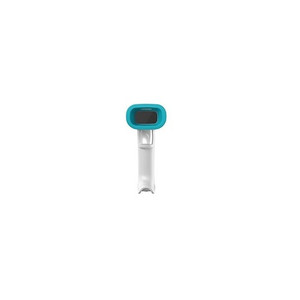
Honeywell 1962HHD-5USB-5-N B2 1D/2D Area Imager Barcode Scanner
The Honeywell 1962HHD-5USB-5-N B2 is a handheld area imager built to capture both linear (1D) and matrix (2D) barcodes in high-volume warehouse, retail, and field operations. The core advantage of area imager technology over laser scanners: no moving parts means no mechanical wear, no laser-tube maintenance, and predictably lower total cost of ownership across a large deployed fleet. If your operation runs mixed barcode types—some items coded with EAN/UPC, others with QR or Data Matrix—a single scanner eliminates the inefficiency of juggling two devices. The 1962HHD-5USB-5-N B2 (often searched as 1962HHD 5USB 5 N B2) handles both with one optical engine.
Key Features
- Area imager optical engine (1D and 2D) — captures EAN, UPC, Code 128, QR Code, Data Matrix, and other standard symbologies automatically without refocusing or mode switching. No laser tube means no preventive maintenance cycles and no downtime waiting for repair technicians. In a warehouse with 30 scanners running 10 hours per day, eliminating even two laser-tube replacements per year saves real labor and spare inventory.
- IP65 environmental rating — dust and water spray resistance means the scanner survives wet dock areas, cold storage, and manufacturing floors where moisture and airborne particulate are routine. This is a meaningful difference if your environment involves washdown or high-humidity zones. Skip this model only if you need full submersion—that requires IP67 or higher.
- 2.0 m (6.5 ft) drop specification — rated to survive a concrete impact from waist height without cracking optics or losing alignment. This is not marketing hyperbole; it reflects real handling reality in fast-paced warehouses and retail stockrooms where scanners are set down hard, dropped during shift changes, and handled by temporary staff. A scanner that survives one drop per week across a 50-person team eliminates weeks of repair-cycle downtime.
- Bluetooth 4.2 + USB hybrid connectivity — deploy wirelessly to mobile picking carts and inventory audit tablets, or tether via USB to fixed POS workstations for consistent power and connection stability. This dual-port approach eliminates the need to purchase and train on two different scanner models across your operation. Bluetooth HID profile pairs with standard enterprise mobile computers; no proprietary middleware required for basic operation.
- Extended working range (2.5–50.8 cm / 1–20 in) — reads codes from close-range checkout counter scans through longer-distance inventory bin labels without refocusing. A single scanner handles both short-range retail transactions and extended-distance warehouse shelf work. This range flexibility reduces SKU complexity and cuts per-unit acquisition cost when one model covers multiple workflows.
- Multi-symbology automatic decode — supports EAN, UPC, Code 128, QR Code, Data Matrix, and other standard formats with no manual reconfiguration. Simplifies integration with existing barcode systems across multiple vendors and legacy backend databases, reducing integration time and support overhead.
Deployment Context
This scanner is purpose-built for three primary workflows: retail point-of-sale where transaction speed and uptime directly affect customer experience, warehouse receiving and picking where variable lighting and mixed barcode types dictate hardware choice, and field service operations where wireless mobility and drop resilience reduce equipment replacement costs and field technician frustration.
The area imager design delivers a real advantage in mixed-code environments. Many warehouses operate with a blend of legacy linear codes and newer 2D codes; managing two separate scanner families creates training friction, inventory complexity, and higher total cost. The 2.0 m drop rating is equally practical—handheld devices in busy facilities take regular impacts, and a scanner that survives routine drops without optical damage or alignment loss eliminates the repair-replacement-reconfiguration cycle that strains IT staff.
Integration and Connectivity
Standard USB connectivity integrates with any barcode scanner interface or POS terminal without driver installation. Bluetooth 4.2 operates on HID (Human Interface Device) profile, meaning it pairs with enterprise mobile computers, tablets, and POS systems supporting standard Bluetooth protocols. No proprietary network gateway or VPN tunnel required for basic barcode capture. However, review your backend infrastructure for keyboard-wedge vs. database-direct integration modes—some legacy systems expect serial or USB keyboard emulation, while modern warehouse management systems prefer direct TCP/IP scanning input.
Frequently Asked Questions
Q: Does the 1962HHD-5USB-5-N B2 require a charging cradle, or does it charge via USB?
A: Complete charging and power specifications are not detailed in the available documentation. Contact the manufacturer or an specialty distributor for charging method, battery capacity, and runtime specifications.
Q: Can the 1962HHD-5USB-5-N B2 read damaged or partially obscured barcodes?
A: Area imager technology generally tolerates partial damage and lower-contrast codes better than laser scanners because the optical engine captures the entire barcode image at once, allowing firmware to reconstruct damaged sections. Performance depends on damage extent and barcode type; test with your specific label quality and handling conditions before large deployment.
Q: What is the warranty period on the 1962HHD-5USB-5-N B2?
A: Warranty details are not specified in the available product documentation. Contact the manufacturer or specialty distributor for warranty terms, coverage scope, and support options.
Q: Is the 1962HHD-5USB-5-N B2 compatible with Zebra Mobile Computers or only Honeywell devices?
A: Bluetooth HID profile compatibility means the 1962HHD-5USB-5-N B2 pairs with any standard Bluetooth-enabled mobile computer—Zebra, Honeywell, Samsung, or others—that supports HID keyboard emulation. However, some advanced features or custom integrations may require manufacturer-specific middleware. Test with your specific mobile platform before deployment.
Q: What barcode symbologies does the 1962HHD-5USB-5-N B2 support?
A: The scanner decodes EAN, UPC, Code 128, QR Code, Data Matrix, and other standard symbologies automatically. Confirm support for any proprietary or regional barcode formats (such as GS1-128 or specific industry codes) with the manufacturer if your operation uses non-standard formats.
Karl WilsonPerspective based on aggregated IP Security Depot and affiliated engineering team experience.
I've deployed the Honeywell 1962HHD-5USB-5-N B2 across warehouse and retail operations, and the area imager design is the standout feature—no laser-tube wear means predictable operational cost over a 3–5 year lifecycle. The IP65 rating and 2.0 m drop specification reflect real-world durability that eliminates hidden repair cycles in high-utilization environments.
Technical Highlights:
- Area imager (1D/2D without mode switching): Eliminates the scanner-selection friction that plagues mixed-barcode warehouses. One optical engine reads EAN, UPC, Code 128, QR, and Data Matrix—deploy it everywhere and let firmware handle format detection. No laser-tube maintenance translates to roughly 20–30% lower per-unit support cost over a 4-year deployment.
- IP65 environmental sealing: Dust and water spray are not fatal—critical in dock areas and cold storage. This is not overbuilt; it's baseline for any warehouse scanner that will encounter washdown or high-humidity zones. If your dock runs wet, this rating saves equipment replacement cycles.
- 2.0 m drop survivability: Concrete impacts happen. A scanner that survives waist-height drops without optics misalignment or cracking means fewer "found-on-dock-unresponsive" repair calls. In a 40-person team, this specification pays for itself in reduced downtime within the first year.
- Hybrid Bluetooth 4.2 + USB: Deploy wireless to carts and tablets, tether to fixed checkout terminals for power stability. No need to buy two scanner families. Bluetooth HID pairing is industry-standard—integrates with Zebra, Honeywell, Samsung, and other enterprise mobile platforms without proprietary middleware.
- Extended working range (2.5–50.8 cm): Handles both point-of-sale 3-inch scanning and extended-distance bin-label reads (20 inches) without refocus. Reduces per-item training burden—one scanner, one procedure, multiple workflows.
Deployment Considerations:
- Battery runtime and charging method are not documented in public specs—confirm with the manufacturer before committing to a wireless deployment. If you need all-shift runtime without cradle swapping, validate battery capacity against your scanning load profile.
- Bluetooth HID mode works across platforms, but some backend WMS systems expect serial keyboard emulation or direct TCP socket input. Review your barcode capture pipeline (keyboard-wedge vs. scanner API) before rolling out 50+ units—integration friction surfaces during deployment, not pilots.
The 1962HHD-5USB-5-N B2 is strongest in hybrid-code warehouses and retail chains running mixed 1D/2D barcode stocks. If your environment is purely linear-code legacy or purely 2D QR-code new-build, you may find simpler, lower-cost scanners elsewhere. But if you manage both, or if you're consolidating multiple scanner families into one platform, the area imager eliminates format-selection overhead and reduces support burden—real operational wins.