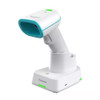
Honeywell 1962HHD-5USB-WCBF Xenon XP 1952g Area Imager Scanner
The Honeywell 1962HHD-5USB-WCBF is a 1D/2D area imager scanner built for high-volume warehouse, retail, and field service environments where durability and reliable barcode capture matter. Unlike laser scanners, the area imager optical engine photographs barcodes across a plane, meaning you get faster decode times on damaged or poorly printed codes—a real advantage in receiving operations where label wear is common. The device combines IP65 environmental protection with a 2.0 m (6.5 ft) drop rating, so spills and occasional floor impacts won't take it offline.
Key Features
- Area Imager (1D/2D) Technology: Captures standard and high-density barcodes in a single shot. Eliminates the need to hunt for the red laser dot and works on reflective surfaces where laser scanners fail—meaningful in automotive and metal-intensive receiving environments.
- Bluetooth 4.2 + USB Dual Connectivity: Operate wirelessly to reduce cable clutter on checkout counters and warehouse workstations, or plug USB directly into a terminal for guaranteed uptime when radio interference is a concern. Switch without changing the scanner.
- 1 to 20 Inch Working Range: Scan items held close (inventory labels) or at arm's length (pallet codes) from the same device. No need to maintain separate near-field and far-field scanner SKUs.
- IP65 Ingress Protection: Dust and direct water spray won't compromise the optical or electronic path. Typical in wet logistics operations; skip this if you need full submersion (IP67) or need to work in harsh chemical environments.
- 2.0 m (6.5 ft) Drop Rating: Survives concrete-floor drops from waist height. Test data means you're not gambling with replacement costs on your first fumble.
- Multi-Symbology Decoding: Handles EAN, UPC, Code 128, Code 39, QR Code, and Data Matrix in firmware. Eliminates inventory complexity by removing the need to stock format-specific scanners.
Integration & Compatibility
The 1962HHD-5USB-WCBF (often searched as 1962HHD 5USB WCBF) pairs with any system accepting standard USB Human Interface Device (HID) keyboard input or serial RS-232. Bluetooth 4.2 support means integration with modern mobile data terminals and warehouse management systems without requiring legacy Bluetooth bridges. The scanner emulates a USB keyboard, so no specialized driver installation is needed—critical in regulated environments where IT change control is strict. For retailers using legacy point-of-sale systems, the USB connection bypasses any wireless network dependency.
Typical Deployment Scenarios
- Warehouse Receiving: Dual connectivity ensures operation even if your warehouse Wi-Fi is congested or unavailable; drop to USB in the staging area where interference is highest.
- Retail Point-of-Sale: Area imager handles crumpled barcodes and worn receipt labels better than laser alternatives, reducing scanner timeouts and customer friction at checkout.
- Inventory Cycle Counting: The 1 to 20 inch range supports both shelf-tag scanning and box-label verification in the same workflow without picking up a second device.
- Shipping & Logistics: IP65 protection and drop rating survive the rough handling in loading docks and transit vehicles.
- Fixed Asset & Facilities Management: USB connection to a wall-mounted terminal for real-time asset inventory without requiring mobility.
When to Consider an Alternative
If you need wireless-only operation with enterprise-grade encryption or mobile device integration across iOS and Android with a native app, evaluate Honeywell's handheld mobile computers or ruggedized tablets bundled with area imager modules. If your barcodes are exclusively 1D (linear codes only), a lower-cost single-line laser scanner may reduce acquisition cost. If you require outdoor operation in heavy rain or dusty environments with extended scanning range (beyond 20 inches), look for IP67-rated 2D imagers or dedicated long-range laser variants in the Honeywell barcode portfolio.
Frequently Asked Questions
Q: What's the difference between area imager and laser barcode scanners?
A: Area imagers use a camera to capture the entire barcode in one image, making them better at handling damaged, faded, or wrinkled codes. Laser scanners shine a red line across the barcode and read reflections. Area imagers work on shiny or dark surfaces where lasers struggle and decode faster on high-density 2D codes like QR and Data Matrix.
Q: Can I use the 1962HHD-5USB-WCBF with my mobile device over Bluetooth?
A: Yes, Bluetooth 4.2 pairs with modern smartphones and tablets. The scanner emulates a keyboard, so barcode data appears as typed text in any app. For specialized mobile scanning apps with advanced features (offline queuing, multi-format filtering), verify your mobile app supports standard Bluetooth HID input.
Q: Is the 1962HHD-5USB-WCBF waterproof?
A: No—IP65 means it tolerates splashes and direct spray but not submersion. If you need full waterproofing for dock washdown or outdoor rain exposure, IP67-rated variants exist in the Honeywell line.
Q: Will it work with my warehouse management system?
A: The 1962HHD-5USB-WCBF operates as a USB keyboard emulator, so it integrates with any WMS that accepts barcode input. No specialized drivers or APIs required. For real-time data sync via Bluetooth wireless, confirm your WMS platform supports Bluetooth data terminals or standard HID input over BLE.
Q: What's the warranty coverage?
A: Refer to the manufacturer's standard warranty documentation for the Xenon XP 1952g series. Typical industrial scanners carry 1–3 year manufacturer warranties covering defects in materials and workmanship; confirm with your sales contact for the specific term on this model number.
Q: Can I use USB and Bluetooth at the same time?
A: The scanner supports both connections, but you select one mode for operation. Switching between USB and Bluetooth requires a brief reconfiguration or power cycle—not simultaneous dual-mode transmission.
Ted PerryPerspective based on aggregated IP Security Depot and affiliated engineering team experience.
The Xenon XP 1952g 1962HHD-5USB-WCBF is Honeywell's proven workhorse area imager for general-purpose scanning. The dual-connectivity design (Bluetooth 4.2 and USB) is the real value here—you get the flexibility of wireless mobility without sacrificing the reliability of hardwired operation when radio interference or network unavailability is a risk. In my experience, this split matters most in large facilities where warehouse Wi-Fi congestion is chronic.
Technical Highlights:
- Area Imager Optical Engine: Captures 1D and 2D barcodes in a single image. Eliminates the search-and-scan ritual of laser systems and handles faded or damaged codes that would timeout a laser scanner—meaningful when your barcode inventory includes used or recycled packaging.
- IP65 Environmental Rating: Withstands dust and direct water spray. Not meant for submersion, but adequate for wet logistics environments and dock washdown exposure. The rating is verified, not marketing language—saves you from guessing at equipment lifespan.
- 2.0 m (6.5 ft) Drop Rating: Concrete-floor impact survival from waist height. Real test data; you're not paying to replace the device on the first fumble.
- 1 to 20 Inch Working Range: Eliminates SKU proliferation. One scanner handles both near-field label scanning and mid-range pallet code capture without operator mode-switching.
Deployment Considerations:
- Area imagers require adequate lighting; they won't focus in complete darkness like thermal or ultra-long-range laser systems. Provide at least ambient indoor lighting or pair with a handheld work light in dim receiving bays.
- The USB HID keyboard emulation is a feature, not a limitation—it means zero driver complexity, critical in manufacturing and healthcare where IT change control is strict. However, confirm your system accepts standard keyboard input; some legacy POS terminals or custom terminals may require serial drivers or API integration instead.
- Bluetooth 4.2 is solid for modern terminals but doesn't compare to industrial-grade UHF or legacy 802.11ac data terminals in high-interference environments. Test range and interference in your facility before rolling out wireless across the board.
Position the 1962HHD-5USB-WCBF in retail environments with high barcode volume and mixed label conditions (receipts, corrugated, faded labels) or warehouse receiving where you need to reduce false timeouts and operator frustration. The drop rating and IP65 durability make it equally viable for field service scanning and shipping logistics. Avoid it if you need extended-range outdoor scanning or high-security encrypted wireless transmission—those require different platforms entirely.