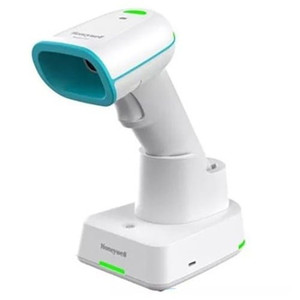
Honeywell 1962HHD-5USB-9WC Xenon XP 1952g 1D/2D Barcode Scanner
The Honeywell 1962HHD-5USB-9WC is an enterprise-grade area imager barcode scanner purpose-built for warehouse, retail, and field service environments where durability and format flexibility matter. It captures both 1D linear codes and 2D matrices—QR, Data Matrix, PDF417—without swapping hardware, reducing the friction and cost of barcode standard transitions. Dual connectivity (Bluetooth 4.2 wireless and USB wired) lets you deploy into mixed-technology infrastructures without forcing a hard migration path.
Key Features
- Area Imager (1D/2D) technology: Reads linear barcodes (EAN, UPC, Code 128) and 2D codes (QR, Data Matrix, PDF417, Aztec) in a single device—no need to stock separate scanners if your barcode estate evolves or spans multiple formats.
- IP65 ingress protection: Dust and water jets won't disable the scanner. Deploy in wet dock areas, outdoor loading zones, or dusty manufacturing floors without enclosure workarounds. Not submersion-rated (that requires IP67), so keep it out of wash-down spray guns.
- 2.0 m (6.5 ft) drop rating: Survives concrete-floor drops on a daily basis—realistic for warehouse environments where scanners hit the ground. Reduces warranty claims and unplanned downtime from accidental damage.
- Bluetooth 4.2 and USB connectivity: Pair wirelessly to mobile carts or POS systems without cables; switch to USB for fixed checkout stations or when Bluetooth range or latency becomes an issue. Both interfaces are native, not dongle-dependent.
- 2.5 to 50.8 cm (1 to 20 in) working range: Close-proximity retail scanning and arm's-length warehouse shelf reads in one device. Extended range eliminates the need for a second handheld or fixed mount scanner for longer-distance applications.
- Multi-symbology support: Handles EAN, UPC, Code 128, Code 39, Interleaved 2 of 5, QR Code, Data Matrix, PDF417, and Aztec out of the box. Firmware updates can add or retire formats without hardware replacement.
- Optimized optical engine: Area imager architecture captures barcode images and decodes them locally—performs reliably under variable lighting (fluorescent flicker, sunlight glare, dim warehouse aisles) where single-line laser scanners stumble.
Deployment Context
This is a general-purpose scanner, not specialized for a single vertical. Retailers use it at checkout and for price-check handheld reads. Warehouse teams deploy it for receiving, putaway, and cycle-count operations. Logistics operations use it for shipping label capture and proof-of-delivery scanning. Manufacturing QC uses it for traceability. Asset management teams use it for fixed-asset and IT equipment audits. The 1D/2D versatility and near-to-extended range make it suitable for enterprises with mixed-barcode inventories or those migrating from legacy 1D systems to 2D encoding.
Choose the 1962HHD-5USB-9WC if you need a single handheld that bridges both wireless and wired worlds, and your environment includes dust, moisture, or regular impact hazards. If your facility is climate-controlled indoors, rarely drops scanners, and runs purely 1D barcodes on short-range checkouts, a lower-cost single-connectivity device may suffice. If you need extended range beyond 50.8 cm or submersion durability (IP67), escalate to a larger or specialized scanner in the Xenon family.
Frequently Asked Questions
Q: Does the 1962HHD-5USB-9WC support Bluetooth pairing with multiple devices simultaneously?
A: The scanner pairs with one host device at a time via Bluetooth 4.2. To switch hosts, you unpair and re-pair—a 10–30 second process. For multi-station wireless deployments, you would pair the same scanner model to different stations sequentially, or deploy multiple scanners on the same subnet.
Q: Can the 1962HHD-5USB-9WC be used in direct sunlight or outdoor daylight?
A: Area imagers handle variable ambient light better than single-line lasers, but bright direct sunlight can wash out contrast on the barcode image. Outdoor use is feasible but works best when barcodes are shaded (under an awning, inside a truck bed, or with a sunshade held by the operator). IP65 protection covers water and dust, not solar glare mitigation.
Q: Is there a 2D-only variant, or does this model require 1D and 2D decoding overhead?
A: The 1962HHD-5USB-9WC is a unified 1D/2D imager. Decoding happens locally at wire speed; there is no performance penalty for supporting both formats. If you wanted 1D-only simplicity, you would need to specify a different Honeywell model—the area imager architecture is inherently format-agnostic.
Q: What is the battery life on Bluetooth mode?
A: Consult the manufacturer datasheet for battery capacity and duty-cycle runtime specifics. Typical handheld scanners in this class operate 4–8 hours per charge depending on scan frequency and Bluetooth radio duty cycle.
Q: Is the 1962HHD-5USB-9WC NDAA Section 889 compliant or of non-Chinese origin?
A: No compliance or country-of-origin certification is present in the available product evidence. Contact Honeywell or your integrator directly for certification and supply-chain documentation if that is a procurement requirement.
Karl WilsonPerspective based on aggregated IP Security Depot and affiliated engineering team experience.
The Honeywell 1962HHD-5USB-9WC strikes a pragmatic balance between wireless freedom and wired reliability. Dual connectivity—Bluetooth 4.2 paired with USB—addresses a real integration friction point: many warehouses run legacy wired checkout systems alongside newer cart-based mobile devices. Rather than forcing a one-size-fits-all migration, this scanner works in both ecosystems. The area imager engine is the differentiator here. It captures barcode images and decodes locally, which means it tolerates the lighting chaos of a real warehouse—fluorescent flicker, outdoor shadows, glare off wet pavement—far better than single-line laser scanners that need clean, high-contrast targets.
Technical Highlights:
- IP65 and 2.0 m drop rating: Real durability numbers that translate to fewer warranty claims. IP65 means the scanner survives dust and water jets in loading docks and outdoor staging areas. The 2 m drop rating (concrete floor, full height from waist) is not theoretical—it's tested, not marketing hyperbole. This reduces total cost of ownership in high-impact environments.
- 50.8 cm maximum working range: One scanner handles both arm's-length shelf reads (warehouse picking) and close-proximity retail checkout. Extended range eliminates the need for a second fixed-mount or longer-range variant, simplifying inventory and training.
- Area imager 1D/2D unification: No format lock-in. EAN, UPC, Code 128, QR, Data Matrix, PDF417, Aztec all decode from the same optical engine. Firmware updates can add new symbologies without hardware replacement—valuable if your business partners shift barcode standards on you.
Deployment Considerations:
- Bluetooth range is typically 10–30 meters in open air, less through walls and metal shelving. If your warehouse spans longer distances, plan for multiple Bluetooth mesh repeaters or default to USB stations at fixed locations.
- Area imagers are excellent in variable light but can struggle with extremely bright direct sunlight (outdoor loading in midday sun). Operators should shade the barcode or use a sunshade attachment if scanning outdoors regularly.
- Battery life varies by duty cycle; high-scan-rate operations (e.g., rapid checkout sessions) drain the battery faster than intermittent warehouse picking. Budget for midday charging or carry a spare in high-volume environments.
This model is well-suited for multi-use retail and logistics operations where barcode format diversity is the norm, wired and wireless systems coexist, and durability against impact and environmental moisture is non-negotiable. It is not the choice for cleanroom or submersion environments (those require IP67+), nor for single-format, single-interface deployments where cost minimization trumps flexibility.