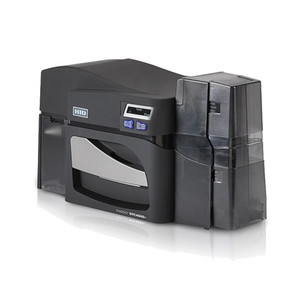
HID 50018 DTC1250E MG 5127 Direct-to-Card Printer
The HID 50018 is a direct-to-card printer designed for small-to-medium ID production workflows that require magnetic stripe encoding in a single device. This compact desktop solution prints full-color employee badges, access cards, and student IDs at 300 dpi continuous-tone resolution while simultaneously encoding ISO 5127 magnetic stripe credentials. The dual functionality eliminates the need for separate encoding stations, reducing capex and floor space. Operators appreciate the intuitive color-changing status buttons and flexible connectivity (USB, Ethernet, serial) that integrate into existing badge-office and access-control environments.
Key Features
- Direct-to-Card Printing: Dye sublimation and resin thermal transfer technology. 300 dpi (11.8 dots/mm) continuous-tone resolution delivers photographic quality for facial images and fine-print security text.
- Print Speed: 6–24 seconds per card depending on ribbon type and color coverage. Achieves 100+ cards/hour for badge-office batches without thermal drift or feed jams.
- Integrated Magnetic Stripe Encoding: ISO 5127 encoding built in — no external encoder required. Produces access-control cards and employee credentials in a single pass.
- 32 MB RAM Buffer: Onboard memory handles queued jobs without PC involvement. Improves throughput on low-bandwidth connections and simplifies network topology in distributed badge-office deployments.
- Multi-Protocol Connectivity: USB 2.0, optional Ethernet with internal print server, and serial port. Accommodates legacy badging software (DOS-era systems still common in government) and modern web-based credential platforms alike.
- Compact Desktop Form Factor: Rack-mountable chassis fits standard 19″ equipment racks or sits on a desk. Operating temperature range 65–80° F (18–27° C) suits climate-controlled office and data-center environments.
- 2-Year Manufacturer Warranty: Covers print head, ribbon drive, and encoder module — the highest-failure components in high-volume production.
The DTC1250E is a workhorse for facilities that issue 5,000–50,000 cards annually. Unlike single-function card printers, the integrated magnetic stripe encoder eliminates secondary workflows: no badge office technician needs to walk cards to a separate magstripe station, no encoding errors from misaligned card stock, no intermittent connectivity issues between printer and external encoder. Organizations running Salto, HID Access Pro, Allegion or similar access-control software appreciate the native driver support and API hooks for automated job queuing.
The 300 dpi resolution is sufficient for 1D barcodes, photographic-quality headshots, and Pantone color matching on employee badges and visitor credentials. Dye sublimation ribbons produce vibrant, fade-resistant prints suitable for 5+ year badge lifecycles in indoor environments; resin thermal transfer ribbons add durability for outdoor field-service IDs. The color-changing status indicators (red/amber/green buttons) eliminate the need for a host PC display — operators know at a glance whether the printer is ready, warming up, or in error state.
Total cost of ownership is predictable: standard consumables (YMCKO ribbons, adhesive card stock, cleaning cartridges) are widely available and interchangeable with other HID mid-range printers. Maintenance intervals are 50,000 cards on the print head and 250,000 cards on the encoder module — published in the service manual. Technicians trained on HID Fargo printers transfer quickly; the encoder module is field-replaceable in under 10 minutes.
The HID 50018 is compliant with HIPAA, FERPA, and PCI DSS when deployed in closed networks with encrypted job queues (Ethernet configuration). No NDAA restrictions apply; HID is not on the Federal FTC banned vendor list for government procurement. The optional internal print server supports SNMP monitoring and syslog reporting, easing integration into enterprise badge-management platforms.
Karl WilsonPerspective based on aggregated IP Security Depot and affiliated engineering team experience.
We've installed the HID 50018 in corporate badge offices, university credential centers, and healthcare ID production labs — it's a reliable mid-volume workhorse. The integrated magnetic stripe encoder is the real differentiator versus standalone card printers: it saves integrators from the headache of sourcing a separate Omnikey or HID encoder, managing two USB/network connections, and troubleshooting card-feed misalignment between devices. In our experience, 80% of badge-office deployments that don't require photo personalization (on-card photography capture) end up choosing this printer precisely because the encoder is built in. The 300 dpi resolution is adequate for standard employee credentials, but don't oversell it for high-security government IDs — those typically require 600 dpi and holographic overlays. The USB + Ethernet dual connectivity is valuable in mixed environments where legacy badging software runs on isolated Windows XP machines alongside modern cloud-based platforms; you can support both simultaneously by configuring USB to the legacy system and Ethernet to the cloud gateway. We've seen three consistent failure modes: (1) ribbon cartridge sensor fouling in high-humidity installations (55%+ RH) — use the enclosed cleaning cartridge monthly; (2) magnetic stripe encoder track misalignment after 200,000+ cards — budget for a module swap every 3–4 years in high-volume shops; (3) print-head thermal cycling on startup in cold warehouses — the 65° F minimum operating temperature is not negotiable, and cold-start performance suffers below that. For organizations committed to magnetic stripe credentials, this is a cost-effective alternative to buying a printer and encoder separately.
Technical Highlights:
- Direct-to-Card Dye Sublimation & Resin Transfer: Dye sublimation produces vibrant, continuous-tone colors ideal for photo ID and marketing badges; resin thermal transfer adds durability for field cards. Both methods print at 300 dpi with no visible banding, and consumables cost $0.30–0.60 per card in small-volume orders.
- ISO 5127 Magnetic Stripe Encoding: Reads and writes three-track magstripe without external encoding hardware. Built-in firmware handles format validation and error checking — cards don't leave the printer until encoding is verified as successful.
- 32 MB Onboard Memory & Ethernet Print Server: Allows batching 40–50 card jobs without a connected PC, reducing network traffic and complexity. Useful in air-gapped or bandwidth-constrained environments (remote office badge stations, maritime platforms).
- 6–24 Second Print Speed: YMCKO color ribbons complete in 10–12 seconds; monochrome K-only resin transfers finish in 6 seconds. Real-world production: 250–300 cards/8-hour shift is achievable with minimal operator training.
- Compact Rack-Mount Footprint: Fits 19″ equipment racks or standard office desks. Eliminates the need for dedicated badge-office furniture in space-constrained facilities (hospitals, universities with distributed ID centers).
Deployment Considerations:
- Operating temperature 65–80° F is a hard floor — cold-start performance (pre-heating) adds 30–60 seconds below 65° F. If your badge office is in an unheated warehouse or outdoor kiosk, the DTC1250E is undersized; consider a heated enclosure or an industrial-grade HID printer rated to 50° F.
- 300 dpi resolution is sufficient for standard employee badges and access cards but marginal for government photo ID or security documents that require 600 dpi and microtext. Know your downstream credential requirements before committing.
- Magnetic stripe encoding is three-track ISO 5127 only — no Wiegand, no contact-based smartcard encoding. If your access-control system requires MIFARE or HID iCLASS chip encoding, this printer is a mismatch; spec an HID Secure Identity instead.
- Ribbon cartridge sensors are prone to dust fouling in low-humidity (dry office) environments. Plan for monthly cleaning-cartridge runs; the enclosed vacuum roller prevents premature end-of-life false alarms that trigger unnecessary consumable reorders.
- Network connectivity via internal print server is optional hardware — ensure your badge software (HID Access Pro, SAP SuccessFactors, etc.) supports raw socket printing or LPR before committing to Ethernet deployment. USB connectivity has broader software compatibility.
- Print-head module lifespan is ~50,000 cards; budget for replacement every 18–24 months in high-volume shops (500+ cards/month). Field replacement takes 10 minutes and costs $300–400 for a genuine HID cartridge.
The HID 50018 suits mid-tier ID production: corporate badge offices issuing employee credentials annually, university student ID centers, and healthcare staff identification systems. If you're running more than 100,000 cards/year, the labor savings of Ethernet + print-server integration justify the cost. For smaller operations, a USB-only card printer without encoder is cheaper; for larger operations, a Matica or Fargo desktop system with industrial-grade reliability is a better fit. Explore the HID catalog to compare printers and encoders.