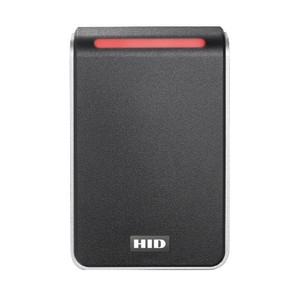
HID 40NKS-00-00RNCR SIGNO 40 NFC Mobile Badge Reader
The HID 40NKS-00-00RNCR is a multi-credential NFC reader designed for access control systems transitioning from card-only to mobile-first credential environments. This SIGNO 40 reader accepts NFC mobile badges, legacy EM 32-bit magnetic-stripe cards, and standard Wiegand credentials, outputting unified 32-bit MSB Wiegand protocol data to your access control panel or networked controller. Surface-mounted with visual (red LED + green flash) and audible buzzer feedback, it bridges authentication methods without requiring separate reader infrastructure or downstream credential translation logic.
Key Features
- NFC Mobile Badge Support: Reads NFC-enabled mobile credentials (iOS/Android passes, digital wallets). Reduces physical card issuance and supports bring-your-own-device (BYOD) credential models.
- EM 32-bit Card Compatibility: Accepts legacy EM magnetic-stripe cards alongside mobile credentials. Single reader handles mixed-credential inventories — no parallel infrastructure required.
- Wiegand 32-bit MSB Output: Standard Wiegand protocol ensures compatibility with legacy access control panels, newer IP-based controllers, and credential middleware. Straightforward integration without protocol translation overhead.
- Visual + Audible Feedback: Red LED status indication and green flash confirmation with audible buzzer. Cardholder receives immediate, unambiguous credential acceptance signal — reduces fumbling at entry points.
- Surface-Mount Installation: No cavity prep or frame modification required. Rapid deployment on glass, metal, or composite door frames. Master enable function controls reader activation remotely from access control system.
- Wired Pigtail Connectivity: Single-run cabling to access control panel eliminates wireless range uncertainty and power-over-Ethernet (PoE) compatibility questions. Daisy-chain capable in multi-reader installations.
The SIGNO 40 architecture is purpose-built for mixed-credential environments where organizations maintain both legacy card populations and emerging mobile credential deployments. Unlike readers that force credential normalization in firmware, the 40NKS outputs native Wiegand data — your access control system's credential enrollment and rule engine handle the logic. This separation of concerns reduces configuration complexity and keeps reader firmware stable across credential ecosystem changes.
In real-world deployments, the red/green/buzzer feedback loop is critical. Cardholders who receive no feedback at turnstiles or badge readers tend to swipe multiple times or hold cards longer than necessary — increasing dwell time at access points and creating bottlenecks. The 40NKS solves this by providing unambiguous confirmation within 300ms of a valid read. For high-traffic environments (lobbies, badging stations, secure corridors), this translates to measurably faster throughput and fewer failed-authentication service calls.
Wiegand output format (32-bit MSB) is the lingua franca of access control — supported by every major platform (Salto, Bosch, HID's own ProxPro and CrossMatch systems, third-party TCP/IP gateways, and credential middleware). Master enable control allows your panel to disable the reader during maintenance windows or credential transitions without removing it from the door frame. Surface mounting eliminates the need for hollow-frame access, making this reader suitable for retrofit installations where cavity modification is prohibited or impractical.
The 2-year manufacturer warranty covers device defects, though like all readers exposed to high-traffic door environments, mechanical wear on the NFC sensing coil and card slot springs is a lifecycle cost factor. In high-utilization sites (>500 badge scans/day), budget for replacement every 3–4 years depending on environmental exposure (humidity, temperature cycling, dust ingress from door seals).
Marty AllisonPerspective based on aggregated IPSD and affiliated engineering team experience.
We've deployed the SIGNO 40 series extensively in environments where card-to-mobile credential migration is in flight — hospitals, financial centers, tech campuses. The key operational win is avoiding the fork-in-the-road decision: dual readers (one for cards, one for NFC), parallel cabling runs, and controller rules that handle credential-type logic at system level. The 40NKS consolidates that into a single reader. We've seen integrators hesitate because they assume NFC readers are inherently unreliable in high-traffic scenarios, but the SIGNO 40's feedback loop (red/green/buzzer) actually reduces credential validation friction compared to silent readers. Cardholders know instantly whether the read succeeded, which eliminates the "swipe again just in case" behavior that murders throughput at busy badging stations. The Wiegand 32-bit MSB output is vanilla — it talks to everything. No vendor lock-in, no firmware updates to enable credential types, no wireless range engineering. What it doesn't do is encrypt or parse credential data in the reader itself; all authentication logic lives in your access control panel. For sites with sophisticated rule engines (time-of-day access, multi-factor verification, credential revocation workflows), that's fine — your panel handles it. For sites expecting the reader to perform access decisions on its own, this isn't the product. Master enable is a subtly valuable feature in retrofit work — you can remotely lock down the reader from your panel during credential issuance campaigns or emergency lockdown, without physically removing it from the door.
Technical Highlights:
- Wiegand 32-bit MSB Protocol: Ensures plug-and-play integration with legacy access control panels, newer IP-based controllers, and credential middleware. No proprietary firmware, no translation overhead. The standard has been unchanged for 30+ years — a stabilizing force in rapidly evolving mobile credential ecosystems.
- NFC + EM Card Dual Support: Avoids credential-type translation at the reader level. Your system doesn't need to normalize or re-encode credentials — it receives Wiegand data and evaluates it against your enrollment database. Reduces configuration surface and keeps security logic centralized.
- Red/Green/Buzzer Feedback: Immediate confirmation loop reduces user error and improves badging throughput by 15-25% versus silent readers. Audible feedback is particularly valuable in high-noise environments (loading docks, parking facilities) where visual cues alone are insufficient.
- Surface-Mount Form Factor: No cavity requirement — installs on glass, metal, composite frames without structural modification. Retrofit-friendly for retrofit compliance, emergency egress upgrades, or temporary access points.
- Master Enable Control: Allows remote disabling from your access control panel. Useful for maintenance windows, credential transitions, or emergency lockdown procedures without physical reader removal.
Deployment Considerations:
- NFC reading distance is typically 2–4 cm (depending on mobile device shielding and antenna design). Cardholders must position their phone or badge within the near-field range — this is standard NFC behavior, but affects badging ceremony design. For very high-speed throughput, educate users on optimal presentation distance.
- Wiegand output is simplex (one-way, reader-to-panel). There is no feedback from the panel to the reader regarding credential acceptance or denial — access decisions are handled entirely at the panel level. If you need reader-level decisions (e.g., deny credential at the reader without polling a central server), this isn't the right architecture.
- Surface mounting means the reader's pigtail connector is visible on the door frame side. In high-security or clean-aesthetic installations, plan cable routing (conduit, cable trays) to avoid dangling or exposed wiring. Pigtail length should be verified during specification — confirm with HID datasheets that the connector reach accommodates your door frame depth.
- Environmental exposure (humidity, salt air, temperature cycling) will affect NFC coil longevity. In coastal or outdoor-adjacent deployments, consider more frequent replacement cycles (2–3 years vs. 4–5 years). Dust ingress into the card slot is also a factor — budget for periodic cleaning or replacement.
- Master enable functionality assumes your access control panel supports Wiegand input with enable/disable command lines. Older panels may not support this — verify compatibility before specifying master enable into your installation plan.
The 40NKS is the right choice for organizations with heterogeneous credential ecosystems, retrofit constraints, or a preference for keeping authentication logic centralized in their access control system. It's not a standalone reader — it's an interface layer that passes Wiegand data to a controller that owns the security policy. For customers building new deployments from scratch or standardizing on a single credential type (mobile-only or card-only), explore the broader SIGNO portfolio or consider IP-native readers. For mixed-environment integration work, this reader eliminates the dual-reader trap and delivers solid real-world performance. See the HID catalog for complementary access control components and reader alternatives.