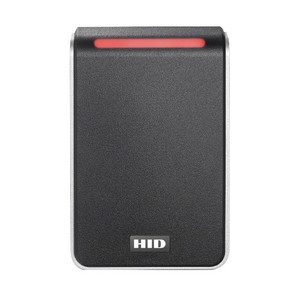
HID 40NKS-00-00N6LH SIGNO 40 Pigtail Reader
The HID 40NKS-00-00N6LH is a SIGNO 40 series pigtail reader engineered for multi-credential access control deployments requiring simultaneous support of legacy proximity cards, modern smart cards, and NFC mobile credentials. This reader handles 125kHz proximity, DESFire, iCLASS, MIFARE, HID, SEOS, and NFC at 13.56MHz formats—meaning a single reader manages older card populations alongside new smartphone-based access without hardware replacement. The pigtail configuration (no keypad) reduces mounting footprint and installation complexity on retrofit projects where surface area is constrained or existing aesthetics demand a low-profile reader. Black finish with silver trim baseplate integrates discreetly into standard security installations.
Key Features
- Multi-Credential Support: 125kHz proximity, DESFire, iCLASS, MIFARE, HID, SEOS, and NFC/13.56MHz in a single reader—eliminates credential format swaps during facility transitions.
- NFC Mobile Credentials: Built-in support for smartphone-based access without additional hardware; users authenticate via contactless mobile wallet or HID Mobile ID app.
- OSDP & Wiegand Output: OSDP (Open Supervised Device Protocol) for modern panels; 32-bit MSB Wiegand fallback ensures compatibility with legacy access control infrastructure.
- Pigtail Configuration: No integrated keypad—compact form factor for surface mounting on narrow mullions, glass doors, or retrofit installations where space is limited.
- Status Indicators: Red LED and green flash confirmation lights provide installer diagnostics and user feedback during credential acceptance.
- Finish Options: Black or white housing with silver trim baseplate; mounts flush to standard mounting backplate.
- Power Flexibility: Operates on standard 5V or 12V DC (confirm voltage availability on existing panel before installation).
Multi-credential readers eliminate the operational burden of managing separate hardware for magnetic stripe, proximity, and mobile access populations. On a facility with mixed-generation badge inventories—older 125kHz prox cards circulating alongside newly issued DESFire credentials and pilot NFC mobile users—the SIGNO 40 pigtail reader consolidates all formats into one wiring run, one reader installation, and one panel integration point. This reduces cabling clutter, lowers support overhead, and simplifies credential lifecycle management.
The OSDP protocol is the modern standard for reader-to-controller communication, offering encrypted command/response, tamper reporting, and advanced credential validation logic pushed to the device. Facilities upgrading from Wiegand-only infrastructure gain real-time reader health monitoring, remote firmware updates, and synchronized multi-reader coordination without replacing the reader hardware—only updating the access control panel firmware. Wiegand fallback ensures this reader works with older panels lacking OSDP support; integrators confirm protocol support during system audit to maximize feature utilization.
NFC mobile credential capability broadens access options without requiring users to carry a physical card. Credential issuance, revocation, and expiration are managed centrally through the access control platform's mobile credential service (e.g., HID Mobile Access on supported systems). On high-traffic entrances—lobbies, stairwells, parking areas—the ability to authenticate via smartphone reduces friction and eliminates lost-card reissue cycles. Integrators should confirm mobile credential licensing and backend infrastructure availability before positioning this reader as a mobile-first deployment.
The pigtail form factor (no keypad) is optimized for card-only or mobile-only access points; if PIN code entry is required, a separate keypad module must be wired in parallel or a pinpad-integrated reader (such as the SIGNO 40 with embedded keypad) should be substituted. Mounting is surface-based with standard hardware; unobstructed read range is typically 2–4 inches depending on card thickness and material composition. Power and communication are delivered via a single cable from the access control panel, reducing installation labor compared to multi-wire pinpad configurations.
The HID 40NKS-00-00N6LH carries a 2-year manufacturer warranty. It is compatible with all major access control panels supporting OSDP or Wiegand input—Salto X-Series, Genetec Security Center, Bosch B-Series, Lenel, and others. For facilities operating HID-native platforms (e.g., HID VertX controllers) or hybrid multi-vendor systems, this reader's credential and protocol agility makes it a reliable consolidation point. Consult the datasheet for pinout and voltage specifications before procurement.
Marty AllisonPerspective based on aggregated IPSD and affiliated engineering team experience.
We've deployed the SIGNO 40 pigtail reader across a range of retrofit access control projects—mid-market office upgrades, hospitality properties transitioning from magnetic stripe to smart cards, and facilities piloting NFC mobile credentials alongside traditional badge infrastructure. The real value of this reader isn't any single feature, but the consolidation of credential complexity into one integration point. Most access control migrations stumble because the incumbent badge population (often 125kHz prox or EM-format) can't be retired immediately; users keep old cards, new credentials roll out in phases, and support teams must manage two or three reader types simultaneously. The SIGNO 40 pigtail reader absorbs that friction. It reads everything—old proximity cards, new DESFire smart cards, iCLASS, MIFARE, and smartphone-based mobile credentials on the same wiring. That means your installer runs one cable, integrates one reader into the panel, and the facility gradually transitions credential populations without touching the reader hardware. We've seen that simplicity save 20–40 hours of engineering and installation labor on 50+ door rollouts.
The OSDP protocol support is a quiet but significant differentiator. Wiegand output is legacy—it's the industry default, and we've integrated readers with Wiegand on countless older panels. But modern access control platforms (Genetec, Salto, Bosch, Lenel) increasingly favor OSDP because it's encrypted, bidirectional, and allows the reader to report its own health status, firmware version, and tamper events back to the controller in real time. If you're implementing this reader on a panel with OSDP support, you gain the ability to remotely update reader firmware, synchronize credential validation across multiple readers, and receive alerts if the reader has been physically compromised or is disconnected from the network. On legacy Wiegand-only panels, the reader falls back to standard 32-bit Wiegand, and you lose those advanced features—but the credential reading itself doesn't degrade. It's a future-proofing play: spec this reader now, and if the facility upgrades the access control platform in five years, the reader's full feature set unlocks without hardware replacement.
Technical Highlights:
- Credential Format Agility (125kHz, 13.56MHz, NFC): Legacy 125kHz proximity and EM-format credentials are read identically to modern DESFire and iCLASS smart cards and NFC mobile wallets. On a mixed-inventory facility, this eliminates the need to run separate reader branches for different credential types—one reader input on the panel handles all formats, reducing wiring complexity and panel port count.
- OSDP with Wiegand Fallback: OSDP protocol offers encrypted communication, remote firmware updates, and reader diagnostics; Wiegand output ensures compatibility with older panels lacking OSDP support. System integrators confirm protocol support during system audit and configure the reader's communication mode to match the panel's capability.
- NFC Mobile Credential Ready: Smartphone-based access is enabled out of the box (requires backend mobile credential service license and configuration). Users authenticate via HID Mobile ID app or compatible mobile wallet without carrying a physical card—reduces lost-card replacement cycles and enables temporary access issuance (e.g., short-term visitor passes) via smartphone push.
- Compact Pigtail Form Factor: No integrated keypad means minimal mounting footprint—ideal for narrow glass-door mullions, retrofit installations where space is constrained, and aesthetic-sensitive areas (lobbies, lobbies). If PIN-based access is required, a separate pinpad must be wired in parallel or a keypad-integrated reader variant selected.
- Standard 5V/12V DC Power: Most access control panels provide reader power via dedicated relay output or power supply. Confirm voltage availability (5V or 12V) before installation; incorrect voltage will prevent reader operation.
Deployment Considerations:
- Credential Inventory Audit: Before procurement, audit your facility's badge stock (proximity format, smart card type, issuer) and determine if the SIGNO 40 pigtail covers all formats in use. Most HID facilities issue DESFire or iCLASS; legacy sites may have EM-format or 125kHz prox; mixed environments require this multi-format reader. If your site uses proprietary or non-standard credential formats, confirm compatibility with HID technical support.
- OSDP Panel Support Verification: If you intend to use OSDP protocol features (firmware updates, reader diagnostics, encrypted communication), confirm that your access control panel and controller firmware support OSDP output to readers. Legacy panels supporting only Wiegand will function normally, but advanced OSDP features will not be available; plan panel upgrades if those features are required for your deployment roadmap.
- NFC Mobile Credential Backend Setup: Mobile credential capability requires a compatible backend service (HID Mobile Access, Genetec Synergis mobile module, or equivalent). Device provisioning, credential issuance to mobile wallets, and lifecycle management are handled by the access control platform's mobile service—not the reader itself. Budget engineering time for mobile credential service configuration and user enrollment workflows if mobile access is a deployment requirement.
- Pigtail Configuration Limitation: This reader has no integrated keypad. If PIN-based access, multi-factor authentication (card + PIN), or emergency egress keypads are required at this door, you must either wire a separate pinpad module in parallel or select a SIGNO 40 keypad-integrated reader variant (e.g., HID SIGNO 40 with 2×6 or 3×4 keypad). Confirm access control requirements during design phase to avoid post-installation hardware changes.
- Read Range and Material Considerations: Typical read range is 2–4 inches for proximity and smart card credentials; NFC mobile wallet range may vary by smartphone chipset and case material. Avoid mounting the reader directly behind metal surfaces (door frames, reinforced mullions) which can degrade read reliability. If installation surface is constrained, test read performance on-site before finalizing mounting location.
The SIGNO 40 pigtail reader is the right choice for facilities with mixed-credential populations transitioning to modern access control infrastructure—office parks consolidating badge formats, hospitality properties upgrading from legacy magnetic stripe, and any environment where NFC mobile credentials are part of the deployment roadmap. Integrators managing multi-year credential migrations benefit most from this reader's ability to absorb multiple credential types without hardware swaps. For more options in the HID SIGNO 40 series, browse the HID catalog.