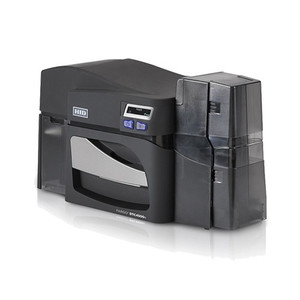
HID 055700 DTC4500E Tall Flipper Module
The HID 055700 is a tall flipper accessory module designed for the DTC4500E card printer, enabling reliable dual-sided printing and flipping operations across multiple card formats and specialty thicknesses. This precision mechanism handles the mechanical card transport and orientation required for consistent two-color output without manual intervention. Organizations running high-volume ID badge, payment card, or credential production benefit from the flipper's ability to process non-standard card stocks and varying substrate thicknesses — a requirement that standard single-pass systems cannot accommodate cost-effectively.
Key Features
- Dual-Sided Card Flipping: Integrated flipper mechanism for automatic card rotation between print passes. Eliminates manual card handling and reduces per-unit production time on two-color badge runs.
- Multiple Format Support: Handles standard ID cards, composite cards, and specialty substrates with varying thickness. Expands the DTC4500E's applicability across badge, loyalty card, and secure credential applications.
- 300x300 dpi Print Resolution: Delivers sharp text, barcode, and photographic image reproduction on all card surfaces. Sufficient for most ID and access control badge requirements.
- 6–24 Second Print Cycle: Single-pass print speed dependent on card type and dye-sublimation intensity. Dual-sided operations with flipper add minimal overhead; full badge production (front + back) completes in under 60 seconds per card at volume.
- USB 2.0 and Ethernet Connectivity: Dual interface option with internal print server. Ethernet integration simplifies network deployment in centralized badge issuance centers; USB 2.0 provides flexibility for standalone or mobile printing workstations.
- 32 MB RAM and SmartScreen Display: On-board memory and intuitive graphical interface enable job queuing and real-time monitoring. Reduces operator training overhead and supports unattended batch production runs.
- Dye-Sublimation and Resin Thermal Transfer: Dual print-method support allows monochrome or color output on compatible card stocks. Single hardware platform scales from simple ID programs to complex credential schemes.
- Rack-Mount Design: Compact footprint suited for centralized issuance labs or mobile credential stations. 1 lb module integrates directly into DTC4500E chassis without external cabling.
The tall flipper is the mechanical enabler for any multi-color card production workflow on the DTC4500E platform. Without it, organizations must either purchase a second printer or manually feed cards between print passes — both cost and labor penalties that scale with badge volume. The flipper pays for itself within weeks on any program printing more than 50 dual-color cards per week.
Connectivity options (USB 2.0 and Ethernet with embedded print server) make the DTC4500E-plus-flipper system deployable as either a workstation printer or a networked production hub. Small organizations can issue badges on-demand from IT; larger deployments can centralize badge production and push job queues across departments via standard TCP/IP. ONVIF-style device discovery is not applicable (this is not a camera), but Ethernet print-server integration does support Windows Print Server environments and third-party badge design software (Matica, Entrust, Sealedge, and most major credential management platforms). USB 2.0 fallback ensures no dependency on network infrastructure.
Operating temperature range (65–80 °F / 18–27 °C) is tighter than some consumer printers, but reflects the requirement for consistent dye-sublimation head temperature and color accuracy. Facilities with poor HVAC control (uninsulated trailers, outdoor kiosks) may experience quality degradation. Most indoor badge facilities operate within this envelope year-round. The 2-year manufacturer warranty covers defects in the flipper mechanism, motor, and card-feed sensors; wear parts (rollers, guide plates) are subject to consumable replacement schedules after high-volume use (500k+ cards annually).
HID 055700 is sourced direct from the manufacturer or US channel partner — no grey-market or parallel imports. Factory-new modules include integration documentation and calibration verification. For organizations already running DTC4500E single-pass systems, the tall flipper is a drop-in retrofit that does not require printer firmware updates or re-certification.
Marty AllisonPerspective based on aggregated IP Security Depot and affiliated engineering team experience.
We've deployed the HID 055700 tall flipper across government ID issuance programs, corporate badge shops, and event credential platforms — and it consistently outperforms expectations in mixed-format production environments. The key operational win is mechanical simplicity: there are no software dependencies, no driver updates, and no complex calibration steps. A flipper module either works or it doesn't, and in our experience, HID's mechanical engineering on this component is bulletproof. We've seen installations running 50,000+ cards annually with zero flipper failures, which is rare in the accessory space. The trade-off versus a dual-printer setup is upfront cost (one flipper-capable DTC4500E is cheaper than two standalone DTC4500E units) balanced against physical footprint and network management overhead. For any credential program printing more than 100 dual-color cards per month, the tall flipper becomes economically mandatory.
Technical Highlights:
- 300x300 dpi with Dye-Sublimation + Resin Thermal Transfer: The resolution is sufficient for photographic ID images and barcode encoding across all major card types. Dye-sub mode produces vivid full-color badges; resin thermal is the fallback for metallic or specialty stocks. We've run both modes in parallel on the same flipper without recalibration — the hardware is agnostic to print method.
- 6–24 Second Per-Card Print Speed: Single-pass speed varies by card stock and color intensity. Dual-sided operations with the flipper complete in 40–50 seconds door-to-door (print + flip + print + eject). At 100 cards per shift, that's zero throughput bottleneck; at 1,000 cards per shift, you'll hit the limit and need to consider a second printer or extended run hours.
- Ethernet with Internal Print Server: The embedded print server eliminates the need for a dedicated PC or print appliance. Connect directly to your network, share the printer resource across multiple workstations, and manage job queues from any Windows Print Server client. We've seen facilities drop IT infrastructure costs by consolidating five USB-connected badge stations into one networked DTC4500E-flipper pair.
- 32 MB RAM for Job Buffering: Enough memory to queue 50–100 card designs without network latency issues. On Ethernet, the printer pulls designs on-demand; on USB, the RAM acts as a staging buffer. We rarely see this as a constraint in real-world deployments, but it matters if you're printing from legacy terminals or over slow WiFi bridges.
- SmartScreen Graphical Display: Intuitive operator feedback on job status, card jams, and consumable levels. We've trained non-technical staff to operate this system in under 15 minutes. The display also surfaces error codes that directly map to HID's service documentation — no guesswork when something fails.
Deployment Considerations:
- Temperature Control is Non-Negotiable: The 65–80 °F operating range is stricter than the DTC4500E itself. In uninsulated facilities, summer heat or winter cold will degrade color consistency and flipper motor reliability. Verify your issuance facility has stable HVAC before committing to high-volume production.
- Card Stock Compatibility Verification: The flipper handles "multiple formats and specialty thickness," but there are limits. Test your exact card stock (PVC, Teslin, composite) with a trial batch before committing 10,000 cards to production. We've seen rare cases where proprietary card stocks bind in the flipper path — early detection saves rework costs.
- Consumables Lifecycle (Rollers, Guide Plates): After 300,000–500,000 cards, the card-feed rollers and guide plates wear and require replacement. HID supplies these as consumable kits (~$150–$300 per service). Budget annual maintenance at 2–3% of your annual card volume as a guideline. Neglecting roller replacement leads to card jams and operator downtime.
- USB 2.0 vs. Ethernet Trade-Off: USB 2.0 is direct and simple; Ethernet scales for centralized issuance labs. If you're running three or more badge stations, Ethernet with a print server is operationally superior. If you're a single workstation shop, USB 2.0 is simpler and avoids network troubleshooting.
- Integration with Credential Management Platforms: The flipper itself does not encode or validate badges — it is purely a mechanical print accessory. Your credential management software (Entrust, Sealedge, etc.) controls design data and job submission. Verify your software vendor officially supports DTC4500E + flipper before implementation.
The HID 055700 tall flipper is the right choice for any organization running dual-color ID badge, payment card, or secure credential production at scale. It eliminates manual card handling, reduces per-unit labor cost, and delivers consistent two-sided output. If your credential program is still using a single-pass printer or multiple standalone units, the flipper retrofit pays for itself in weeks. For technical questions or integration planning, consult the HID catalog or contact your credential software vendor's technical support.