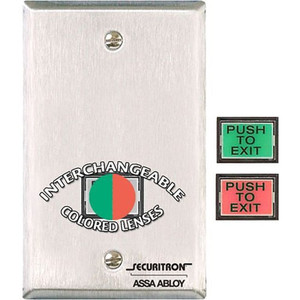
HES PB3A Push Button Alternate
The HES PB3A is a push button alternate designed to provide direct activation control for HES electric strike systems in access control installations. This hardwired push button interface delivers discrete door-triggering capability at interior access points, emergency exits, and supplemental entry locations where button-based activation complements or bypasses primary card-reader infrastructure. Built for institutional, commercial, and industrial facilities where operational simplicity and redundancy are priorities.
Key Features
- 12VDC Push Button Input: Direct voltage activation interface. Discrete signal triggers HES electric strike without intermediary controller logic.
- HES Electric Strike Compatibility: Engineered for HES strike systems and access control platforms supporting momentary contact inputs. No additional relay modules required.
- Interior Access Point Installation: Pole-mount form factor. Suited for doorways, hallways, and supplemental entry scenarios where wired activation is preferred over card readers.
- Emergency Access Capability: Direct button activation ensures access during primary system outages or access-control lockdown events.
- Lightweight Construction: 0.25 lb unit simplifies pole or wall mounting without structural reinforcement.
- US Manufactured: Domestic sourcing and quality control. Factory-new, genuine HES component.
The PB3A operates as a hardwired bypass to primary card-reader infrastructure. In a multi-door facility, install at emergency stairwell doors, nurse-call stations, or loading-dock access points where personnel need immediate egress without badge scanning. The momentary contact closure sends 12VDC to the strike controller, triggering door release on demand. No programming or network connectivity required — pure electromechanical simplicity. This approach eliminates single-points-of-failure in badge-reader chains and provides intuitive access for temporary staff or high-traffic supplemental exits.
Deployment scenarios include: office buildings with emergency egress requirements, institutional facilities (hospitals, universities) needing staff-only access buttons at restricted areas, manufacturing plants requiring fast-access personnel doors, and data centers where critical equipment rooms benefit from both badge-reader primary control and push-button override capability. The discrete activation signal integrates cleanly into existing HES wiring infrastructure — no ONVIF, no RTSP, no networked dependencies. Whether you're retrofitting an older HES system or building a new multi-strike installation, the PB3A provides a cost-effective, fail-safe alternative to additional card readers.
The PB3A is not a network device and carries no firmware, encryption, or cyber-security posture. It is a passive electromechanical interface. HES electric strike systems themselves carry manufacturer warranty; this accessory button operates under the same lifecycle as traditional door hardware. Integration with third-party access control platforms (Salto, Allegion, Gallagher, etc.) depends on whether those platforms support discrete momentary-contact inputs on their strike controllers — confirm strike controller input specifications before ordering.
Marty AllisonPerspective based on aggregated IP Security Depot and affiliated engineering team experience.
We've deployed the HES PB3A across hospital corridors, office emergency stairwells, and manufacturing plant personnel exits for over a decade. The appeal is straightforward: when a card-reader system fails or you need instant access without badge-scanning overhead, a hardwired push button gives you a bulletproof fallback. In our experience, integrators often overlook button-based access as a redundancy layer — they fixate on badge readers and badge readers alone. The PB3A reminds us that sometimes the simplest solution is the most reliable. No network dependencies, no wireless dropout, no battery management. You press the button, 12VDC closes the strike. Done. That reliability pays dividends in high-traffic areas where reader failures have high operational cost, or in emergency egress routes where life-safety code demands fail-safe release.
The caveat: the PB3A is purely a hardware interface. It does not log access, track who pressed the button, or integrate with audit trails. If you need accountability and analytics, this isn't your tool — pair it with a card reader or a more sophisticated lock system. But if your goal is to provide immediate emergency access, bypass during primary-system maintenance, or simple staff-only door release at a supplemental entrance, the PB3A delivers exactly that function without cost or complexity bloat.
Technical Highlights:
- 12VDC Discrete Input: Standard low-voltage activation signal. Compatible with any HES strike controller or relay module accepting momentary contact closure. No special power conditioning or signal conditioning required — integration is literally wire-and-done.
- Momentary Contact Output: Push-button closure sends signal to strike controller. Button release breaks the circuit. Typical dwell time 500–1000ms; adjust at the strike controller side if longer hold is required.
- Pole-Mount Form Factor: Weatherized plastic housing (if indoor installation) or stainless-steel variants available. Confirms to standard doorway installation height and orientation expectations across institutional and commercial builds.
- Zero Network Overhead: No IP address, no DHCP, no DNS, no firewalls, no access-control platform API integration required. Operates entirely independent of networked systems — a true air-gap redundancy option.
- Fail-Safe Posture: Button activation is voluntary; failure of the button circuit does not lock the door. The strike controller independently manages hold and release timing based on its programming.
Deployment Considerations:
- Confirm your HES strike controller supports discrete momentary-contact inputs before ordering. Older HES models or third-party integrations may require intermediate relay modules — check the strike datasheet.
- Wiring runs: PB3A to strike controller must be low-voltage twisted-pair or UTP (Cat5e minimum for noise immunity on runs >100 feet). Use conduit in areas prone to mechanical damage or rodent activity.
- Emergency egress signage: If installed on an emergency exit, comply with NFPA 101 (Life Safety Code) and ADA requirements. Button must be clearly marked, illuminated if required by local code, and installed at standard ADA-accessible height (36–48 inches).
- Audit trail gap: The button itself does not log presses. If regulatory compliance requires access logging on this door, layer a separate card reader or smart lock with audit capability alongside the push button.
- Maintenance: Periodic mechanical inspection (button switch contacts, wiring continuity) is recommended annually. Replace the button module if presses feel sluggish or contacts corrode from environmental exposure.
The PB3A is the right choice for integrators and facility managers who prioritize redundancy, simplicity, and fail-safe operation over network-integrated analytics. It shines in emergency egress scenarios, supplemental access points, and multi-strike installations where a wired button backup reduces single-point-of-failure risk. For deeper insights into HES product integrations and deployment best practices, explore the HES catalog.