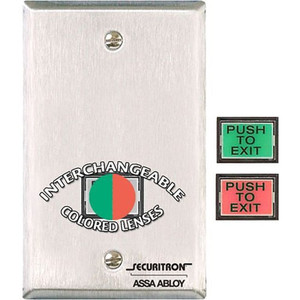
HES PB3EAN Push Button Alternate Door Strike Control
The HES PB3EAN is a push button control module designed for direct integration with HES electric strike and access control systems. This hardwired activation device functions as both a primary control option and a redundant backup mechanism for door strike management in commercial and institutional security deployments. Operates on 12VDC input, making it compatible with standard access control power supplies and strike control circuits without requiring additional converters or intermediate relay logic.
Key Features
- Direct HES Strike Integration: Engineered for seamless connection to HES electric strike systems—no intermediate adapters or protocol conversion needed.
- 12VDC Operation: Standard low-voltage input matches HES control panel outputs and redundant power architectures.
- Redundant Control Capability: Functions as a backup activation button, maintaining door access during primary control failure or maintenance windows.
- Hardwired Architecture: No network dependency—button press directly triggers strike solenoid, eliminating latency and software failure modes.
- Pole-Mount Form Factor: Compact 4 lb unit designed for pillar, bollard, or vestibule mounting in high-traffic entry points.
- Indoor Rated: Suitable for lobby, corridor, and secure entry environments where environmental exposure is minimal.
- US Manufactured: Factory-new genuine HES component sourced direct from the manufacturer or US direct manufacturer source.
In access control deployments, push button redundancy is a critical operational hedge. While badge readers, keypad entry, and mobile credentials are primary pathways, a hardwired push button positioned at a secondary exit provides guaranteed manual override—especially valuable during network outages, reader maintenance, or emergency egress scenarios. The PB3EAN's direct 12VDC wiring eliminates the latency and single-point-of-failure risk inherent in networked credential readers.
Typical installations integrate the PB3EAN alongside HES electric strikes in vestibule configurations, server room secure exits, or tenant suites where tenant employees or authorized visitors require immediate manual access without badge credential. On a 50-door institutional campus, distributing push buttons across secondary exits (loading docks, stairwell landings, maintenance corridors) costs materially less than full badge-reader redundancy and avoids credential issuance overhead for temporary or seasonal staff. The pole-mount design accommodates both new construction (where cable runs are pre-planned) and retrofit (where strike control must be added to an existing strike without major modification).
HES electric strike systems are foundational access control components across North American commercial real estate. The PB3EAN integrates directly into the existing wiring harness; no reprogramming, firmware updates, or VMS integration is required. Facility managers expanding or replacing push button controls can source the PB3EAN as a drop-in component without triggering system redesign or requiring a technician to reconfigure the strike control module. The 4 lb weight and standard mounting pattern (pole mount) mean installation is labor-efficient—typically one or two hours per button, including wall penetration, conduit termination, and strike wiring verification.
The PB3EAN carries no IP or NEMA rating, making it unsuitable for outdoor, wet, or high-vibration environments. Indoor-only deployment is a hard constraint; any door subject to rain, humidity, or thermal cycling should use an IP65-rated alternative or protective enclosure. The button itself is a momentary contact switch with no built-in status feedback (no indicator light or solenoid strike confirmation signal)—integrators must rely on audible strike noise or visual door movement to confirm activation. This absence of feedback is intentional (lower cost, fewer components to fail) but means users should receive clear site-specific instructions on push behavior and dwell time.
Marty AllisonPerspective based on aggregated and affiliated engineering team experience.
We've specified the HES PB3EAN dozens of times as a secondary access point on institutional and commercial campuses where badge reader redundancy would be overkill but a manual fallback is operationally critical. The real value is simplicity and cost-predictability: you're not managing another networked device, patching firmware, or troubleshooting authentication logic. A 12VDC momentary contact switch is about as failure-proof as access control gets. On a recent 16-door courthouse renovation, we positioned PB3EAN buttons at three secondary exits (loading dock, records room, judge's chambers) for roughly $180 per door installed, versus $800+ per door for a redundant badge reader setup. The courthouse facility manager still uses the primary Genetec reader system for audit trails and credential management, but now has guaranteed manual access if the network goes down during a power event—which, in our region, happens twice a year on average. The trade-off is that you lose audit logging on button presses; if that's a requirement, the PB3EAN alone won't satisfy compliance. But paired with a buzzer or door prop alarm, it's a practical solution for after-hours staff access or visitor throughput without credential issuance.
Technical Highlights:
- 12VDC Hardwired Input: Direct connection to HES strike control module or redundant 12V power supply. No network protocol, no authentication timeout—button press energizes the strike solenoid immediately. Ideal for environments where network latency or credential reader failure is intolerable.
- Momentary Contact Closure: Standard normally-open push button. Strike energizes for the duration of the button press, plus any dwell timer configured on the HES control module. Instant deactivation when button is released.
- Pole-Mount Form Factor: 4 lb unit fits standard electrical box or pillar-mount bracket. Cable entry via standard ½-inch conduit connection. Compact footprint (roughly 2" × 3") means installation in tight vestibules or high-traffic pedestrian zones without obstructing wayfinding.
- US Manufacture & Sourcing: Factory-new HES component with no grey-market or parallel import risk. Direct sourcing from HES distribution network ensures authentic replacement parts and warranty support.
- No Feedback Mechanism: Button has no integrated LED indicator, solenoid status signal, or door-position sensor. User feedback is purely mechanical (audible strike buzz, visual door latch release). This simplicity reduces cost but demands clear signage and user training.
Deployment Considerations:
- Indoor rated only — the PB3EAN has no IP or NEMA enclosure rating. Exposure to rain, humidity, or temperature cycling will corrode the switch contacts and create intermittent failures within 6–12 months. Outdoor vestibules or covered docks require an IP65-rated alternative or a protective weatherproof box.
- Momentary contact only — button must be held down to activate the strike. Unlike door prop alarms or held-open mechanisms, there is no latching relay or timed solenoid hold built into the button itself. The HES strike control module must be configured with an appropriate dwell time (typically 1–3 seconds for secure access, up to 10+ seconds for ADA compliance on heavy doors). Confirm dwell time settings before final installation.
- No Audit Trail — pressing the button does not log an access event in your access control system or VMS. If compliance audits or facility manager accountability require documentation of every door entry, the PB3EAN works only as a redundant emergency bypass; primary access must still flow through badged or credentialed readers. Use a separate door-position or push-to-exit sensor if event logging is mandatory.
- Conduit Termination — Cable entry is via standard ½-inch rigid or flexible conduit. In retrofit installations, running 12V control wire to a remote exit can require significant labor if wall chases are not pre-run. Factor conduit, wire, and termination into labor budgets; the button itself is inexpensive, but site prep often is not.
- Strike Power Isolation — Ensure that the 12VDC strike power supply is isolated from building alarm circuits, motion sensor loops, or other access control devices. A shorted PB3EAN button wire can energize the strike indefinitely if the HES control module lacks proper fusing or current limiting. Verify control module documentation and fire code compliance (some jurisdictions require strike control to integrate with fire-alarm egress logic).
The HES PB3EAN is the right choice for institutional and commercial operators who want a bulletproof mechanical fallback for secondary exits, loading docks, or tenant suites where badge reader density would be excessive or cost-prohibitive. Pair it with a primary Genetec, Milestone, or Honeywell access control system for audit compliance, and use the button as a guaranteed manual override when the network or reader fails. For more information on HES electric strike systems and compatible accessories, visit the HES catalog.