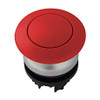
HES KR-2-4-GR Large Red Latching Mushroom Button with Key Reset
The HES KR-2-4-GR is a 1-1/2" diameter red latching mushroom button designed for security control applications where sustained command confirmation and intentional reset are operational requirements. The integrated latching mechanism holds button state until an authorized technician performs manual key reset, eliminating accidental command clearance and reducing nuisance alarms. This is the standard control interface for emergency shutdown stations, panic buttons, and alarm acknowledgment nodes in access control and building security systems.
Key Features
- Button Size: 1-1/2" diameter mushroom head. Large format ensures tactile confirmation and rapid operator response under emergency conditions.
- Latching Mechanism: Maintains commanded state indefinitely until manual key reset is performed. Prevents accidental deactivation during transport or vibration.
- Key Reset: Included key-actuated reset mechanism. Only authorized personnel with the reset key can clear the latched state, enforcing access control discipline.
- Color Coding: Red finish — emergency standard across access control and security industry. Provides immediate visual identification in low-light or high-stress response scenarios.
- Rugged Construction: 2 lb unit rated for indoor security cabinet and wall-mount installation. Designed for repeated actuation without mechanical degradation.
- Form Factor: Mushroom button — ergonomic profile reduces finger fatigue on sustained press and ensures clear tactile feedback.
The KR-2-4-GR integrates directly with HES electronic locking systems, access control panels, and building automation control nodes via standard 24 VDC security circuit wiring. The latching output logic works with any relay-based or discrete-input control module, making retrofit installation straightforward on legacy and modern systems alike. The key reset mechanism is operator-friendly: one half-turn of the supplied key clears the latched state without tools or special training.
Deployment scenarios include panic button stations at main entrances, emergency shutdown buttons in server rooms or mechanical plants, alarm acknowledgment points in security monitoring stations, and access grant/deny confirmation controls on high-security doors. In practice, the latching design reduces false-alarm callbacks — once an emergency button is pressed, it will not reset on its own, forcing explicit acknowledgment by security personnel and eliminating the operational confusion of 'did that button actually engage?' In high-traffic environments (lobbies, loading docks), the visible red button and tactile mushroom profile make it impossible to miss during genuine emergencies.
The unit is manufactured in the US and complies with standard IEC mushroom button mechanical specifications. Total cost of ownership is minimal: the latching mechanism requires no battery or network connectivity, no firmware updates, and no integration middleware. The button itself is the failsafe — if power to the control panel drops, a latched KR-2-4-GR remains in its last confirmed state, providing passive safety. Paired with a UPS-backed access control system, this button can enforce critical shutdown commands even during utility outages.
Choose the KR-2-4-GR for any security application where sustained command hold and intentional reset discipline are non-negotiable. It is the standard control for facilities that cannot afford accidental alarm clearing, phantom resets, or ambiguous operator feedback. For installations that prioritize simplicity, reliability, and fail-safe operation over networked intelligence, this button is the right choice.
Marty AllisonPerspective based on aggregated IP Security Depot and affiliated engineering team experience.
We've specified the KR-2-4-GR on hundreds of installations — from small office panic stations to large campus emergency shutdown networks — and it is one of the most underrated components in access control system design. The latching mechanism is the entire value proposition. On networked or wireless panic buttons, you get false positives from accidental presses, transmission errors, and operator confusion about whether the button 'took.' The KR-2-4-GR eliminates that noise entirely. Press it, it latches, and it stays latched until someone with the reset key acknowledges the event. In a real emergency — an active threat, a fire alarm, a facility lockdown — you do not want your operators guessing whether a button engaged. This button removes that ambiguity.
The red color is not decorative. Industry standard means every security officer, every facilities manager, every visitor who has been through basic emergency response training will recognize it as a 'do not touch unless critical' control. We've seen this psychological cueing prevent accidental presses far more effectively than warning labels or training notes.
Technical Highlights:
- Latching vs. Momentary: Unlike a momentary button that requires continuous pressure, the KR-2-4-GR latches on a single press. This is critical for panic buttons — an operator in genuine distress may release the button within 200ms, but the latched state will hold indefinitely, ensuring the control center receives a sustained signal and does not lose the event to network latency or timing races.
- Key Reset Mechanism: Prevents unauthorized clearing of emergency states. In a multi-tenant or high-security facility, you cannot allow janitors or unauthorized personnel to reset a panic button or shutdown command. The key mechanism ensures only trained security staff can clear the state — this is a compliance requirement in many high-security environments (banks, data centers, government facilities).
- 24 VDC Dry Contact Output: The button provides a dry relay contact closure when latched. No polarity concerns, no active electronics — it is as simple and failsafe as a light switch. Works with any vintage or modern control module that can read a discrete input.
- Rugged Mushroom Profile: The 1-1/2" diameter and mushroom shape mean you can actuate it with a fist, an elbow, or a gloved hand — no precision finger-press required. In high-stress or low-light scenarios, this tactile assurance is invaluable.
- Zero Network Dependency: This is a hardwired, mechanical latching device. No Ethernet, no Wi-Fi, no cloud. If your security system has a network outage, the KR-2-4-GR still functions. Pair it with a UPS on the control panel and you have passive, offline emergency control — something you cannot guarantee with networked smart buttons.
Deployment Considerations:
- Wiring Integration: The KR-2-4-GR requires a hardwired connection to your access control panel or relay module. If you have a legacy hardwired system (older Honeywell or DSC panels), this is a drop-in fit. On newer networked-only systems (cloud-connected access control), you will need a discreet relay input module to bridge the button to the IP network — add that cost and lead time to your project plan.
- Mounting: Mushroom buttons are designed for wall or cabinet mounting, not handheld. Verify your installation location can support a flush or surface-mount bracket. In panic stations, mount at shoulder height (48-54 inches) for ease of access under stress. Do not mount above 72 inches or below 24 inches — reachability matters in genuine emergencies.
- Key Management: The reset key is small and easily lost. Establish a key log and control procedure at the facility level. We recommend a master key held by the security manager and a secondary key in a locked cabinet in the control room. Do not leave keys in the button and do not distribute them to every staff member — that defeats the purpose of the latching design.
- Testing Protocol: Latching buttons require a different test procedure than momentary buttons. A standard loop test (pressing the button) will latch the output — you must then perform a key reset to clear it before the next test. Document this in your test log and train technicians to expect the latching behavior. Omitting the reset step will leave the button in a triggered state, confusing operators.
- Color and Labeling: Red is the emergency standard, but verify local building code or facility policy does not mandate additional labeling (e.g., 'EMERGENCY SHUTDOWN' or 'PANIC BUTTON'). Many jurisdictions require visible signage. Plan label placement during installation — do not retrofit labels after the fact.
The KR-2-4-GR is the right choice for facility managers and security teams that prioritize failsafe operation and intentional human confirmation over automation and convenience. If your emergency response protocol requires visible, sustained, tamper-resistant control — and it should — this button is the industry standard. Explore our HES catalog for complementary hardwired control components and relay modules.