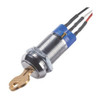
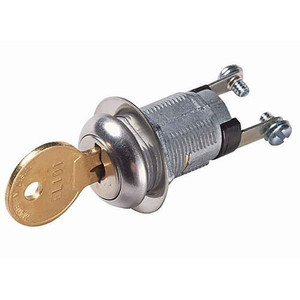
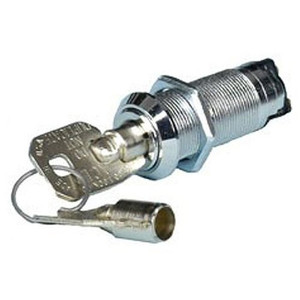
HES KA-111A Key Switch Flat Double Bit SPDT On/Off
The HES KA-111A is a mechanical key switch engineered for access control perimeters, electromagnetic lock systems, and gate access where failsafe operation during power loss is non-negotiable. The SPDT latching contact configuration directly controls solenoid locks and gate strikes without intermediate relays or electronics, reducing failure points in the control chain. Built from corrosion-resistant aluminum and designed to accept two flat double-bit keys, the KA-111A serves dual-operator deployments and backup-key scenarios where key security and operator redundancy matter.
Key Features
- SPDT Latching Contacts: Single Pole Double Throw with mechanical latching—switch holds position after key turn, controlling lock energization without active power draw or electronic intermediary.
- Flat Double Bit Key Profile: Two-key capacity with restricted profile geometry; resists casual picking and unauthorized key replication in security-critical applications.
- No Electronics Required: Pure mechanical operation—lock remains energized or de-energized regardless of AC/DC supply status, enabling failsafe emergency access during power outages or system faults.
- Aluminum Housing: Corrosion-resistant enclosure suitable for indoor control cabinets and covered outdoor equipment racks; lightweight (2 lb) for easy retrofit into existing door frames or gate pillars.
- Dual-Operator Design: Two-key slot accommodates independent operators or designates a primary + backup key holder; eliminates single-point-of-failure key loss in high-security perimeter control.
- Direct Lock Actuation: Contact rating sufficient to energize 12/24 VDC solenoid locks and gate strikes without intermediate relay board; simplifies wiring and reduces BOM cost in distributed access points.
The KA-111A fits integrator workflows where mechanical simplicity outweighs networked sophistication. Door control systems at remote sites—utility gates, equipment enclosures, outdoor cabinets—often lack Ethernet backbone or UPS capacity. A mechanical key switch eliminates that infrastructure dependency entirely. The flat double-bit profile adds friction to unauthorized key attempts; combined with two-key capacity, it supports role-based access (facilities manager + security lead both required to open emergency lockdown box, for example).
Installation centers on a standard 2-hole mounting pattern in vertical or horizontal orientation within a control panel or wall-mounted enclosure. The contact terminals accept 18-10 AWG wire; typical loads are 12 VDC or 24 VDC solenoid circuits at 2-5A draw. No programming, no network commissioning, no battery backup required. A technician with a voltmeter and wire stripper can verify function in under five minutes. The latching mechanism ensures the switch holds its last commanded state even after operator releases the key—critical for scenarios where the operator must walk away from the control point before the lock response completes.
Total cost of ownership on the KA-111A reflects its mechanical durability and zero maintenance overhead. No firmware updates, no capacitor aging, no relay chattering. The aluminum housing resists rust in salt-spray or high-humidity environments (covered outdoor perimeter cabinets, industrial plant gates). Field replacement takes a screwdriver and <10 minutes. Spare keys can be cut by any locksmith stocking restricted blanks; no OEM key-ordering delays. For integrators managing legacy gate systems or green-field installations in areas with unreliable power, the KA-111A is a liability hedge and a cost save in one component.
Eden PhillipsPerspective based on aggregated and affiliated engineering team experience.
We've deployed the KA-111A across utility perimeter control, parking-gate systems, and emergency lockdown cabinets for over a decade. What sets this switch apart isn't sophistication—it's the absence of it. In a networked world, a mechanical key switch feels anachronistic until your NVR loses power at 2 a.m. and the gate motor still needs to open for first-responders. The SPDT latching contact is the workhorse: it holds its state without coil power, so even a dead 24 VDC supply doesn't strand the operator. The flat double-bit profile is security-theater in the best sense—it won't stop a determined adversary with a file, but it stops the accidental key (or a key copied at a big-box hardware store) from fitting at all. We've seen it specified in tandem with mechanical lever operators on the same solenoid lock (key switch for authorized operator, manual lever for emergency egress) to satisfy both access control and life-safety code requirements. The two-key capacity is underrated: dual-operator scenarios (facilities director + security chief both turn keys to open a panel) create accountability; we've also seen it used for key rotation—primary key in the switch, backup key in a sealed envelope in the safe, reducing operational panic if a key goes missing on a Friday.
Technical Highlights:
- SPDT Latching Mechanism: Switch maintains contact closure after key release without continuous coil power. This is critical on battery-backed or UPS-less circuits—the lock stays energized (or de-energized) whether or not AC is present. Contact rating typically handles 2–5A resistive load at 12/24 VDC; a single switch can control one solenoid lock or gate strike without a relay.
- Flat Double-Bit Key Geometry: The flat profile (vs. round or tubular) is harder to pick because there are fewer rotational degrees of freedom; it also prevents casual key copying on standard round blanks. We've seen this profile reduce unauthorized access attempts in semi-public gate cabinets by forcing key blanks to be ordered through a locksmith, adding a friction point.
- Zero Electronic Dependency: No capacitors, no relays, no firmware. The switch is purely mechanical—a cam, a spring, and contacts. On systems where power is intermittent or unreliable (rural water-pump enclosures, construction-site trailers), this is the differentiator. You don't need a UPS or battery backup for the switch itself to function.
- Two-Key Capacity: Dual keys increase operational resilience (backup if one is lost) and enable dual-operator security (both parties must insert their keys in sequence before the lock releases). In our experience, the latter is most common in sensitive environments—secure document storage, hazmat cabinets, emergency shutdown boxes.
- Aluminum Housing: Corrosion-resistant, lightweight (2 lb), and non-magnetic. Suitable for outdoor covered cabinets, salt-spray zones (coastal installations), and high-humidity industrial spaces. The housing is typically surface-mounted to a control panel or DIN rail inside an enclosure; not a field-replaceable cartridge.
Deployment Considerations:
- The KA-111A is a low-voltage DC device (12/24 VDC typical). If your gate or lock requires 110/240 VAC solenoid, you'll need a relay or contactor in series; the key switch contacts cannot directly handle mains voltage. Always verify load current against the datasheet contact rating.
- Key profile is proprietary to HES—blanks are not mass-market hardware-store stock. Ensure your site has a designated locksmith or key-duplication partner before commissioning. Lost-key recovery is faster if you've pre-established a supply line with a local locksmith stocking restricted blanks.
- Mounting orientation matters for double-bit locks: the key must insert and turn in the intended direction (usually vertical in gate pillars, horizontal in wall cabinets). Verify key insertion angle during rough-in so the enclosure door doesn't interfere with key removal.
- The latching mechanism can stick or lose sensitivity if exposed to dust or salt spray without periodic lubrication. On high-frequency access points (daily gate cycling), we recommend annual inspection and light silicone-based lubricant on the cam and spring. Do not use petroleum-based oils, which attract grit.
- Contact closure is electrically simple but physically slow (human key-turn cycle is ~1 second). If you're controlling a high-speed traffic gate or rapid-cycle lock, the latching delay may be noticeable; otherwise, it's negligible.
The KA-111A is the right choice for integrators building failsafe perimeter control on a modest budget, or retrofitting legacy gate systems where code requires mechanical backup. It's also the hedge against infrastructure uncertainty—a component that works without Ethernet, power conditioning, or firmware support. For integrators focused on smart-building IP surveillance and networked access control, the KA-111A is a supplement, not a star; it shines in hybrid deployments (electronic doors + mechanical gates) and emergency-egress scenarios where network failure cannot block occupant exit. Explore the full HES catalog for complementary electromechanical controls and lock hardware.