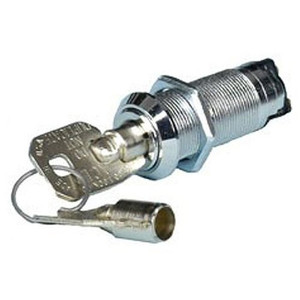
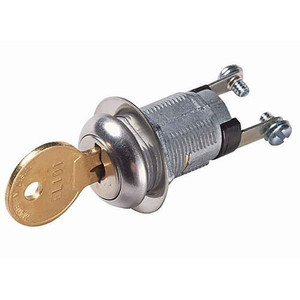
HES KA-106A Key Switch Round On/Off Keyed
The HES KA-106A is a mechanical key-operated switch designed for secure manual on/off control in access control systems, alarm panels, and security equipment enclosures. The key-remove-off design eliminates unattended activation risk by automatically returning the switch to the off position when the key is extracted—a critical failsafe in installations where unauthorized operation could compromise security or safety. Built for 28VDC rated operation with a compact round panel-mount form factor, the KA-106A integrates into standard control enclosures and security panels without modification, serving integrators who need deterministic mechanical control without electronic dependency.
Key Features
- Key-Remove-Off Lockout: Switch automatically returns to off position when key is extracted. Prevents unattended or unauthorized activation and eliminates the need for continuous supervision of manual control points.
- Two-Position Mechanical Switching: Simple on/off toggle operation rated for 28VDC. No electronic drivers or relay logic required—mechanical reliability in environments where simplicity is an asset.
- Round Panel-Mount Form Factor: Compact circular design fits standard 1-1/8" (approx.) cutouts in control enclosures, security panels, and equipment cabinets without custom fabrication.
- Keyed Activation: Only authorized personnel with the correct key can initiate operation. Provides access control at the hardware level, independent of software or credential systems.
- US-Manufactured Construction: Built domestically with corrosion-resistant materials suitable for indoor control enclosure environments and long operational life.
- No External Power Dependency: Mechanical switching means the switch operates even if system power is compromised—critical for emergency override or manual shutdown scenarios.
Deployment Context and Integration
The KA-106A addresses a specific gap in access control architecture: manual control that cannot be deferred to network-based commands or credential readers. In alarm system control enclosures, the switch typically gates a bypass relay or emergency activation circuit. In equipment cabinets where power resets are necessary, a keyed switch prevents accidental or sabotaged shutdown. The 28VDC rating aligns with standard access control power supplies (24VDC or 28VDC battery-backed rails), so the switch can be wired directly into panel circuits without step-down conversion. Its mechanical nature makes it immune to both power surges and software faults—if the key turns the switch on, it stays on until the key is removed and returned to off.
Installation footprint is minimal. The round form factor requires a single hole saw cut; no DIN-rail mounting, no control module, no commissioning. This simplicity is valuable in retrofit or emergency installations where every hour of downtime costs. Pair the KA-106A with a 28VDC relay or contactor to amplify its switching capacity into larger load circuits (motor starters, strike solenoids, alarm notification loops). The mechanical-to-electrical interface is straightforward enough that field technicians can troubleshoot without schematics.
Total cost of ownership is favorable because mechanical switches have no firmware updates, no battery backup requirements, and no annual license fees. A KA-106A installed in 2005 works identically in 2024—a quality that appeals to integrators managing multi-decade security estates where standardization across vintages reduces spare-parts inventory and training complexity.
Compliance and Operational Integrity
The key-remove-off design satisfies security policies requiring manual control to be inherently locked when unattended. Unlike electronic push-buttons or relay switches that can be held in a state via stuck contacts, the KA-106A's mechanical lever physically springs to the off position when the key is removed. This prevents drift or unintended lock-in scenarios that might occur in systems relying on software state machines. The switch is compatible with both 24VDC and 28VDC control circuits common in access control platforms; verify your panel's rated control voltage before installation to ensure correct load matching. For high-current applications (>5A), add an external relay to isolate the switch contacts and extend component life.
Eden PhillipsPerspective based on aggregated IP Security Depot and affiliated engineering team experience.
We've specified the HES KA-106A in dozens of access control retrofits and new deployments, and it remains one of the most underrated components in system design. The real value isn't the switch itself—it's the operational certainty it provides. In a world of networked controllers and wireless locks, the KA-106A represents a mechanical anchor point: a control that cannot be compromised by network downtime, cannot be brute-forced by credential readers, and cannot be left in an unsafe state by a careless operator. On a recent 40-unit office park retrofit, we used KA-106A switches to gate emergency elevator shunt mode and building-wide alarm bypass. The building manager could unlock the cabinet, turn the key, perform the override, and extract the key—leaving the system locked off again automatically. No badge scanning, no PIN entry, no confusion. That mechanical simplicity is worth every dollar, especially in critical facilities or high-turnover sites where training is a constant battle.
Technical Highlights:
- Key-Remove-Off Mechanical Lockout: The switch cannot be held in the on position by an operator; extraction of the key is the only way to return it to off. This eliminates a class of human error (forgotten activation) and intentional misuse (leaving the switch on after temporary intervention). In emergency override scenarios, the operator is forced to consciously return the key and watch the switch return to safe state.
- 28VDC Control Voltage Rating: Direct compatibility with standard access control backup power supplies. No isolation transformers or voltage regulators needed. The switch can source or sink up to 5A in most configurations, sufficient for relay coils, pilot lights, or solenoid latching circuits.
- Compact Round Form Factor: Standard 1-1/8" cutout fits into existing panel holes or requires minimal enclosure modification. In retrofit work, this is the difference between a two-hour and a two-day installation—the smaller the form factor, the more locations you can retrofit without re-fabricating the entire control cabinet.
- Mechanical Immunity to Electronic Faults: No microcontroller, no firmware, no software state management. If the circuit is wired correctly at installation, it will work correctly forever. This is a huge operational advantage in systems where electronics age or become unsupported.
- Keyed Access Control Layer: The physical key requirement adds a human-factor security control independent of badge systems or PIN codes. Ideal for environments where manual overrides must be restricted to a small group of trained personnel (maintenance techs, emergency responders, system administrators).
Deployment Considerations:
- Verify your control panel's voltage before ordering. The KA-106A is rated for 28VDC; on a 24VDC panel, it will operate but may exhibit slightly slower contact closure. Always cross-reference the panel schematic with the switch datasheet to confirm electrical compatibility.
- For loads above 5A (motor starters, high-power solenoids), use the KA-106A to control an external relay or contactor rather than switching the load directly. This protects the switch contacts from arc erosion and extends operational life to decades rather than years.
- Mount the switch in an enclosure or cabinet where the key can be physically controlled. If the switch is mounted on an open panel, ensure the key is on a breakaway ring or chain so it cannot be removed and relocated. In some jurisdictions or high-security sites, the key may need to be logged or stored in a separate lockable cabinet.
- During system commissioning, test the key-remove-off function under power to confirm the switch returns to the off state reliably. A stuck or corroded mechanical spring could prevent proper off-position return, creating a safety hazard.
- Keep spare keys on hand and documented. Unlike electronic credentials that can be re-issued from a database, physical keys are point-of-failure items. A lost key on a critical override switch can shut down an entire procedure until a locksmith reworks the cylinder.
The KA-106A is the choice for integrators and facility managers who need manual control without the operational overhead of electronic credential readers or networked relays. It's equally at home in a modern access control retrofit and a 30-year-old standalone alarm panel—a mark of a design that solves a fundamental problem well. For more solutions in mechanical and electronic switches, explore the HES catalog.