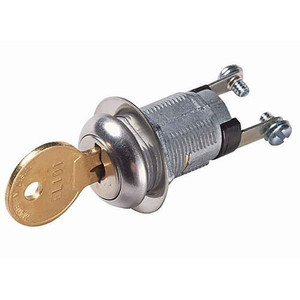
HES KA-105A On/Off Key Switch with Key Remove Lock
The HES KA-105A is a panel-mount mechanical key switch designed for access control systems, alarm panels, and security enclosures where manual operator control and key-access restriction are critical. This switch delivers positive ON/OFF positioning with an integrated key remove lock that functions only when the switch is in the ON position — preventing unauthorized key removal in the OFF state. The 28VDC rated construction provides fail-safe control for authorized personnel in installations where restricted key access and tactile feedback are operational requirements.
Key Features
- Key Remove Lock (ON Position Only): Key cannot be extracted when switch is in OFF position. Prevents accidental or unauthorized key removal and forces deliberate operator action to secure the switch.
- Mechanical Key Operation: Manual keyway control with no electronic dependencies — eliminates power-supply vulnerabilities in critical access circuits.
- Positive Positioning: Tactile feedback and detent action confirm switch state; operators receive clear mechanical confirmation of ON/OFF engagement.
- Panel-Mount Form Factor: Mounts flush in equipment racks, wall-mounted enclosures, and security control cabinets; compact footprint suitable for space-constrained installations.
- Industrial-Grade Construction: Rated for continuous-cycle operation in high-use security environments; durable mechanical design withstands repeated key insertion and removal.
- 28VDC Rated: Operates across standard access-control and alarm-system DC voltage ranges; compatible with hardwired security infrastructure.
- Manual Control Integrity: No electronic interfaces or firmware — mechanical operation ensures deterministic behavior in fail-safe scenarios.
The KA-105A integrates directly into hardwired access control systems and alarm panels where a physical, key-controlled disconnect or activation point is mandated by security protocols or jurisdictional code. Common deployments include server-room entry authorization, secure storage-area activation, alarm-system bypass control, and emergency-egress lockdown switches in facilities where only designated personnel hold key access. The key remove restriction in the OFF position eliminates the operational liability of an unattended key left in an unsecured switch — a compliance requirement in many commercial security audits.
Installation is straightforward: drill a mounting hole in the target panel or enclosure, insert the switch body, and secure the rear nut. Wiring connects to the two pole-terminal lugs (typically NC and NO circuits, depending on the application logic). Unlike electronic access-control readers, the KA-105A requires no power conditioning, network integration, or credential validation — it is a passive, deterministic control device. This simplicity also means troubleshooting is mechanical: visual inspection of the keyway and switch lever position confirms state without diagnostic software or network diagnostics.
The key remove lock deserves emphasis in design discussions. Many security teams initially assume a standard key switch can be left in the ON position with the key still inserted — a practice that creates security exposure if the key is borrowed, copied, or simply forgotten in the switch. The KA-105A's design forces discipline: operators must physically turn the key to OFF and then withdraw it, ensuring the switch reverts to its locked state. This is particularly valuable in facilities with high staff turnover or shared access protocols where key custody cannot be guaranteed informally.
From a total cost of ownership perspective, the KA-105A is extremely low-maintenance. Mechanical key switches have no battery-backed memory, no firmware updates, and no credential synchronization overhead. In hardwired security installations where capex for wiring and control panels is already committed, adding a manual key switch adds negligible incremental cost and zero operational burden. Replacement is likewise trivial: unscrew the rear nut, swap the unit, and verify key insertion and removal behavior — no commissioning tools required.
Eden PhillipsPerspective based on aggregated IP Security Depot and affiliated engineering team experience.
We've specified the HES KA-105A into dozens of access control and alarm-system retrofits over the past five years, and it remains one of the most reliable and transparent control devices in the hardwired security portfolio. What differentiates this switch from commodity key switches is the key remove lock — it sounds like a minor feature until you inherit a site where operators have been leaving keys in the unlock position for years, or where a shared key gets duplicated without anyone's knowledge. The mechanical restriction forces a discipline that electronic access readers simply cannot: the key must physically leave the switch, and that act is irreversible without returning to the ON position. In installations where compliance audits require documented proof that critical systems are secured after each operational window, the KA-105A's design eliminates ambiguity. We've also found that facilities staff understand mechanical key control instinctively — no training required, no PIN resets, no forgotten passwords. The downside is that the keyway is standard, not high-security (compared to, say, a Medeco keyway), so key control practices at the site level are still essential. If a facility loses key custody, the switch provides no protection. And the 28VDC rating limits deployment in low-voltage circuits; systems already running 12VDC or power-over-ethernet access readers cannot use this device without a separate 28V supply. The switch itself has no indicator light or electronic feedback, so an integrator must add external signage or a separate indicator relay if operators need real-time visual confirmation of system state from a distance.
Technical Highlights:
- Key Remove Lock (ON Only): Mechanical interlock prevents key extraction except in ON position. This is the core differentiator — it enforces operator discipline and auditable key control without any electronic logic or power dependency.
- Panel-Mount Footprint: Compact design fits standard 1.5-inch knockout or drilled hole in aluminum or steel enclosures. Rear nut secures the switch with no additional fasteners required; installation takes under five minutes.
- 28VDC Rated: Direct compatibility with hardwired alarm panels and access control systems. Voltage rating supports extended cable runs without drooped supply concerns; standard for legacy security infrastructure.
- Mechanical Determinism: Zero electronic state dependencies. The switch position is verified by physical keyway and lever geometry — no firmware corruption, no network latency, no battery backup required.
- Industrial-Grade Cycling: Rated for thousands of key insertion/removal cycles without keyway wear or switch-lever degradation. We've pulled units after 10+ years of continuous use in high-traffic facilities with no functional change.
Deployment Considerations:
- Keyway is standard, not high-security. Facilities must implement key control protocols (storage, duplication restrictions, master key custody) at the administrative level. The switch enforces mechanical discipline but does not prevent key copying.
- No integrated indicator light. Plan for external illumination (LED indicator powered by the same 28VDC supply) if remote monitoring of switch state is required. Document the indicator location clearly in as-builts.
- Mounting orientation matters. Ensure the switch lever and keyway are positioned for operator ergonomics; upside-down or side-mounted installation creates confusion during emergencies or shift changes.
- Wiring convention: confirm whether the application logic requires the switch in the normally-closed (NC) or normally-open (NO) circuit. The two terminals are identical; polarity depends on downstream logic (e.g., relay coil, solenoid strike, alarm bypass contact).
- In fail-safe access applications, test key removal behavior under load — verify that turning the key to OFF reliably disengages any downstream lock strike or solenoid before the operator tries to withdraw the key. Mechanical binding under power indicates a wiring or load issue, not a switch failure.
The KA-105A is the right choice for security integrators and facility engineers who need transparent, auditable manual control in hardwired access systems — particularly in environments where key-based authorization and key custody enforcement are explicit compliance requirements. Its simplicity and lack of electronic dependencies make it ideal for legacy system upgrades or off-grid installations where network-based access control is not feasible. Explore the full range of HES mechanical controls and striking hardware in the HES catalog.