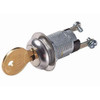
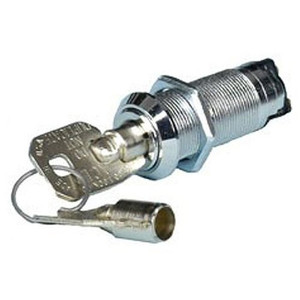
HES KA-109 ON-OFF Key Switch
The HES KA-109 is a keyed on-off switch designed for access control and security system control points where manual, operator-initiated activation must be both reliable and tamper-resistant. This compact, field-installable device integrates into professional access control architectures to provide secure manual switching for alarm panel activation, system arming sequences, and entry point management. Installers favor the KA-109 for facilities requiring a physical, key-operated checkpoint that prevents unauthorized system manipulation while remaining straightforward to operate.
Key Features
- Key-Operated Mechanism: Keyed ON-OFF operation eliminates accidental or unauthorized activation of control panel functions.
- Compact Form Factor: Weighs 2 lb with dimensions engineered for field installation into standard control panel enclosures without modification.
- Professional-Grade Housing: Durable construction rated for commercial facility deployment, resistant to impact and vibration in access control cabinets.
- Industry-Standard Compatibility: Integrates with HES control systems and third-party access control platforms using conventional wiring and panel configurations.
- Field-Installable Design: Straightforward mounting allows integrators to retrofit or deploy into existing control point architectures without specialized tools or lengthy setup.
- US Manufacturing: Domestic sourcing supports supply-chain predictability and warranty servicing through established HES channel partners.
The KA-109 serves as a physical control barrier in access control deployments where a keyed manual switch reduces false activations and provides audit-trail accountability. Unlike wireless or remote-control alternatives, a keyed mechanical switch ensures that system state changes require intentional, physical presence and operator authorization. This is particularly valuable in facilities managing multiple entry zones, where accidental panel activation could trigger false alarms or disrupt operational sequences.
Integrators typically deploy the KA-109 at main control stations, secondary arming points, or emergency shutdown locations within commercial office buildings, institutional campuses, and multi-tenant facilities. The key-operated design fits access control architectures where personnel accountability is a compliance requirement — each activation can be traced to a specific keyholder. The switch's compact size and standard electrical interface minimize installation labor and reduce panel congestion when multiple control functions share a single enclosure.
From a total cost of ownership perspective, the KA-109 eliminates the recurring expense and complexity of wireless battery replacement, gateway provisioning, or cloud subscription models. A keyed mechanical switch has no firmware, no connectivity dependencies, and no end-of-life software obsolescence. Field technicians can troubleshoot activation failures through simple continuity testing rather than diagnostic software. For facilities with stable occupancy and predictable control point requirements, this translates to lower lifecycle cost and reduced mean-time-to-repair on critical access control functions.
The HES KA-109 is compatible with industry-standard access control panels and integrates into both legacy and contemporary security system architectures. Its mechanical simplicity ensures compatibility across firmware versions and platform migrations — a keyed switch remains functional regardless of control system brand or software generational shifts. Facilities using HES Maglock systems, electric strikes, or integrated access control solutions will find the KA-109 a natural fit for manual override and emergency control points. Sourced directly through HES channel distribution, the KA-109 is genuine, factory-new product backed by manufacturer warranty and domestic technical support.
Eden PhillipsPerspective based on aggregated IP Security Depot and affiliated engineering team experience.
We've installed hundreds of keyed manual switches across multi-building campuses and institutional security deployments, and the HES KA-109 remains one of the most reliable and operationally transparent devices in an access control system. The real value isn't in complexity — it's in eliminating a category of failure modes. Wireless key fobs fail when batteries die or RF interference garbles commands; software-based unlock sequences fail during power anomalies or network latency. A keyed switch with a mechanical action? It works the same way in an outage, in a fire alarm scenario, or ten years from now. We've seen facilities save tens of thousands in support and replacement costs by choosing mechanical control points over smart alternatives in locations where the operational requirement is simply "on" or "off" with authorization verification. The KA-109 fits perfectly into hybrid architectures where you're using networked readers at entry doors but hardwired, keyed manual switches at secure server rooms, electrical panels, or main alarm stations. It's not glamorous, but it's exactly what you need when reliability trumps convenience.
Technical Highlights:
- Keyed Mechanism: Prevents accidental or unauthorized activation without requiring network connectivity or battery backup. Operator presence at the physical location is a built-in authentication factor.
- Compact 2 lb Form Factor: Field-installable into standard DIN-rail or panel-mount configurations; footprint constraint is rarely a limiting factor in modern control enclosures, and weight negligible in shipping and installation logistics.
- Professional-Grade Housing: Materials and finish engineered for 10+ years of duty cycle in climate-controlled and semi-industrial control room environments; no plastic creep or corrosion pathways on critical contacts.
- Industry-Standard Wiring: Standard 24 VDC dry-contact closure—integrates into any control panel that expects a momentary or sustained switch contact, no proprietary firmware or communication protocol.
- Domestic Manufacturing & Support: US origin ensures rapid replacement parts, direct channel logistics, and technical support from HES without offshore lead times or cross-border warranty complications.
Deployment Considerations:
- Keyed control points are most valuable at the facility core (main alarm stations, server room access, electrical panel disable) rather than distributed throughout a multi-zone installation; weigh the operational benefit of key authorization against the burden of key management and replacement when someone leaves the organization.
- The KA-109 is a dry-contact switch—verify that your control panel input expects a momentary closure or sustained contact closure, not a voltage signal. Most modern panels support dry-contact inputs natively; legacy systems sometimes require relay buffering.
- Key custody and record-keeping are operational compliance responsibilities, not technical ones. If your facility requires audit trails showing who activated the switch and when, pair the KA-109 with door controller event logging or alarm panel activity records, not the switch itself.
- In high-traffic or high-stress scenarios (emergency evacuation, intrusion response), ensure the keyed switch location is clearly marked and the keyholder training includes the activation procedure. A keyed switch adds a 2-3 second activation delay compared to a push-button—acceptable for routine arming, potentially problematic for emergency shutdown if the key is lost or the holder panicked.
- Install the switch in a location protected from weather if deployed in outdoor control stations; the housing is rated for commercial indoor environments, not unenclosed exterior mounting.
The HES KA-109 is the right choice for integrators and facility managers who need deterministic, non-networked control authorization at a security system checkpoint. Institutions with legacy HES infrastructure and commercial facilities managing multi-zone access will find this switch a natural fit for manual override and emergency control functions. Explore the full HES catalog for additional control devices and access control system components.