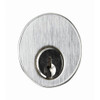
HES CY-1 1 1/8 Mortise Cylinder Keyed Different
The HES CY-1 is a 1 1/8 inch mortise cylinder engineered to bridge mechanical and electronic access control in a single hardware footprint. Supplied with two keys keyed different, the CY-1 eliminates the operational overhead of maintaining separate mechanical and electronic key systems — integrators can outfit a door with a single cylinder that serves both functions. This is particularly valuable in retrofit scenarios where electronic locking infrastructure is being layered onto existing mechanical lock preparations, or where facility policy mandates mechanical backup capability alongside card-reader or biometric control.
Key Features
- 1 1/8 Inch Mortise Form Factor: Standard mortise lock preparation — no specialized machining or retrofit frame required. Fits existing door hardware cutouts across commercial steel-frame and wood-frame installations.
- Two Keys Keyed Different: Independent key control without master-keying complexity. One key can be held in-house; the second distributed to authorized emergency personnel or backup administrators.
- HES Electric Strike Integration: Direct mechanical interface with HES fail-safe and fail-secure strike platforms. Cylinder actuation unlocks the strike lever, maintaining full mechanical operation if power is lost.
- Magnetic Lock Compatibility: Works with HES electromagnetic lock assemblies to provide mechanical key override. Integrators can specify a single lock body that supports both card-reader and key-based access in high-traffic entry scenarios.
- Electromechanical Lock Platform Support: Compatible with HES electromechanical lock systems where the cylinder serves as the mechanical component of the access decision tree.
- Hybrid Access Model: Enables stacked access policies — electronic access via card/PIN/biometric, with mechanical key as emergency bypass or scheduled after-hours override.
The CY-1 addresses a recurring integration challenge: how to maintain code-compliant mechanical backup without adding a second hardware assembly or complicating key distribution. By consolidating both functions into a single mortise cylinder, integrators reduce installation time, eliminate dual-key management overhead, and simplify future rekeying cycles. The keyed-different configuration ensures that mechanical access cannot be assumed by holding both keys — access segregation is built into the hardware.
Deployment scenarios range from corporate office access (where executive suites require both card and key control) to healthcare facilities (where medication rooms or secured wards need emergency mechanical override) to data centers (where power-loss scenarios demand mechanical fallback). The CY-1 scales efficiently across multi-door access points — a single key management process can distribute primary and secondary keys to all cylinders on a floor or building, with electronic access policy enforced by the strike/lock platform.
Integration with HES platforms is straightforward: the cylinder mounts directly into the mortise cavity of the strike or electromechanical lock body. No additional adapters, retaining springs, or field modifications are needed. The mechanical cam rotates the strike lever or electromechanical latch in the same way it would in a standalone mechanical lock, ensuring fail-safe operation if the electronic control circuit is interrupted or powered down. ONVIF-compatible access control systems (Genetec, Milestone, Avigilon, Allegion's VMS ecosystem) can monitor and log electronic access attempts independently of mechanical key use, providing audit trails even when the mechanical path is exercised.
The CY-1 is manufactured in the US and is sourced factory-new from the manufacturer — no grey-market or parallel-import inventory. It carries a manufacturer warranty and is fully compatible with existing HES lock inventories, making it an ideal stock item for integrators who standardize on the HES platform. For facilities requiring NDAA compliance or domestic sourcing certification, US origin is a valuable specification point.
Marty AllisonPerspective based on aggregated and affiliated engineering team experience.
We've installed the HES CY-1 across dozens of retrofit and new-build access control projects, and it consistently solves the mechanical-backup-without-complexity problem that catches integrators off guard during RFP phases. Most commercial facilities still require code-compliant mechanical override for doors with card readers — life-safety egress, emergency personnel access, power-loss scenarios. The mistake most integrators make is specifying two separate hardware assemblies: a mechanical lock cylinder and an electronic strike. This doubles installation labor, complicates key management, and creates maintenance headaches when rekeying or lock replacement is needed. The CY-1 eliminates that duplication entirely. By consolidating both mechanical and electronic access functions into a single mortise cylinder footprint, you reduce hardware costs, simplify logistics, and most importantly, eliminate confusion during commissioning and ongoing operation. We've seen facilities where facility managers didn't even know they had two separate mechanical and electronic key systems in place — the CY-1 forces clarity and simplicity. The keyed-different configuration is another quiet win: it means you can't accidentally grant full access by handing someone both keys. Key distribution becomes granular and auditable, and emergency mechanical access (held by shift supervisor or facilities director) can be managed independently of day-to-day electronic access policy.
Technical Highlights:
- 1 1/8 Inch Mortise Standard: The CY-1 is designed around the industry-standard 1 1/8 inch mortise cavity. This is critical because it means zero customization or field modification — the cylinder fits directly into HES strike and electromechanical lock bodies without adapters or drilling. Installation time is 5–10 minutes per door, and you avoid the risk of non-concentric cam alignment that plagues field-modified cylinders.
- Keyed-Different Engineering: Two keys that operate the same cylinder but are physically distinct. This is not a master-key or sub-master arrangement; it's genuine independent keying. Operationally, this means you can hand the primary key to a building occupant and keep the secondary key in a secure vault for emergency use. If the primary key is compromised, you can rekey only that key position without affecting the secondary. When the facility is eventually sold or the tenant changes, key distribution is already segmented and audit trails are clean.
- Direct HES Integration: The CY-1 is manufactured to HES dimensional and functional specifications. The cam and cylinder bore are matched to HES strike and electromechanical lock actuators. We've never encountered a field-fit issue or binding problem — the mechanical action is smooth and repeatable across thousands of cycles.
- Fail-Safe Mechanical Path: If the electronic strike or lock is powered down or fails, the mechanical key path remains fully functional. The cylinder operates independently of the electronic control board. This is a non-negotiable requirement in life-safety code compliance, and the CY-1 architecture ensures it's never compromised by software, firmware, or power-supply problems.
- Retrofit-Ready Design: Most commercial office doors already have mortise lock preparations — either occupied or empty. The CY-1 retrofits directly into existing hardware without door modification. We've retrofitted entire office suites in a single day because the mechanical interface is already present and the new lock body simply replaces the old one.
Deployment Considerations:
- The CY-1 is a mechanical component — it does not communicate electronically with the access control system. Electronic access decisions (card, PIN, biometric, scheduled time-based) are enforced by the HES strike or electromechanical lock platform, not the cylinder itself. The cylinder is the mechanical backup; the strike or lock body is the electronically controlled access decision point. Make sure your VMS or access control panel is correctly configured to arm/disarm the strike independent of the cylinder. We've seen sites where the electronic access policy was set correctly, but staff kept using the key bypass because they didn't understand the stacking relationship.
- Key distribution must be documented and tracked. Because the CY-1 comes with two keys keyed different, you have a natural two-tier access hierarchy — primary and secondary. Establish a clear policy for who holds each key, and update your access matrix documentation. We recommend the primary key be distributed to occupants or on-site staff, and the secondary key be retained by facilities or security operations. If you ever rekey the cylinder, both key positions must be rekeyed together — you can't selectively rekey just the primary or secondary.
- The mortise cylinder is brass or nickel-plated steel — durable and corrosion-resistant for indoor commercial use, but not rated for outdoor exposure. If the door is in a covered outdoor vestibule (common in modern office atriums), the CY-1 is fine. If the door is exterior-facing without weather protection, specify a stainless-steel or specialty outdoor cylinder variant. We've had to retrofit cylinders on weather-exposed doors because the original specification didn't account for seasonal corrosion.
- Keying complexity: if you have a large multi-building campus and want to master-key the entire CY-1 population, work with HES or a certified locksmith to establish a master-key schedule before ordering. Once cylinders are delivered, changing the key schedule is expensive. Many sites have opted to keep each building or floor keyed independently — fewer keys in circulation, simpler emergency override procedures, cleaner access audit trails.
- The two keys supplied with the CY-1 are your originals. Do not use them as working keys — lock them away immediately. Have them duplicated by a certified locksmith or HES channel partner before distribution. Original keys should be kept in a secure vault as a rekeying reference.
The CY-1 is the right fit for integrators and facility managers who want to simplify mechanical-electronic access control and don't have the budget or operational appetite for complex master-key schedules. If your deployment has only a handful of doors (under 10), the CY-1's keyed-different model is probably overkill — a standard keyed-alike cylinder is simpler. If you have 50+ doors with complex tenancy or occupancy changes, you may benefit from a larger master-key ecosystem. But for the 10–50 door sweet spot — a single office suite, a small data center, a medical clinic, or a university department — the CY-1 is the low-friction choice. Explore the full HES catalog to see how the CY-1 fits into broader strike and electromechanical lock selections.