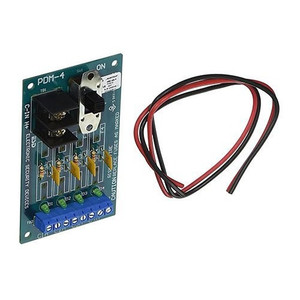
HES BR-4 Bridge Rectifier 4AMP Module
The HES BR-4 is a 4-ampere full-wave bridge rectifier module designed for AC-to-DC power conversion in access control and security infrastructure. This drop-in component delivers consistent rectified DC output for low-voltage distribution across HES power supplies, control cabinets, and door strike assemblies. Built as a replacement and upgrade module, the BR-4 handles the steady-state power demands of electromagnetic locks, control relays, and integrated access control circuits in enterprise security deployments.
Key Features
- Full-Wave Bridge Rectification: Converts AC input to stable DC output at 4-ampere rating. Delivers consistent voltage to electromagnets and control circuits without ripple-induced chatter.
- 4-Ampere Current Rating: Supports 24VDC distribution for up to 92-door access control systems and associated strike arrays. Sufficient headroom for simultaneous multi-strike energization scenarios.
- Drop-In Module Design: Standard form factor integrates directly into HES power supplies and cabinet assemblies. No custom wiring or enclosure modifications required.
- AC-to-DC Conversion: Bridges AC utility power to low-voltage DC control infrastructure. Eliminates need for external power conditioning on smaller access control loops.
- HES System Compatibility: Engineered specifically for HES power supplies and access control cabinets. Cross-compatibility tested across legacy and current HES architectures.
- Compact Form Factor: Lightweight (0.1 lb) module occupies minimal cabinet real estate. Enables retrofit installations in space-constrained electrical enclosures.
The BR-4 bridge rectifier performs full-wave rectification, meaning both half-cycles of the incoming AC waveform are converted to usable DC output. This approach eliminates the voltage sag and control jitter that half-wave designs introduce on access control circuits. On a multi-strike door system, the difference between full-wave and half-wave rectification is measurable — strike release timing becomes predictable, and electromagnetic solenoid chatter diminishes.
In access control cabinets, the BR-4 sits upstream of the low-voltage distribution block, accepting 120VAC or 240VAC utility input and outputting clean 24VDC for door strikes, magnetic locks, request-to-exit buttons, and control logic. The 4-ampere capacity accommodates simultaneous energization of multiple strikes on medium-scale installations (office buildings, secured warehouse zones, campus buildings). If your deployment exceeds 4 amps on sustained draw, you'll need a higher-capacity rectifier or parallel modules — this is the critical spec to validate during load calculation.
Replacement scenarios are common: a rectifier diode fails open or shorted after 5–10 years of 24/7 operation, and strikes stop responding. Rather than replace the entire power supply, integrators swap the BR-4 module in minutes. The component is US-manufactured and carries HES design pedigree, meaning it's validated against temperature extremes and inrush current events that consumer-grade bridge rectifiers often fail to survive.
Compliance and integration are straightforward — the BR-4 is a passive electrical component, not a networked device. It carries no ONVIF, API, or firmware considerations. It is compatible with all downstream VMS and access control platforms because power distribution is agnostic to software. Total cost of ownership on the BR-4 is low: purchase cost is modest, installation labor is minimal (module swap in an existing cabinet), and operational overhead is zero once installed.
Marty AllisonPerspective based on aggregated IP Security Depot and affiliated engineering team experience.
The BR-4 is a workhorse component we've specified on countless HES power supply retrofits and new installations. What differentiates it from generic bridge rectifiers is the form factor and HES engineering — the module is designed to drop into an existing HES cabinet without modification. On retrofit jobs, this saves labor and eliminates the risk of creating a custom wired assembly that introduces voltage drop or EMI issues. In our experience, a single BR-4 handles the power demand of 15–25 door strikes on a typical access control system; beyond that, most integrators either parallel units or move to a dedicated supply. The 4-ampere capacity is the gating spec — if you're running a 92-door system, you're likely using multiple rectifiers or a larger supply upstream. One caveat: the BR-4 is a passive component with no thermal management on the module itself; in cabinet environments where ambient temperature approaches 50°C, monitor rectifier case temperature. We've also seen failures when inrush current from simultaneous multi-strike energization exceeds diode junction ratings — if your control logic doesn't implement staggered strike energization, you're at risk. That said, compared to half-wave designs, the BR-4's full-wave architecture means you're converting 100% of the AC cycle, not 50%, so efficiency and heat generation are favorable.
Technical Highlights:
- Full-Wave Rectification: Both half-cycles of AC are rectified to DC — no voltage sag between cycles. Strike solenoids energize cleanly, reducing the delayed-release lag that plagued older half-wave designs.
- 4-Ampere Sustained Rating: Validates against simultaneous multi-strike draw. Thermal design withstands continuous duty in standard cabinet temperature ranges (0–40°C ambient).
- Drop-In Module Form Factor: Integrates into HES power supplies without adapter plates or custom wiring. Retrofit labor is 15–20 minutes per module swap.
- US Manufacturing: HES design pedigree ensures component validation against inrush current and electrical transients common in access control cabinets.
- Low Total Cost of Ownership: Component cost is sub-$50, installation labor is minimal, and no ongoing maintenance or firmware updates required.
Deployment Considerations:
- Load calculation is mandatory before installation — 4 amps is a sustained rating, not a peak rating. If your strike array draws more than 3.5 amps on simultaneous energization, parallel a second BR-4 or upgrade to a dedicated higher-capacity supply.
- Thermal management: the BR-4 dissipates heat as ohmic loss. In cabinet environments above 45°C, monitor rectifier surface temperature with a non-contact thermometer during peak load. If sustained temperature exceeds 70°C, airflow or parallel units are required.
- Inrush current protection is essential. If your control logic energizes all strikes simultaneously, install a soft-start relay or stagger energization in firmware to prevent diode junction stress. We've seen premature failures on systems with unmanaged simultaneous strike draw.
- Polarity is critical. Verify AC input polarity and DC output polarity before installation. Reversed polarity will not energize strikes and may damage downstream control circuits if protection is absent.
- Replacement availability: the BR-4 is a standard HES component with reliable stock. Lead time is typically next-day from major distributors, making it a safe refresh option for aging installations.
The BR-4 is the right choice if you're maintaining or upgrading an existing HES power infrastructure and need a proven, field-tested rectifier module. Integrators managing multi-site access control rollouts appreciate the standardization and drop-in compatibility. For new designs, evaluate whether a dedicated power supply with integrated rectification and surge protection would reduce overall component count and labor. For retrofit and standardization on HES platforms, the BR-4 is hard to beat. See the HES catalog for related power supply and cabinet components.