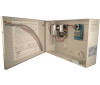
HES AQD2-4F1R1 4-Door Access Control Module
The HES AQD2-4F1R1 is a dedicated access control module designed for enterprise-grade door management and credential verification in multi-door deployments. This controller bridges electronic locks and card readers, providing centralized signal conditioning and relay logic for commercial facilities, institutional campuses, and secured multi-tenant properties. It operates as a standalone or networked component within larger access control architectures, scaling from small office buildings to distributed facility networks.
Key Features
- 4-Door Control with Single Reader: Manages lock release, door sensors, and credential reader signals for up to 4 independent doors using one reader input. Ideal for small-to-medium secured areas without requiring separate reader per door.
- 24VDC Powered: Standard industrial DC supply eliminates AC conversion complexity. Integrates with existing facility power distribution and UPS backup systems.
- Industry-Standard Protocol Support: Compatible with Wiegand and other established credential protocols, ensuring interoperability with third-party readers and access management software platforms.
- Wall and Cabinet Mounting: Flexible form-factor allows surface mounting or DIN-rail cabinet installation, reducing on-site fabrication and speeding deployment in retrofit scenarios.
- Indoor-Rated Construction: Engineered for controlled climate environments—office corridors, server rooms, security control centers. Not rated for outdoor or high-humidity installations.
- Relay Output Signal Management: Provides isolated relay contacts for electronic locks, door strikes, and request-to-exit inputs, protecting the controller from electrical noise and lock coil surges.
- Battery Backup Charging Support: 2-pin terminal block connection for battery backup module (sold separately), enabling fail-safe lock operation during power loss on configured doors.
The AQD2-4F1R1 operates as a compact control node, handling the signal translation between credential readers and electromechanical locks without requiring a full NVR or dedicated software server. This architecture reduces total system cost and network complexity for facilities that do not need centralized event logging or advanced analytics—only reliable, deterministic access grant/deny.
Integration methodology depends on your access management platform. For HES-native deployments (such as HES EdgeStar or legacy HES systems), the AQD2-4F1R1 communicates via direct wiring or optional network gateway modules. For third-party VMS or access-control software (Genetec Synergis, Salto, DoorKing, AMAG), protocol bridge modules or gateway integration may be required—confirm with your system architect during specification phase. Industry-standard Wiegand support offers a fallback integration path for most conventional readers.
Operational lifespan and total cost of ownership benefit from the module's simplicity. No moving parts, no internal drives, and standard power requirements reduce maintenance overhead. Lock solenoid failures and reader electronics wear faster than the controller itself—budget replacement cycles accordingly. Battery backup connectivity enables graceful degradation: if power is lost, a subset of critical doors can remain unlocked (or locked, depending on your fail-safe policy) for up to 24 hours on a standard lead-acid backup battery.
For facilities with distributed door control across multiple buildings or floors, daisy-chain multiple AQD2-4F1R1 modules behind a central access database or controller. Throughput is not a constraint for typical badge-swipe rates; even a facility with 500+ daily access events per door will not saturate the module's signal processing. The primary limitation is reader count—if you require more than one reader per door (dual-factor, emergency override), you'll need additional relay logic or a higher-capacity controller model.
Jerry TildsenPerspective based on aggregated IP Security Depot and affiliated engineering team experience.
We've installed the AQD2-4F1R1 in dozens of small-to-medium commercial and institutional environments—office parks, medical clinics, university building access points—and it consistently delivers predictable, no-frills door control. The value proposition is straightforward: you're not paying for a networked access control platform, you're buying a reliable relay controller that translates a card reader signal into lock release. In our experience, the biggest operational win is the battery backup connection. On a typical 4-door installation with a small lead-acid battery, you get 18–24 hours of fail-safe operation (unlocked) when utility power drops. For facilities without redundant power infrastructure, that's a material risk mitigation. The trade-off is that this module has no event logging, no audit trail, and no remote management—if you need to know who accessed which door at what time, you need a higher-tier controller or a separate badge-reader interface connected to your access management software. We've seen integrators pair the AQD2-4F1R1 with standalone swipe-log readers (such as HES ThinLine or third-party equivalents) to capture basic transaction history; that approach works but doubles the wiring and maintenance footprint. For 4-door clusters in lower-risk areas (office suite entry, utility room, storage closet), the pure controller module is cost-effective. For critical facilities or multi-floor deployments, specify a networked controller with integrated logging instead.
Technical Highlights:
- 4-Door / 1-Reader Configuration: Each door gets its own relay output for lock strike or solenoid control; all doors respond to the same reader input. Works well for corridor access (e.g., all four office suite doors unlock on a single valid badge) or for time-based scheduling (e.g., unlock all four doors at 8 AM, lock at 6 PM). Request-to-exit inputs are managed per-door, so egress logic remains independent even though credential validation is shared.
- 24VDC Requirement: Most facilities already have a 24VDC security supply (used by camera PSUs, alarm panels, intercom systems). Piggybacking the AQD2-4F1R1 onto existing 24V infrastructure is simpler than running a separate line. If your facility does not have 24VDC supply, budget an industrial DC power supply and UPS battery backup separately—typically adds $200–400 to the project BoM and complicates circuit design.
- Wiegand Protocol Compatibility: Wiegand is a 25+ year old standard (still the de facto card-reader output format for proximity and magnetic-stripe readers). The AQD2-4F1R1 speaks Wiegand natively. Newer credential types—mobile BLE, NFC, Bluetooth—require separate reader hardware and may not integrate without a gateway module. Know your credential ecosystem before specifying this controller.
- Isolated Relay Outputs: The lock-control relay is galvanically isolated from the reader signal path, meaning a failing solenoid coil (short circuit, arcing) won't destroy the controller. In our experience, this isolation is underrated—a $400 controller failure due to a $50 lock solenoid is a painful lesson. The AQD2-4F1R1 architecture avoids that failure mode.
- Indoor Rating Only: No IP rating, no NEMA enclosure rating. Mounting it in an unheated garage or near a dock door where humidity and temperature fluctuate will reduce component lifespan. Install indoors, in a cabinet or wall-mounted in a climate-controlled space.
- Battery Backup Connectivity: The 2-pin terminal block is for charging a separate battery module during normal operation, and then automatically powering lock release when mains power is lost. This is a one-way failsafe (doors unlock on power loss). If you require fail-secure (doors lock on power loss), you need a different control strategy or a latch-hold solenoid with mechanical override.
Deployment Considerations:
- Single-reader limitation for 4 doors: If your design requires dual-badge or dual-reader authentication for any of the 4 doors, the AQD2-4F1R1 cannot support it directly. You'd need to add external logic or upgrade to a multi-reader controller. Confirm badge policy with the facility manager before finalizing the spec sheet.
- No remote management: If the building has a distributed IT infrastructure or the customer expects cloud-based access audit reports, this controller won't meet those expectations. Set expectations early—this is a local, deterministic relay controller, not a networked platform.
- Wiring density in cabinet installations: With 4 door lock relays, 4 sensor inputs, 1 reader input, and backup battery connections, the terminal block can become crowded in retrofit DIN-rail cabinets. Plan for generous cable management and consider pre-terminated harnesses to reduce installation error.
- Failsafe vs. fail-secure: Confirm the facility's preference before installation. Unlock-on-power-loss (fail-safe) is the default with battery backup; some facilities prefer fail-secure (stay locked) or a hybrid approach. The relay logic and solenoid selection must align with your choice—changing it after installation requires re-wiring.
- Integration with building automation systems (HVAC, lighting): If the facility has a building management system that controls lighting schedules or HVAC, the AQD2-4F1R1 has no BACnet or similar protocol support. Access control remains siloed. For integrated buildingwide security and comfort control, specify a networked controller with BMS gateway support instead.
The AQD2-4F1R1 is best suited for integrators and facility managers who need straightforward, cost-effective door control without the overhead of a networked platform. It's a proven workhorse for small clusters of doors in low-risk areas—office suites, utility access, secure storage—where reliability and simplicity outweigh advanced analytics. If your deployment spans multiple buildings, requires audit logging, or includes mixed credential types (cards, mobile, biometric), evaluate a higher-tier controller or platform architecture. For more information on HES access control solutions and compatible modules, visit the HES catalog.