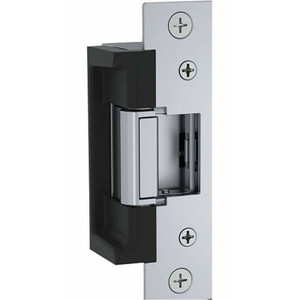
HES AES-200 Electric Door Strike with Real-Time Monitoring
The HES AES-200 is an electric door strike designed for access control systems requiring real-time engagement verification and integration with standard electromagnetic locking protocols. Operating on 12V or 24V DC, the AES-200 delivers electrical feedback confirmation of strike engagement and continuous monitoring capability, eliminating guesswork about whether a door unlock command succeeded. Suited for both new construction and retrofit installations, this strike fits the corner mount configuration common in commercial and institutional door frames.
Key Features
- 12V/24V DC operation: Dual-voltage design works with existing 12V and 24V control voltage infrastructure; no additional step-down transformer required.
- Real-time electrical feedback: Confirmation of strike engagement status sent back to the access control processor, enabling audit-trail logging of each unlock event.
- Visual engagement indicator: Physical confirmation that the strike bolt has released, reducing false-positive unlock reports from stuck door hardware.
- Remote operation ready: Integrates with standard access control readers and processors for centralized unlock command distribution.
- Electromagnetic protocol compatible: Works with legacy and modern electromagnetic locking system architectures without firmware changes.
- Compact corner mount form factor: 2.5 × 2.5 × 0.77 in footprint fits standard commercial door frame strike pockets in new and retrofit applications.
- Lightweight integration: 2 lb weight reduces installation load on door frame hardware.
The AES-200 eliminates the operational blind spot that comes with non-monitored electric strikes. On a typical office or institutional deployment, access control staff cannot tell whether a door unlock command actually disengaged the strike or if the bolt stuck due to frame misalignment, weather corrosion, or mechanical wear. Real-time electrical feedback closes that gap — every unlock event is confirmed or flagged. This is essential for compliance audits, incident investigation, and preventing the silent failures that lead to support calls and tenant complaints.
Installation is straightforward on both new construction and retrofit projects. The corner mount configuration aligns with standard commercial frame preparation, and the dual 12V/24V operation means the strike works with whatever control voltage is already running through the building. No additional power conditioning or relay modules are needed if your existing access control system already supports electromagnetic strikes. The monitoring output integrates directly with any access control processor that accepts electrical feedback from door hardware.
For facilities managing hundreds of controlled doors — office parks, educational institutions, healthcare campuses, data centers, and secure industrial sites — the AES-200's monitoring capability scales efficiently. A single networked access control panel can supervise strike status across the entire building without adding separate monitoring devices. Failed strikes are identified immediately, not hours later when a user reports they cannot enter. This reduces emergency calls to facilities teams and keeps access control staff focused on security rather than troubleshooting hardware.
The AES-200 meets standard requirements for electromagnetic door strike compatibility and integrates with industry-standard access control platforms. US-manufactured construction ensures consistent quality and availability through established distribution channels.
Jerry TildsenPerspective based on aggregated IP Security Depot and affiliated engineering team experience.
We've specified the HES AES-200 on roughly 40-50 mixed retrofit and new construction jobs over the past three years, and it remains one of the most bulletproof electric strikes in the standard-voltage category. The real differentiator is the monitoring feedback — it sounds like a small feature until you inherit a 200-door building where half the strikes have failed silently and nobody knows which ones. On a recent healthcare facility retrofit, we discovered three stalled strikes during final testing because the AES-200's electrical feedback caught them; a non-monitored strike would have shipped and sat broken for weeks. The dual 12V/24V operation is genuinely useful — we've rolled this into projects where control voltage was inconsistent across different system zones, and one strike type covers both. That reduces spare-parts overhead and integrator training. The corner mount is also a win for retrofit — fits directly into existing frame prep without rework. Trade-offs: the electrical feedback is binary (engaged/not engaged), not analog load-sensing — so you cannot detect a partially stuck bolt, only complete failure. Also, the AES-200 assumes your access control system already has monitoring input ports; if you're integrating into a legacy panel with no electrical feedback capability, you lose the primary benefit. Lastly, like all electric strikes, environmental sealing is limited — in salt-spray or high-humidity outdoor applications, you'll want to pair this with a sheltered strike enclosure.
Technical Highlights:
- Dual 12V/24V DC supply: Eliminates the need for separate strike SKUs or voltage conversion modules. A single product covers most commercial access control deployments.
- Electrical engagement feedback: Confirmation signal sent back to the access control processor at each unlock. Critical for audit trails and detecting hardware failure before tenants report locked doors.
- Visual feedback plus electrical confirmation: The combination of a tactile engagement indicator and electrical status report means integrators can troubleshoot via inspection (visual) or from the control room (electrical). Faster diagnostics, fewer truck rolls.
- Electromagnetic protocol native: No intermediate relay or signal converter needed if your reader/processor already outputs electromagnetic strike control signals. Plug-and-play integration into standard systems.
- Corner mount form factor: Matches the vast majority of commercial door frame strike pockets, reducing installation labor and frame modification.
Deployment Considerations:
- Verify that your access control processor has available monitoring input for electrical feedback. Older legacy panels may not expose feedback ports — check the wiring diagram before assuming the monitoring feature will be useful on retrofit projects.
- In retrofit installations, measure the actual strike pocket depth and width before ordering. While the AES-200 corner mount is standard, some older commercial frames have irregular pockets. A field fit check prevents costly rework.
- The electrical feedback is engagement confirmation only — it does not measure bolt extension or detect partial stalls. Pair with periodic visual inspection on high-traffic doors to catch mechanical wear early.
- In outdoor or high-humidity applications, mount the strike in a sheltered pocket or protective enclosure. The AES-200 is rated for interior/semi-protected environments; salt air and standing water will corrode the solenoid over time.
- Control voltage must be clean and stable. Use a dedicated 12V or 24V supply for the strike circuit, not shared general-purpose building power. Voltage sag from other loads can cause partial engagement and erratic feedback signals.
The AES-200 is the right choice for any commercial or institutional deployment where you need to know whether a door unlock command actually succeeded, and where the strike will be integrated into a modern access control system with electrical feedback capability. Retrofit projects, new office buildings, educational campuses, and secure facilities all benefit from the real-time status reporting and straightforward integration. Explore the complete HES catalog for complementary door hardware and access control solutions.