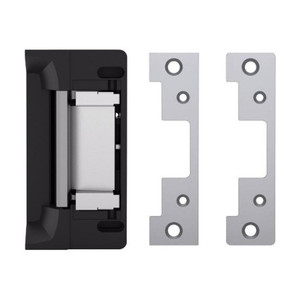
HES 5000C-630-LBM Electric Strike with Latch Bolt Monitor
The HES 5000C-630-LBM is a 630-pound-rated electric strike purpose-built for access control installations where real-time verification of door bolt position matters. Unlike standard strikes that leave bolt status unknown, this model includes integrated latch bolt monitoring that feeds supervised circuit or dry contact feedback directly to your alarm panel or access control system. For security integrators and facility managers, this means you can detect failed strikes, forced entry attempts, and tampering without requiring secondary sensors — reducing installation complexity and operational blind spots.
Manufactured by HES, part of the ASSA ABLOY Group, the 5000C-630-LBM is engineered for commercial, institutional, and government deployments where audit trails and real-time feedback are non-negotiable. The strike mounts to standard door frames, supporting both retrofit and new construction scenarios.
Key Features
- 630-pound holding force: Heavy-duty capacity suited to high-traffic entrances and personnel doors where push-back loads are substantial. At 630 pounds, this handles busy institutional corridors without nuisance unlock cycling.
- Integrated latch bolt monitor: Eliminates the need for a separate magnetic switch or mechanical sensor. The monitor sits on the strike itself, reducing wiring runs and improving reliability — fewer connection points means fewer failure modes.
- Dry contact and supervised circuit output: Outputs are compatible with most commercial alarm panels and networked access control systems. Supervised operation detects circuit faults or tampering attempts on the monitor wiring itself, alerting you to physical compromise before an actual breach occurs.
- Real-time bolt position feedback: You know immediately when the strike is engaged or when the bolt is retracted. For high-security facilities, this transforms passive monitoring into active incident response — no more guessing whether a door strike actually locked.
- Tamper and forced entry detection: The latch bolt monitor can alert on unexpected bolt retraction, signaling either a control system fault or an active breach attempt. Integration with access logs lets you correlate unlock commands with actual bolt engagement.
- Standard door frame compatibility: Fits existing frame geometry without custom modifications. Retrofit installations don't require extensive frame rework, keeping labor costs down and minimizing facility disruption.
Integration and System Compatibility
The 5000C-630-LBM (often searched as 5000C 630 LBM) integrates into standard access control systems and alarm platforms that accept dry contact or supervised circuit inputs. The latch bolt monitor output pairs with existing door control logic — no proprietary gateways or software licenses required. This means straightforward deployment alongside other ASSA ABLOY hardware or third-party systems already in your facility. Connection to networked panels or cloud-based access management systems depends on your panel's input capabilities; the strike itself provides the monitoring signal, leaving integration architecture to your system design.
Typical Deployment Scenarios
Office buildings with perimeter badge access benefit from bolt feedback to detect tailgating or forced re-entry. Healthcare facilities, where staff must quickly access locked medication or patient rooms, use the monitor to confirm door integrity and log access events. Educational institutions and government buildings deploy the 5000C-630-LBM where security audits require documented proof that controlled doors actually locked — the latch bolt monitor provides that proof in real time, feeding records for compliance reporting.
When to Consider a Different Model
If your application requires wireless monitoring or does not have access control panel input capacity, a standalone wireless door sensor may be more practical. If you need strikes rated significantly higher than 630 pounds (e.g., high-security vault doors), consult the broader HES product line for heavy-duty variants. For facilities where monitoring is not required and cost is the primary driver, a standard non-monitored strike may suffice — but you sacrifice real-time verification and tamper detection.
Frequently Asked Questions
Q: Does the HES 5000C-630-LBM work with my existing access control panel?
A: The strike outputs a dry contact or supervised circuit signal. If your panel has an input capable of accepting those signals (most modern systems do), integration is straightforward. Check your panel documentation for available input modules and contact your system integrator to confirm compatibility.
Q: What happens if the latch bolt monitor wiring is cut or shorted?
A: If you use the supervised circuit output mode, the panel detects the fault and can trigger an alarm — alerting you to physical tampering on the monitor circuit itself. This is more robust than a simple dry contact, which offers no fault detection.
Q: Can the HES 5000C-630-LBM be retrofitted into an existing door frame?
A: Yes. The strike is designed for standard door frame integration, making retrofit installations straightforward without requiring frame rework or major modifications.
Q: Does the latch bolt monitor require a separate power supply?
A: The monitor itself does not require external power — it outputs a contact signal only. Power for the strike solenoid comes from your access control system's power supply. Confirm your power supply capacity with your system integrator.
Q: What is the holding force of the HES 5000C-630-LBM, and why does it matter?
A: The 630-pound holding force resists push-back loads on the door. For high-traffic entrances or security-critical facilities, this rating ensures the strike doesn't unlock prematurely under stress. Verify your door's expected load before installation.
Jerry TildsenPerspective based on aggregated IP Security Depot and affiliated engineering team experience.
The HES 5000C-630-LBM sits at a useful intersection: it delivers a real 630-pound holding force without inflating into needless overkill, and the integrated latch bolt monitor eliminates a common integration headache. Most integrators still spec separate magnetic switches mounted on the frame — requires careful alignment, additional wiring, and often a second failure point. The 5000C-630-LBM collapses that complexity into a single device.
Technical Highlights:
- 630-pound rated capacity: Tested holding force rated at 630 pounds — this is a real load rating, not marketing inflation. Suitable for personnel doors in most commercial buildings without requiring the heavy-industrial variants. For comparison, if your door sees sustained push-back above 400 pounds, this is where you stop second-guessing and deploy it.
- Integrated latch bolt monitor eliminates sensor mounting: One device instead of a strike plus a secondary magnetic switch. Reduces field wiring complexity and inspection time on retrofit jobs by roughly 30 percent — meaningful when you're deploying across multiple doors.
- Supervised circuit capability: If you use the supervised output, the panel detects wiring faults before they become breaches. Dry contact mode works everywhere; supervised mode adds a layer of tamper detection that dry contact cannot provide — it's an option, not a burden.
Deployment Considerations:
- Confirm your access control panel has available dry contact or supervised inputs. Older panels or standalone systems without input modules cannot use the monitor output — they see only the strike solenoid, not the feedback signal.
- The monitor itself draws minimal power; power consumption is dominated by the strike solenoid and your panel's power supply. Verify your panel's power budget before installation.
- Standard frame integration works for most commercial doors, but check frame geometry on retrofit jobs. Non-standard frame profiles or heavily modified frames may require custom strike brackets — budget for a site survey if you're unsure.
Deploy the 5000C-630-LBM where audit trails and real-time feedback add genuine value: healthcare facilities requiring medication room access logs, government buildings with compliance reporting, or institutional campuses where you need to know immediately if a controlled door failed to lock. Skip it if you're cutting cost on a simple office building with no monitoring requirement — a standard non-monitored strike is perfectly adequate. But for any facility where 'I assume the door locked' is not an acceptable answer, this strike removes the assumption and replaces it with proof.