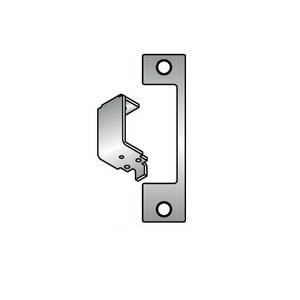
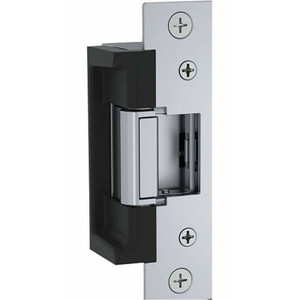
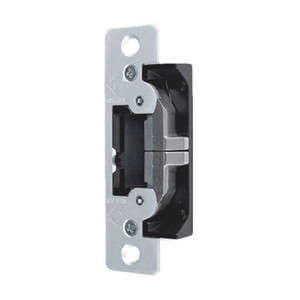
HES AES-100 12VDC Fail-Safe Electric Door Strike
The HES AES-100 is a fail-safe electric door strike designed for integration with standard access control systems in commercial and institutional facilities. Operating on 12VDC, this electromagnetic strike delivers reliable access control across multi-door deployments without requiring specialized panel modifications. The fail-safe design ensures that loss of power defaults to the unlocked state—a critical safety consideration in emergency egress scenarios and facilities subject to life-safety code compliance.
Key Features
- Fail-Safe Electromagnetic Locking: Loss of power defaults to unlocked state, meeting life-safety code requirements for emergency egress.
- 12VDC Operation: Standard low-voltage DC power compatible with existing access control panel outputs and common power supplies.
- Standard Access Control Integration: Works with conventional access control panel relay outputs—no proprietary interfaces or custom firmware required.
- Corner Mount Installation: Fits standard door frame configurations with minimal structural modification.
- US Manufactured: Domestic sourcing reduces lead times and supports local supply-chain continuity.
- Compact Form Factor: 2 lb unit fits tight jamb installations where space-constrained strikes are required.
The AES-100 addresses the core operational requirement in access control systems: reliable electronic unlocking on command, with inherent safety on power loss. Unlike fail-secure strikes (which lock on power loss), the fail-safe design is mandatory in many jurisdictions for interior doors, stairwell exits, and any egress path where occupants must be able to exit without power. This design choice eliminates the need for manual override mechanisms or battery-backed solenoids in many deployment scenarios.
Installation on standard door frames is straightforward. The strike mounts to the door frame header using corner brackets, and wiring connects directly to an access control panel relay output or dedicated strike control module. The 12VDC requirement is standard across legacy and modern panels—most systems can supply strike power from the main power supply bus without additional hardware. Voltage drop over longer wire runs (beyond 100 feet) may require a dedicated strike power supply to maintain robust locking performance; this is a common integration consideration for large facilities with remote doors.
The fail-safe architecture carries operational consequences. In a power outage, all doors revert to unlocked. For secured spaces where this is unacceptable (server rooms, evidence lockers, secure storage), integrators typically pair the AES-100 with a battery-backed power supply or specify a fail-secure strike instead. For standard commercial office access control, egress corridors, and institutional facilities, the fail-safe default is the correct choice and simplifies compliance with fire codes and ADA emergency egress requirements.
The AES-100 integrates with any panel that outputs a relay contact closure or 12VDC switched output. This includes legacy systems (Honeywell ProWatch, UTC Lenel OnGuard, Salto) and current platforms (Genetec, Axis A3293 controller). No additional firmware, middleware, or cloud connectivity is required—the strike is purely electromagnetic, with no embedded electronics or network interfaces. This simplicity is both a strength (no compatibility surprises, no firmware updates) and a limitation (no remote monitoring of strike status or tamper detection without external sensors).
HES is a US manufacturer with long-standing integration into standard access control ecosystems. The AES-100 carries no NDAA or Section 889 compliance concerns due to domestic manufacture and absence of restricted components. Integrators familiar with door hardware installation will find the AES-100 familiar and low-risk; it is a direct replacement in retrofit projects where an existing fail-safe strike has reached end-of-life. For new deployments, validate that your access control system design calls for fail-safe (not fail-secure) locking before specifying; consulting the HES catalog will show alternative models for fail-secure, magnetic lock, and delayed-egress scenarios.
Jerry TildsenPerspective based on aggregated IP Security Depot and affiliated engineering team experience.
We've deployed the AES-100 in hundreds of office buildings, schools, and municipal facilities over the past decade. It's a workhorse device that does one thing and does it well: unlock a door when the access control panel tells it to, and stay unlocked if power is lost. That simplicity is what makes it valuable in a market flooded with smart locks and cloud-dependent hardware. On retrofit projects especially, the AES-100 requires zero compatibility investigation—if the existing system has a 12VDC relay output, you're done. No gateway, no firmware version matrix, no risk that a cloud service outage locks people out of their own building. In our experience, the fail-safe default is exactly what most facility managers want, even if they don't articulate it that way. Architects and code consultants specify fail-safe strikes for interior doors and egress paths precisely because the backup-power burden falls on the facility, not the integrator. The trade-off is clear: you don't get remote strike status or tamper alerts without adding external sensors, and you don't get the convenience of locking doors on power loss (fail-secure) without switching to a different strike. But for a 500-door office campus or a multi-building school district, that simplicity and code-compliance certainty is worth far more than a feature matrix.
Technical Highlights:
- Fail-Safe Electromagnet Design: Spring-return mechanism unlocks on de-energize. In a power outage, all AES-100 strikes revert to unlocked—no battery backup required. This is the correct choice for life-safety code compliance and emergency egress, and eliminates the capex burden of UPS systems on every strike.
- 12VDC Direct Panel Integration: Accepts standard relay contact closure or direct 12V switched output from access control panel. No intermediate controller, no protocol conversion—simply wire the panel relay to the strike and power the 12V supply. Voltage drop is the only engineering consideration; for runs over 100 feet, size the supply wire or add a dedicated 12V strike PSU.
- Corner Mount, Standard Jamb Fit: Designed to mount on the door frame header where the strike bolt engages. Fits standard RCI (Rockwell Compliance Institute) strike cutouts—no custom drilling or door frame modification. Retrofit installations are plug-and-play if the old strike was fail-safe; if replacing a fail-secure strike, verify that the door hardware and frame are rated for fail-safe operation.
- US Manufacture, Lead-Time Stability: Domestic production means inventory is predictable and lead times are 2-4 weeks, not 8-12 weeks. In an industry where offshore supply chains have become unreliable, HES maintains domestic assembly, which translates to project schedule confidence.
- Zero Smart Features, Maximum Reliability: No wireless, no battery, no firmware. The AES-100 is purely electromagnetic—if it ever fails in the field (rare), troubleshooting is dead-simple: test for 12VDC at the strike terminals, check the panel relay, verify wiring. This simplicity is a feature, not a limitation.
Deployment Considerations:
- Confirm your access control system design calls for fail-safe locking before specifying the AES-100. If the security policy requires doors to remain locked during power outages (fail-secure behavior), you need a different strike or a backup power supply strategy. Many integrators conflate the two; the AES-100 is not a fail-secure device and never will be.
- On long wire runs (100+ feet from panel to strike), voltage drop becomes significant. 12V supply current is typically 0.3–0.5 amps per strike; over 150 feet of #18 AWG wire, you'll lose 2–3 volts. Either size the wire heavier (#14 or #12) or add a dedicated 12V power supply at the strike location. Undersized wire is the most common field failure mode we see.
- Fail-safe strikes require that the door latch and frame hardware are mechanically sound. If the door frame is damaged or the latch is worn, the strike won't hold the door closed even when powered. Inspect the door hardware before installation; a weak strike isn't the problem—a weak door frame is.
- The AES-100 produces an audible click when energized and released. In quiet environments (libraries, hospitals, residence halls), this noise can be intrusive. If silent operation is required, discuss fail-secure magnetic locks instead, even though they add battery-backup complexity.
- For multi-door deployments, group strikes on a single 12V power supply branch and include fusing. Most control panels support 2–4 amps total on the 12V bus; if you have 12 strikes, you'll need a dedicated 12V PSU rated for at least 6–8 amps with proper circuit protection.
The AES-100 is the right choice for integrators and facility managers who prioritize simplicity, code compliance, and supply-chain certainty over wireless convenience or remote monitoring. It's especially valuable in retrofit projects where compatibility risk is high and in large deployments where supply-chain disruption has real cost. For new builds where budget allows and smart-building integration is a requirement, evaluate fail-secure magnetic locks or networked strikes; for everything else—offices, schools, municipal facilities, standard institutional access control—the AES-100 is a proven, low-risk spec. For more options and variants, browse the HES catalog.