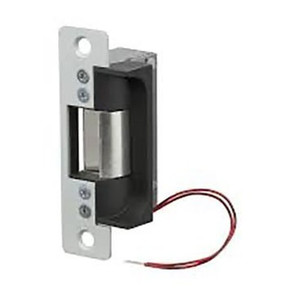
HES 7140-310-628-00 12VDC Direct-Release Strike
The HES 7140-310-628-00 is a 12VDC direct-release electric strike engineered for electromagnetic access control systems. This unit integrates into door lock assemblies to provide remote electric release functionality, supporting both fail-safe and fail-secure configurations depending on your security posture and power loss requirements. It is widely deployed across commercial office buildings, educational institutions, healthcare facilities, government installations, and multi-tenant residential properties requiring centralized access control and enhanced security management.
Key Features
- 12VDC Power Supply: Operates on standard 12VDC, compatible with existing access control infrastructure and power supplies — no exotic voltage requirements that would complicate wiring or require additional equipment.
- Direct-Release Design: Provides immediate electromagnetic response to access control commands, ensuring doors unlock promptly when authorized signals are sent from your access control system.
- Fail-Safe or Fail-Secure Configuration: The strike can be configured for either mode depending on your facility security policy — fail-safe releases the door on power loss (emergency egress scenario), while fail-secure keeps the door locked on power loss (high-security scenario). Your access control system logic determines which mode applies.
- Robust Electromagnetic Construction: Delivers consistent holding force and rapid release cycles, critical in high-traffic commercial environments where door operation is continuous and reliability is non-negotiable.
- Standard Form Factor: Fits industry-standard door frame geometry, enabling straightforward installation without custom fabrication or unusual mounting requirements.
- Multi-Door Scalability: Supports both single-door and multi-door access control deployments, making it suitable for entry-point control in small offices or distributed across large facility perimeters.
Integration and Deployment Considerations
Proper installation of the 7140-310-628-00 requires adequate electrical wiring routed from your access control power supply to the strike location, appropriate power management infrastructure (ensuring the power supply has sufficient amperage headroom for all strikes in your system), and correct integration with your access control system logic. The strike's fail-safe/fail-secure behavior is determined by how your access control system is wired and configured — this is not a hardware setting, but a system-level design choice that must align with your facility's security policy and fire code requirements.
Consult with your access control system integrator or the system manufacturer to verify correct wiring, voltage specifications, power budget calculations, and fail-safe/fail-secure configuration before installation. Improper wiring or configuration can result in doors remaining locked during an emergency or unlocking unexpectedly during a power event — both create safety and liability risks.
The HES 7140-310-628-00 (often searched as 7140 310 628 00) integrates with standard electromagnetic access control panels and readers from major vendors in the field, provided your system supports 12VDC strike outputs.
When to Choose a Different Model
If you require specialized environmental protection (outdoor weathering, corrosive atmospheres), a heavier-duty holding force for high-security applications, or integration with alternative power schemes (24VDC), consider evaluating other models within the HES electric strike family. Consult the electric strikes category or speak with your system integrator to identify the right variant for your facility's specific security and environmental requirements.
Frequently Asked Questions
Q: Can the HES 7140-310-628-00 be configured for fail-safe release?
A: Yes. The strike supports both fail-safe and fail-secure modes depending on how your access control system wires and energizes the unit. In fail-safe mode, the door unlocks when power is removed, allowing occupants to exit during an emergency or power outage. In fail-secure mode, the door remains locked if power is lost. Your access control integrator determines which mode your facility requires based on security policy and fire code.
Q: What power supply amperage does the 7140-310-628-00 require?
A: The strike is a 12VDC device, but the exact current draw is not specified in available documentation. Work with your access control system provider or integrator to verify the total amperage budget of your power supply when adding strikes — multiple strikes on a single supply can exceed power budget if not calculated correctly.
Q: Does the HES 7140-310-628-00 work with standard door frames?
A: Yes. The strike uses standard form factor geometry compatible with typical commercial door frame preparations. However, installation must be performed by a qualified integrator to ensure proper alignment, strike-keeper compatibility, and electrical integration.
Q: Is the 7140-310-628-00 suitable for outdoor use?
A: No. This strike is engineered for standard indoor environments. If you require outdoor weathering protection or corrosion resistance, consult with your integrator about alternative models in the HES lineup designed for exterior applications.
Q: What happens if the access control system fails?
A: This depends on your fail-safe/fail-secure configuration. If configured fail-safe, the door unlocks (permitting emergency exit). If configured fail-secure, the door remains locked. This is a critical design decision that must be made during system commissioning — consult your integrator and local fire code before installation.
Ted PerryPerspective based on aggregated IP Security Depot and affiliated engineering team experience.
The HES 7140-310-628-00 is a straightforward, purpose-built component for indoor access control systems — no overengineering, no unnecessary features. The 12VDC specification is the industry standard for distributed electric strike installations, and that's exactly why you'll find this model in thousands of commercial deployments. What matters most here is correct system design and wiring discipline.
Technical Highlights:
- Direct-Release Electromagnetic Design: The strike responds immediately to access control commands, eliminating mechanical delay and ensuring deterministic door operation. This matters in high-traffic environments where occupants expect immediate feedback.
- Fail-Safe/Fail-Secure Flexibility: Configuration is system-level, not hardware-level. You can deploy the same strike in an emergency egress scenario (fail-safe, unlock on power loss) or a high-security perimeter door (fail-secure, lock on power loss). That flexibility is valuable if your facility has mixed security zones.
- Standard 12VDC Infrastructure Compatibility: No need for exotic power schemes. Most commercial access control power supplies already output 12VDC with sufficient amperage for distributed strikes. This reduces design complexity and cost.
Deployment Considerations:
- Power budget is critical when scaling across multiple doors. A single power supply driving 8–10 strikes can easily exceed amperage capacity if you don't calculate overhead. Build a power budget spreadsheet before commissioning.
- Fail-safe/fail-secure configuration is not a hardware setting — it's a system wiring decision. Get this wrong during installation and you've either got doors that won't open in a fire or doors that unlock on every power hiccup. Have your integrator and facilities team sign off on this choice before commissioning.
- Strike-keeper alignment and door frame preparation are installation-critical. Misaligned strikes will cause binding, audible grinding, and premature failure. Use a template and verify geometry before final mounting.
Deploy the 7140-310-628-00 in commercial office buildings, educational campuses, and multi-tenant properties where access control reliability is required but environmental extremes aren't a factor. It's the right choice when you need proven, standard-issue hardware and your integrator is experienced enough to handle the system-level design correctly.