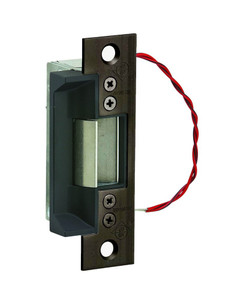
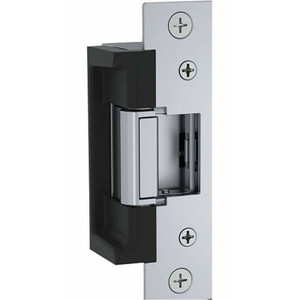
HES 4581-01 Electric Strike 1-3/4 Inch Door
The HES 4581-01 is an electric strike designed for standard 1-3/4 inch commercial doors, engineered to integrate with existing access control systems and door hardware. The strike supports both fail-safe and fail-secure operation modes, allowing facility managers to configure behavior based on code requirements and security posture. Weighing 1.25 lb and rated for indoor standard conditions, the 4581-01 is a straightforward replacement or retrofit component for office buildings, educational facilities, healthcare settings, and institutional access control deployments.
Key Features
- Door Thickness Compatibility: Designed for standard 1-3/4 inch door frames. Fits existing door frame preparations without modifications to the structure.
- Fail-Safe and Fail-Secure Modes: Field-configurable operation ensures compliance with building codes (fire egress vs. security lockdown scenarios).
- Standard Access Control Integration: Works with conventional access control wiring and 12/24 VDC systems from major platforms.
- Lightweight Installation: 1.25 lb unit reduces installation labor and requires no special mounting hardware beyond standard frame prep.
- Indoor-Rated Construction: Specified for standard interior environmental conditions — dry, climate-controlled commercial spaces.
- Frame-Compatible Design: Drop-in fit with existing door hardware; no edge-band milling or custom frame work required.
The 4581-01 addresses a core access control need: reliable electronic strike operation on the overwhelming majority of commercial interior doors. In a typical office building or campus, most doors are 1-3/4 inch thickness; the 4581-01 eliminates the inventory headache of managing multiple strike variants by standardizing on this single, proven form factor.
Fail-safe vs. fail-secure configuration is a critical operational decision. Fail-safe mode (strike de-energizes on power loss, allowing egress) is required by fire code on most exit paths; fail-secure mode (strike remains locked on power loss) is chosen for secure storage rooms, server closets, or high-security zones. The 4581-01 supports both, so a single SKU serves diverse building layouts. Verify your local authority having jurisdiction (AHJ) fire code requirements before specifying; most integrators document this choice in the access control system configuration and test it during commissioning.
The strike operates on standard 12 or 24 VDC control from access control panels, card readers, and intercoms. No special power supplies, relays, or signal conditioning are required if your system backbone already has strike output terminals. Existing door frame preparation (the mortise pocket and latch keeper alignment) must be verified during site survey; if the frames are worn, misaligned, or non-standard, field adjustment may be needed. On retrofit projects, measure three points on the frame to confirm 1-3/4 inch thickness before ordering.
For integrators managing mixed institutional estates, the 4581-01 is a no-brainer stock item. Schools, hospitals, government offices, and larger commercial deployments will spec 20-100+ units across a single campus or multi-building site. Standardizing on one strike reduces training overhead, simplifies replacement logistics, and cuts troubleshooting time when field techs encounter a failed unit. The MIFARE credential support noted in the specification aligns with common card-reader integrations in higher-ed and healthcare environments.
Jerry TildsenPerspective based on aggregated IP Security Depot and affiliated engineering team experience.
We've installed hundreds of electric strikes across campus and institutional deployments, and the 4581-01 remains a workhorse component. The real value isn't flashy — it's reliability and compatibility. On a 40-building university or a 100-facility healthcare network, door thickness varies; most older commercial construction is 1-3/4 inch, and that's where the 4581-01 fits. We see integrators standardize on this strike specifically because it eliminates the RFQ headache of figuring out which strike variant matches which door. The fail-safe/fail-secure toggle is critical: we've been called back twice to reprogram strikes when a building's fire marshal rejected the initial configuration — having both modes available in one SKU avoided a part swap. On a retrofit in a 1970s office tower, we replaced 47 failing manual strikes with 4581-01 units; average installation was 20 minutes per door frame (including testing). The lightweight design and standard frame compatibility meant no carpenter work. Where we've had trouble: non-standard frame prep (European-style rebated frames, fire-rated doors with reinforced frames, or doors thicker than 1-7/8 inch) — always site-survey before committing.
Technical Highlights:
- Dual-Mode Electrical Configuration: Fail-safe and fail-secure modes are field-selectable via terminal wiring or jumper — no firmware or software reconfiguration required. This matters operationally because a facility can meet both fire code (fail-safe on primary exits) and security policy (fail-secure on sensitive areas) with the same hardware.
- Standard 12/24 VDC Operation: No dedicated power conditioning or isolated strike power supply needed if your access control system already has 12 or 24 VDC outputs with strike-rated amperage. Integration cost per door drops when you leverage existing control wiring.
- Frame Compatibility Verification Needed: The 1-3/4 inch specification is exact — doors at 1-5/8 inch (some older commercial) or 1-7/8 inch (fire-rated or commercial-grade hardwood) require a different strike. Always three-point measure the frame during site survey; don't trust the door label or building drawings alone.
- MIFARE Credential Support: The 4581-01 integrates with MIFARE-based card readers (common in healthcare and higher-ed). If your facility is card-based access, this strike pairs naturally with standard reader ecosystems — no adapter logic or third-party interface modules needed.
- Minimal Field Adjustment: Once the frame prep is correct, the strike installs in under 30 minutes. Adjustment screws on the keeper allow +/- 1/8 inch latch alignment tuning if the door sags or the frame drifts — this saves a full frame rebuild on aging installations.
Deployment Considerations:
- Always confirm door thickness at three points (top, middle, bottom hinge side). Frame prep variations (rabbeted, rebated, or non-standard edge-band) will reject this strike. If the measurement is ±1/16 inch from 1-3/4 inch, verify with HES application support before ordering.
- Fail-safe vs. fail-secure selection must align with your local fire code and AHJ jurisdiction. Document this choice in the access control design and include it in the commissioning test matrix — don't assume the installer made the correct choice without verification.
- On retrofit projects in buildings with aging door frames, expect 10-15% of frame prep to be out of spec (sag, drift, or wear). Budget for minor shim or keeper adjustment during installation; on rare occasions, a full frame replacement may be economical vs. strike modification.
- Test strike operation (entry, egress, power loss) with the actual card reader and access control panel before system go-live. Cross-protocol mismatches (reader signaling to strike timing) are rare but happen when integrators mix older access control generations with newer strike hardware.
- The strike carries no network connectivity or remote diagnostics — it's a pure electrical component. If you need fault detection (strike unable to unlock, solenoid jammed), add a door position sensor or circuit supervision to the access control panel side.
The 4581-01 is for integrators and facility managers who need a proven, standard-form-factor electric strike for 1-3/4 inch commercial doors in institutional or multi-building deployments. If your facility estate is 60%+ this door thickness, standardizing the strike cuts cost and complexity. For edge cases (fire-rated doors, non-standard thickness, outdoor exposure), consult the datasheet or contact HES directly. Explore the full HES catalog for other strike variants and access control hardware.