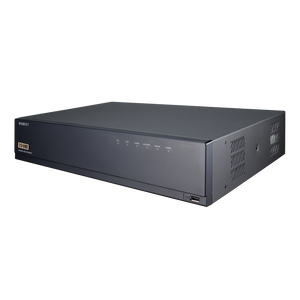
Hanwha XRN-1620SB1 16-Channel 4K PoE+ Network Video Recorder
The Hanwha XRN-1620SB1 is a 16-channel network video recorder designed for mid-to-large surveillance deployments where integrated power delivery and 4K recording matter. Unlike traditional NVRs that require separate AC power distribution, the XRN-1620SB1 delivers power to cameras via PoE+, consolidating network and power infrastructure into a single cable run—reducing installation labor and eliminating the need for dedicated power closet space at each recording site. The system operates at 140 Mbps throughput and supports camera resolutions up to 32 megapixels across all 16 channels simultaneously, meaning you can deploy a mix of 4K, 8MP, and 12MP cameras on the same recorder without bottlenecking.
Key Features
- 16-channel 4K recording with 32MP camera support: All 16 channels can record 4K (8MP) video at full frame rate; the system also accepts 12MP, 8MP, and lower-resolution feeds without codec conversion overhead. This flexibility lets you deploy higher-resolution cameras in critical zones (entry, high-value areas) and standard 4K cameras elsewhere without rework.
- PoE+ power delivery eliminates separate AC infrastructure: Every connected camera draws power from the NVR's PoE+ ports, removing the need to run 120V lines to remote mount points. This is especially valuable in retrofits where AC availability is limited or expensive to add. Standard PoE+ can deliver up to 30W per port, sufficient for most 4K and lower-resolution models in the Hanwha IP camera line.
- 140 Mbps aggregate network throughput: This bandwidth budget means real-time recording across all 16 channels at 4K resolution with H.265 compression; if you use H.264 or MJPEG, you'll need to lower frame rates or resolution on some channels to stay within budget. Plan codec and frame-rate settings during initial deployment to avoid surprises.
- H.265, H.264, and MJPEG codec support: H.265 compresses 4K footage roughly 40–50% better than H.264, cutting storage costs meaningfully when recording 24/7. H.264 remains the fallback for older camera ecosystems or when you need broad vendor compatibility. MJPEG is rarely the best choice but is available for specialized streaming scenarios.
- Quad internal drive bays with up to 24TB aggregate storage: Four 6TB HDDs (or equivalent) give you roughly 8–12 days of 24/7 4K recording per camera at medium compression, depending on scene complexity and frame rate. For longer retention, add external storage or implement tiered archiving to an attached NAS.
- Wisenet AI metadata search: Instead of scrubbing timelines manually, the recorder indexes people, vehicles, and objects detected in video. You can search for "all vehicle entries between 9 PM and 6 AM" rather than watching six hours of footage—a real time saver for investigators. This feature requires compatible camera models that generate the metadata.
- WiseStream bandwidth optimization: Automatically adjusts compression and frame rate in low-motion zones (empty hallways, parked vehicles) while maintaining detail in active areas. In mixed-activity environments, this can reduce bandwidth consumption 20–40% compared to fixed bitrate recording without visible quality loss.
- Dual HDMI and VGA display outputs: Run live view on one monitor and timeline/playback on another simultaneously, a practical setup for 24/7 security operations centers. Both outputs are independent, so you can set different resolutions or refresh rates per monitor.
- N+1 failover redundancy and Automatic Recovery Backup (ARB): If the primary recorder fails, a secondary unit takes over automatically; ARB backs up critical footage to a secondary storage path in real time. This requires a second identical NVR and careful network configuration—not a casual feature.
- Dynamic event management and real-time alerting: Configure rules (motion, object detection, audio) to trigger notifications, relay outputs, or automatic recording mode switches. Useful for reducing false positives by filtering alerts server-side rather than at the camera.
Integration and Compatibility
The XRN-1620SB1 accepts input from any ONVIF-compliant IP camera, but performance and metadata features (Wisenet AI, WiseStream) are optimized for cameras in the Hanwha IP camera portfolio. The recorder also integrates with most third-party network video recorder management platforms via ONVIF Profile S/T support, though full feature access (AI search, event rules) may require Hanwha's native VMS or a compatible third-party platform.
Network design matters: the 140 Mbps throughput includes both recording and remote viewing, so plan your switch and WAN uplink accordingly if you need simultaneous playback or multi-site monitoring. A managed PoE switch with QoS support is strongly recommended to prioritize recording traffic over administrative traffic during peak hours.
Deployment Scenarios
The XRN-1620SB1 fits retail chains, office complexes, distribution centers, and industrial facilities where centralized monitoring and extended retention are required. Retail deployments benefit from AI metadata search to investigate shrinkage or transaction disputes quickly. Office environments value the dual-monitor setup for security operations and the PoE+ architecture for low-cost retrofit cabling. Warehouse automation sites appreciate the 24TB storage capacity paired with H.265 codec support for round-the-clock recording of dock areas, racks, and conveyor lines without constant storage management headaches.
Frequently Asked Questions
Q: Can the XRN-1620SB1 record more than 16 channels if I add external cameras?
A: No. The system is a fixed 16-channel recorder. You cannot expand channel count via firmware or accessory modules. If you need more channels, you would provision a second NVR or select a higher-channel-count model from the Hanwha NVR family.
Q: Does the XRN-1620SB1 support remote viewing over the internet?
A: Yes, via ONVIF streaming and native Hanwha mobile/desktop clients. However, remote bandwidth depends on your WAN uplink and compression settings. At 140 Mbps total throughput, simultaneous remote playback of multiple channels will share bandwidth with live recording—plan your network accordingly, and consider a higher-capacity internet circuit if you require frequent multi-user playback.
Q: What's the storage retention period on the XRN-1620SB1?
A: With 24TB max storage and H.265 compression, expect 8–12 days of continuous 4K recording across all 16 channels at typical bitrates. Actual retention depends on scene complexity (high-motion areas compress less), frame rate (30 fps vs. 15 fps), and resolution. Use the manufacturer's bitrate calculator or a capacity planning tool during design to match your retention requirement.
Q: Does the XRN-1620SB1 require a separate management console or VMS?
A: No. The recorder can operate standalone with local or remote playback via browser or Hanwha client software. A third-party VMS (Milestone, Genetec, etc.) is optional and allows multi-site management, but it's not required for basic recording and retrieval.
Q: Is failover redundancy (N+1) included, or is it an optional add-on?
A: Failover support is built into the firmware, but you must purchase a second XRN-1620SB1 unit and configure it explicitly. ARB (Automatic Recovery Backup) also requires a secondary storage path and careful network planning. This is not a plug-and-play feature—work with an integrator to design the failover topology correctly.
Q: Can I mix different camera resolutions and frame rates on a single XRN-1620SB1?
A: Yes. The recorder accepts simultaneous input from 32MP, 12MP, 8MP, and lower-resolution cameras without re-encoding. However, your total bandwidth consumption across all 16 channels cannot exceed 140 Mbps, so mixing high-frame-rate 4K with lower-resolution feeds requires careful planning to avoid bottlenecks during peak activity.
Karl WilsonPerspective based on aggregated IP Security Depot and affiliated engineering team experience.
The XRN-1620SB1 solves a real infrastructure problem: centralized 4K recording without sprawling AC power runs. If you're retrofitting an older facility or deploying surveillance to a campus where power is scarce, the integrated PoE+ architecture is a genuine differentiator. The 140 Mbps throughput is tight on a full 16-channel 4K deployment, but with H.265 codec enforcement and frame-rate discipline, it's manageable for most retail and office use cases. Where this NVR earns its place is the Wisenet AI metadata indexing—the ability to search video by object type rather than timeline transforms a six-hour investigation into a ten-minute task.
Technical Highlights:
- H.265 codec efficiency: Compresses 4K footage 40–50% better than H.264, translating directly to longer retention within the 24TB storage ceiling. On a 24/7 16-channel recorder, this difference means 8–12 days of retention instead of 4–6 days using older compression—meaningful for forensic investigation windows.
- 24TB quad-bay architecture: Four internal drive slots eliminate external NAS dependency for most deployments. Each 6TB bay can be populated independently, allowing phased upgrades and hot-swap replacement without total system shutdown.
- Wisenet AI metadata indexing: Presupposes compatible camera hardware (most current Hanwha models support it), but when deployed together, the metadata search feature cuts investigation time by 80–90% versus manual scrubbing. This is where the platform earns ROI in high-security or loss-prevention environments.
- Dual monitor outputs (HDMI + VGA): Practical for 24/7 SOC setups where split-screen (live + timeline) operation is standard. Both outputs refresh independently, so you're not locked into matching resolutions or refresh rates.
Deployment Considerations:
- Bandwidth math is non-negotiable: At 140 Mbps total throughput, a mixed deployment of four 4K 30fps cameras, six 4K 15fps cameras, and six 1080p 30fps feeds will consume roughly 100–120 Mbps, leaving little headroom for remote playback or spike transcoding. Run a capacity calculator before commit; bitrate surprises are expensive fixes in production.
- H.265 codec requires camera alignment: Older Hanwha models or third-party ONVIF cameras may default to H.264. The recorder will accept and re-encode H.264 streams on the fly, but this burns CPU and negates codec efficiency gains. Pre-stage camera firmware updates to ensure H.265 encoding at the source.
- PoE+ power budget: Each port delivers up to 30W; a full 16-port deployment can serve cameras drawing 15–25W comfortably, but high-end PTZs or pan-tilt-zoom units with heaters may require inline power injectors. Verify camera power specs against NVR port budget during system design.
- N+1 redundancy requires deliberate setup: Failover is not automatic out of the box—you must buy a second NVR, configure ARB (Automatic Recovery Backup) targets, and test failover before relying on it. Many integrators skip this step; don't. If uptime is contractual, build redundancy into the scope.
The XRN-1620SB1 is strongest in retail chains, office parks, and industrial facilities where PoE+ infrastructure simplifies installation and H.265 codec efficiency extends storage life without capital expense. Avoid it if you need more than 16 channels or require real-time failover transparency (you'll need a load balancer or secondary VMS).