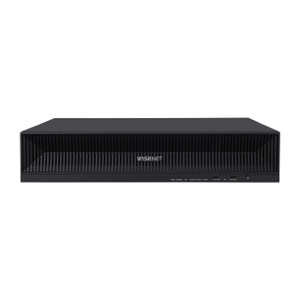
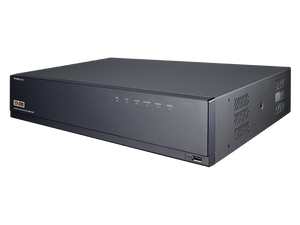
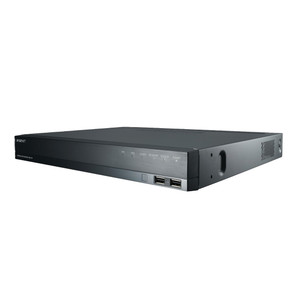
Hanwha XRN-1620SB1-4TB 16-Channel 32MP Network Video Recorder
The Hanwha XRN-1620SB1-4TB is an Intel-based network video recorder built for mid-to-large surveillance deployments where mixed-resolution camera ecosystems and integrated power delivery are non-negotiable. This unit handles up to 32 megapixel camera feeds across all 16 channels simultaneously—critical when you're running both legacy 1080p cameras and new ultra-high-resolution megapixel sensors on the same infrastructure without replacing everything at once. The 140 Mbps recording bandwidth sustains continuous multi-stream capture without frame dropping, a real operational requirement in facilities where coverage gaps create compliance or security exposure.
Key Features
- 16-channel simultaneous IP camera input with CIF-to-32MP resolution support: You can retire cameras incrementally as wear-out cycles hit, not all at once. This translates to budget flexibility—a 4MP sensor in an aisle records at its native rate while a PTZ dome over a loading bay pushes 20MP simultaneously. No resolution restrictions per channel, no cascading or multiplexing overhead.
- 140 Mbps multi-stream recording bandwidth: This throughput ceiling ensures synchronized capture across all 16 ports even when cameras deliver high-bitrate H.265 streams. Drop below this and you'll throttle frame rate or resolution on some channels—unacceptable in loss-critical environments like warehouses, retail, or transit hubs where blind spots create liability.
- H.265 HEVC, H.264, and MJPEG compression: H.265 delivers 40–50% storage efficiency gains versus H.264 depending on scene complexity and motion. On a 24/7 recorder, that margin directly extends retention periods or reduces hard-drive refresh cycles. When storage is often the second-largest operational cost after power in multi-year deployments, codec efficiency matters in the budget line.
- Integrated 200W PoE+ (802.3at) power delivery across all 16 ports: All 16 ports source power—no external injectors, no separate 48VDC supplies, no daisy-chained PoE switches needed. One cable per camera: IP connectivity and power together. This consolidation cuts installation labor, reduces failure points, and supports high-power devices like PTZ cameras or edge-compute appliances. Standard 802.3af supplies roughly 13W per port; this unit handles loads that would starve on standard PoE.
- 4TB factory-installed storage, expandable to 24TB via internal SATA: The unit ships with one 4TB SATA HDD pre-installed. Four additional 6TB SATA HDD slots let you scale to 24TB internal capacity without external NAS complexity. For a 16-channel 24/7 operation at mixed resolution, that supports 30–60 day retention depending on motion density and codec efficiency. Expansion is internal—upgrade at commissioning or add capacity later without forklift replacement.
- Intel processor-based architecture: Reliable, predictable performance under sustained loads. Intel platform means mature driver ecosystems, broad VMS compatibility via ONVIF, and vendor-neutral software stacks. You're not locked into proprietary operating systems or analytics frameworks—integration with network video recorders management platforms is straightforward.
Integration and Deployment Context
The XRN-1620SB1-4TB is a natural fit when you need to consolidate IP camera infrastructure with integrated power management. Typical deployments include enterprise campuses transitioning from analog to IP while preserving existing UPS and power conditioning—this recorder's PoE architecture eliminates added power distribution overhead. Retail and distribution centers benefit from mixed-resolution capability: PTZ domes over loading bays record at high bitrate; fixed 4MP sensors in aisles record at lower rates, all synchronized. The unit's Intel foundation ensures compatibility with industry-standard VMS platforms using ONVIF (Milestone XProtect, Genetec, open-standard deployments), so integration is straightforward regardless of your software stack.
For facilities already invested in Hanwha IP cameras, this recorder optimizes the full ecosystem. However, compatibility is not exclusive—the XRN-1620SB1-4TB accepts any ONVIF-compliant IP camera, giving you flexibility to mix vendors based on application needs rather than infrastructure lock-in. If you're planning the power and network architecture, review your network switch PoE budget: while the recorder supplies 200W to connected cameras, the uplink switch must support the aggregate traffic (140 Mbps sustained across 16 channels at mixed resolution is manageable on modern Gigabit infrastructure, but validate your backbone).
When to Choose a Different Model
If your deployment is small (fewer than 8 channels) or you already have external PoE infrastructure in place, a lower-channel-count recorder may reduce capex. If you need more than 16 channels or require built-in analytics acceleration (AI object detection, face recognition, or VCA at the recorder level), consider higher-channel variants in the Hanwha XRN family. For deployments requiring cold storage or archive-level retention (120+ days), evaluate external NAS integration rather than relying on internal HDD scaling.
Frequently Asked Questions
Q: Does the XRN-1620SB1-4TB support ONVIF cameras from other manufacturers?
A: Yes. The unit accepts any ONVIF-compliant IP camera. You're not locked into Hanwha cameras—mix vendors based on application requirements (e.g., Axis PTZs, Hikvision fixed domes, Vivotek fisheyes) as long as they comply with ONVIF Profile S or G.
Q: Can I upgrade the storage after installation?
A: Yes. The unit ships with 4TB installed and has four additional internal SATA slots. You can add up to four 6TB drives (24TB total) without opening the network or replacing the recorder. Hot-swapping depends on your operating system configuration—consult the documentation for safe expansion procedures.
Q: What's the typical retention period for 16 cameras at 4MP resolution?
A: Retention is driven by bitrate, motion, and codec efficiency. At H.265 with moderate motion (30% scene change), expect 30–45 days on the standard 4TB configuration. Expanding to 24TB internal storage extends this to 180–270 days under similar conditions. Your actual retention depends on camera frame rate, resolution, and scene complexity—test with a pilot deployment to nail the numbers.
Q: Is the PoE power supply redundant or failover-capable?
A: The 200W integrated PoE supply is single-path. For redundancy, you would need to add an external UPS to the recorder's AC input or configure dual-recorder failover at the VMS level. There is no built-in PoE supply redundancy in this model.
Q: What VMS platforms are officially supported?
A: The XRN-1620SB1-4TB is ONVIF-compliant, which means it integrates with any VMS that speaks ONVIF (Milestone XProtect, Genetec Security Center, etc.). For native integration drivers or vendor-specific features, check with the VMS manufacturer. ONVIF support ensures baseline compatibility across platforms.
Q: Does this unit support H.265 recording on all 16 channels simultaneously?
A: Yes. The 140 Mbps bandwidth ceiling is calculated with H.265 in mind. You can record all 16 channels in H.265 simultaneously. Actual bitrate depends on camera settings, resolution, and scene complexity—configure cameras for the bandwidth available and test before full deployment.
Ted PerryPerspective based on aggregated IP Security Depot and affiliated engineering team experience.
The XRN-1620SB1-4TB is a pragmatic choice for deployments that have grown into mixed-camera ecosystems. If you're running 1080p fixed domes alongside new 12MP PTZs and 4MP aisles sensors, this recorder's ability to handle all three simultaneously at their native resolution without throttling is the real win. The integrated 200W PoE+ eliminates a major installation pain point—no separate power distribution, no injector daisy-chains, just one cable per camera. That simplification cuts labor and reduces failure modes in the field.
Technical Highlights:
- 140 Mbps sustained bandwidth across 16 simultaneous channels: This is the throughput that matters in real deployments. You're not paying for theoretical peak; you're getting continuous, synchronized recording across all 16 ports at mixed resolution and codec without frame drops. In warehouse or retail environments with dense camera networks, that consistency prevents the blind spots that compliance teams and loss-prevention managers lose sleep over.
- H.265 compression at 40–50% storage efficiency over H.264: On a 24/7 operation, that directly translates to extended retention or deferred drive refresh. If you're planning for 45-day retention today and growth to 60 days tomorrow, H.265 compression absorbs some of that growth without scaling storage proportionally. The math is real—not marketing.
- Expandable internal storage to 24TB without external NAS complexity: Five SATA slots (one pre-populated with 4TB) mean you can scale at commissioning or incrementally as retention needs grow. No external storage network, no NAS licensing, no separate power and cooling—just internal capacity that stays with the recorder throughout its lifecycle.
Deployment Considerations:
- The 200W PoE budget is sufficient for 16 mid-range cameras (PTZ, analytics appliances, or high-IR models will consume more—validate your camera specs against available per-port headroom before ordering). If you're pushing power limits, audit your camera selection upfront.
- ONVIF compliance is good, but test your specific VMS integration in a lab first. The XRN-1620SB1-4TB plays well with Milestone, Genetec, and vendor-neutral stacks, but native driver features or analytics pass-through vary by platform. Don't assume feature parity without validation.
- Storage expansion requires internal SATA drives—no USB or external SSD support for primary recording. Plan your upgrade path before you max out the base 4TB; sourcing matching HDDs later can be awkward if drive availability shifts.
This recorder is the right answer for enterprise campuses, multi-building retail deployments, and logistics facilities that need to phase out analog systems without ripping out wiring. The integrated PoE eliminates power infrastructure as a constraint, and the mixed-resolution support lets you match camera spec to use case rather than standardizing everything on one resolution. If you're designing a network from scratch and want simplicity, this is it.