
IP Video Encoder Buying Guide: Analog to IP Without Replacing Cameras
An IP video encoder digitizes analog camera signals — legacy CVBS or HD-over-coax (TVI/CVI/AHD) — and serves them as standard IP streams your NVR or VMS records like IP cameras. It is the core tool of analog-to-IP migration: keep the cameras and coax, modernize the recording. This guide covers how encoders work, the specs that matter, channel-count selection, and the models we actually spec.
- The deciding spec is input signal support — legacy SD CVBS and HD-over-coax (TVI/CVI/AHD) are different signals, and an SD-only encoder records nothing usable from HD analog cameras
- H.265 encoders cut recorded storage 40-60% versus H.264 — on continuous multi-channel recording that is hard drives per year
- Match channel count to camera count plus ~25% headroom; 1, 4, and 16 channels are the standard sizes
- Every encoder worth buying is ONVIF-conformant — but brand-matched encoder/VMS pairs (Axis + Camera Station, Hanwha + WAVE) integrate deepest
How IP video encoders work
Behind the BNC inputs, an encoder does three jobs: digitize the analog signal, compress it (H.265/H.264), and serve it on the network as RTSP/ONVIF streams. To the recorder, each encoder channel looks exactly like an IP camera — VMS licensing typically counts each channel as one device.
The business case is cable reuse. Coax runs are usually the most expensive part of a legacy system to replace: ceilings, conduit, parking-lot trenching. An encoder converts the recording side to IP now, and cameras get replaced per-position later on your schedule instead of as one capital hit.
Encoders vs decoders: encoders take analog video onto the network; decoders take IP streams off the network and drive monitors (video walls, spot monitors). If the goal is displaying IP cameras on screens, you want a decoder — see the decoder picks below.
The five specs that matter
Five specs decide the purchase:
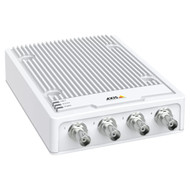
- Input signal type. Identify what is on the coax first. Cameras installed before roughly 2014 are usually SD CVBS (D1/960H); anything later is often HD-over-coax — TVI, CVI, or AHD at 1080p to 5MP. Encoders like the Hanwha SPE-1630 auto-detect all four per channel; Axis M7116 handles CVBS only but integrates deepest with Axis VMS.
- Per-channel resolution and frame rate. A 5MP HD-analog camera needs an encoder that digitizes 5MP at a usable rate (SPE-1630: 30fps at 5MP). SD plants only need D1/960H.
- Codec. H.265 roughly halves storage versus H.264. Axis Zipstream achieves similar savings on H.264 by cutting bitrate on static scenes.
- Power. PoE-powered encoders (single 802.3af cable) drop into closets cleanly; 12V DC units need a local supply. This powers the encoder — analog cameras keep their existing power.
- Audio, alarm I/O, and PTZ passthrough. Intercom audio, door contacts, and RS-485 analog PTZ must ride through the encoder into the VMS if the site uses them. Check counts per model — they vary widely.
Choosing channel count
Encoders come in 1, 4, and 16-channel units plus rack chassis for high density. Size at camera count plus ~25% headroom:
| Channels | Typical use | Price band | Models |
|---|---|---|---|
| 1 channel | Single remote camera, temperature-hardened positions | $60-$550 | Pelco NET5501-XT, ACTi V21 |
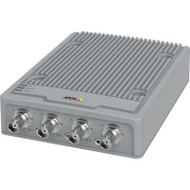
| 4 channels | Small sites, phased migrations | $350-$680 | Hanwha SPE-420, Axis P7304, Hikvision iDS-6704HUHI-M |
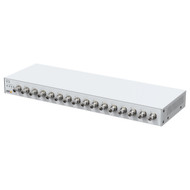
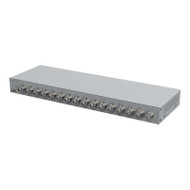
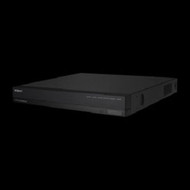
| 16 channels | The standard analog retrofit size | $890-$1,560 | Hanwha SPE-1630, Axis M7116, Axis P7316, Pelco NET6516-US |
| Rack / chassis | High-density central builds, 16-64+ channels | $2,300-$10,000+ | ACTi V32, Axis Q7920 chassis |
Recommended 16-channel encoders
4-channel encoders for smaller sites
4-channel encoders for smaller sites and phased migrations:
Decoders for video walls
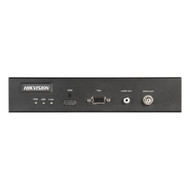
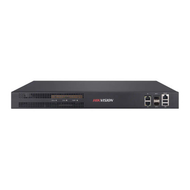
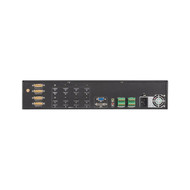
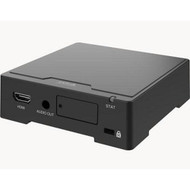
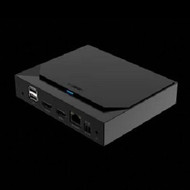
Decoders — the reverse direction, for driving monitors and video walls from IP streams:
CCTV encoders vs IPTV/AV distribution
A recurring point of confusion: CCTV encoders and AV/IPTV distribution encoders are different product classes. The encoders in this guide take BNC camera inputs and produce ONVIF/RTSP streams for surveillance recording. HDMI/SDI streaming encoders for IPTV headends, digital signage, and live-stream distribution are built around different inputs, protocols (HLS, RTMP, SRT, MPEG-TS), and management layers. If your project is video distribution rather than surveillance recording, talk to a specialist — the spec process is entirely different.
Frequently asked questions
- Do I need an encoder or new IP cameras?
- Encoder when the coax is expensive to replace (trenched, hard ceilings) and the existing cameras still produce acceptable images — migrate recording now, replace cameras per-position later. Straight to IP cameras when image quality is the actual complaint: an encoder cannot add resolution the camera never captured.
- Will an encoder work with TVI, CVI, or AHD cameras?
- Only if it explicitly supports HD analog input. Hanwha SPE-1630 and SPE-420 auto-detect CVBS/AHD/TVI/CVI up to 5MP per channel. SD-only encoders (Axis M7116) record nothing usable from HD analog signals.
- How does VMS licensing count encoder channels?
- Almost every VMS counts each encoder channel as one device license — a 16-channel encoder consumes 16 licenses, same as 16 IP cameras. Budget accordingly in Milestone, Genetec, and similar per-device platforms.
- Does an encoder degrade image quality?
- Encoding adds one compression generation, but at correct settings the loss is not visible in practice. The dominant quality factor remains the analog camera itself — encoders faithfully digitize whatever the camera produces, including its limits.
- Can encoders carry PTZ control to analog PTZ cameras?
- Many do, over RS-485 with Pelco-D/Pelco-P protocols. Verify protocol support against a sample camera before ordering — legacy PTZs sometimes run proprietary variants.
- What is the difference between a video encoder and a video server?
- Nothing meaningful — 'video server' is the older marketing term for the same device. Some vendors (Vivotek, Geovision) still label multi-channel encoders as video servers.
Quote an analog-to-IP migration
Send us your camera count, what's on the coax (CVBS or TVI/CVI/AHD), and your VMS — we'll spec the right encoder and quote at channel-direct pricing.
Quote a migration Browse encoders & decoders