
Best 16-Channel Video Encoders for Analog-to-IP Migration
A 16-channel video encoder converts an existing coax camera plant — legacy CVBS or HD-over-coax (TVI/CVI/AHD) — into standard IP streams your NVR or VMS can record, without replacing the cameras or re-pulling cable. The right pick depends almost entirely on what signal is on the coax today. This guide covers the 16-channel encoders we actually recommend, with the trade-offs stated plainly.
Bottom Line
For HD-over-coax (TVI/CVI/AHD) plants: Hanwha SPE-1630 — H.265, auto-detects analog HD up to 5MP per channel, $892.99. For legacy SD CVBS plants going into Axis Camera Station or an enterprise VMS: Axis M7116 — single-cable PoE-powered with Zipstream, $1,200.99. When you need audio channels and HD analog inputs in one box: Axis P7316, $1,559.99. Pelco NET6516-US for Pelco-standardized estates.
Our team specs analog-to-IP migrations across commercial deployments every week. These picks reflect what actually holds up in the field.
Best For
- Facilities with 10-16 working coax cameras migrating to an IP NVR or VMS
- Integrators phasing an analog estate onto IP recording before camera replacement
- IT directors consolidating mixed analog + IP sites onto one VMS
- Budget-cycle migrations that keep cameras now and replace them per-position later
Not For
- New construction or full camera replacement (go straight to IP cameras)
- HDMI / IPTV streaming distribution (different product class — see the FAQ)
In This Guide
What a 16-Channel Encoder Does
A video encoder digitizes analog camera signals and re-serves them as standard IP streams (RTSP/ONVIF). Your NVR or VMS records the encoder's streams exactly as it would record IP cameras — one 16-channel encoder makes sixteen coax cameras look like sixteen IP cameras on the network.
The business case is cable reuse. Coax runs are often the most expensive part of a legacy system to replace — ceilings, conduit, parking-lot trenching. An encoder converts the recording side to IP now and lets you replace cameras position-by-position later, on your schedule, instead of as one capital hit.
Decoders are the reverse direction — they take IP streams and drive monitors (video walls, spot monitors). If you need to display IP cameras on a monitor wall, you want a decoder (Axis D1110, Hanwha SPD-152), not an encoder.
What Matters When Choosing a 16-Channel Encoder
Input signal type — the deciding spec. Legacy CVBS (SD, 720×576 max) and HD-over-coax (TVI/CVI/AHD at 1080p-5MP) are different signals. An SD-only encoder connected to TVI cameras records nothing usable. Check what is actually on the coax before anything else — camera model labels or the old DVR's spec sheet tell you.
Per-channel resolution and frame rate. A 5MP HD-analog camera needs an encoder that digitizes 5MP at a usable frame rate (SPE-1630: 30fps at 5MP). SD plants only need D1/960H, which every pick here handles.
Codec — H.265 halves storage. H.265 cuts recorded storage roughly 40-60 percent versus H.264 at the same quality. On 16 channels recording continuously, that is the difference of multiple hard drives per year. Axis Zipstream achieves similar savings on H.264 by dynamically reducing bitrate on static scenes.
Power architecture. PoE-powered encoders (Axis M7116, single 802.3af connection) drop into a rack or closet with one cable. DC-powered units (SPE-1630, 12V/5A) need a local supply. Note this is power to the encoder — analog cameras still get power from their existing supplies.
Audio, alarm I/O, and serial passthrough. If the site has intercom audio, door contacts, or analog PTZ, the encoder must carry them into the VMS. P7316 carries 8 audio inputs; SPE-1630 carries 16 alarm inputs and 4 outputs.
VMS integration. Every pick here is ONVIF-conformant. Brand-matched pairs integrate deepest: Axis encoders in Axis Camera Station, Hanwha encoders in Wisenet WAVE, Pelco encoders in Pelco VMS estates.
Rack density. Racking dozens-to-hundreds of channels is its own decision — chassis encoders, blade counts, and per-channel cost change the math. See the rack-mount encoder guide for high-density planning.
Which Encoder for Which Coax Signal
Legacy SD CVBS (older analog, D1/960H): Axis M7116. Purpose-built for SD plants: 720×576 per channel, PoE-powered single-cable install, Zipstream bandwidth savings, and first-class Axis Camera Station integration.
HD-over-coax — TVI/CVI/AHD at 1080p-5MP: Hanwha SPE-1630. Auto-detects CVBS/AHD/TVI/CVI per channel up to 5MP at 30fps, records H.265, and carries 16 alarm inputs. The default pick for anything installed in the HD-analog era (roughly 2014 onward).
Audio-heavy sites (interview rooms, intercoms, retail POS audio): Axis P7316. HD analog inputs up to 8MP plus 8 mic/line inputs and 4 line outputs with full-duplex streaming — audio channels most encoders simply do not have.
Pelco-standardized estates: Pelco NET6516-US. 16 BNC inputs, H.265/H.264, ONVIF Profile S with an independent IP stream per channel; the natural fit where Pelco VMS and workflows are already the standard.
High-density rack builds: ACTi V32 (16-channel rackmount, PoE-powered) or step up to chassis encoders — covered in the rack-mount guide.
HD-TVI specifically at 16 channels with i-PRO recording: i-PRO VP-16-V3 (16-channel HD-TVI encoder) keeps an i-PRO-standardized site single-vendor.
Hanwha SPE-1610 vs SPE-1630 — Get the Successor
If your search started at the Hanwha SPE-1610: that model is the previous generation — H.264 only, 4MP max input — and is no longer stocked. The SPE-1630 is its direct successor and better on every axis that matters: H.265 recording (40-60 percent storage savings), 5MP HD-analog input with per-channel auto-detection, and current firmware support. Same 16-channel BNC form factor, in stock, $892.99.
Our 16-Channel Encoder Recommendations
Three encoders covering the two coax signal generations plus the audio-heavy edge case.
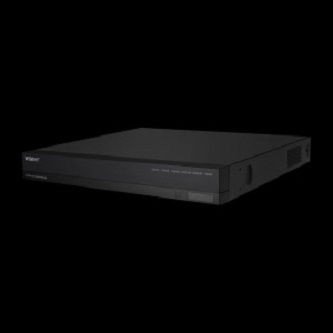
Hanwha
Hanwha SPE-1630 16-Channel Video Encoder
SPE-1630
H.265, auto-detects TVI/CVI/AHD/CVBS up to 5MP per channel at 30fps, 16 alarm inputs. The default 16-channel pick. $892.99, in stock.
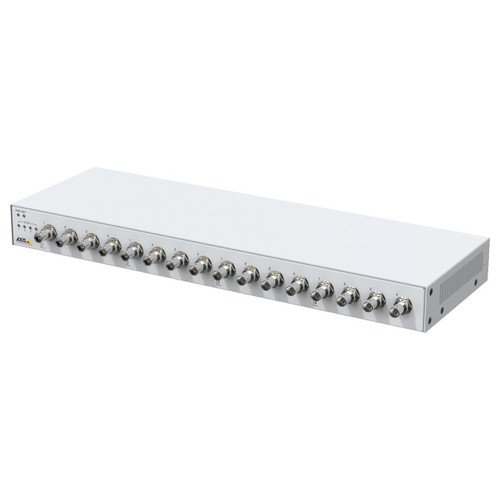
Axis
Axis M7116 16-Channel Video Encoder - 02036-004
02036-004
Axis M7116 — PoE-powered single-cable install, Zipstream bandwidth savings, deep Axis Camera Station integration. For SD analog plants. $1,200.99.
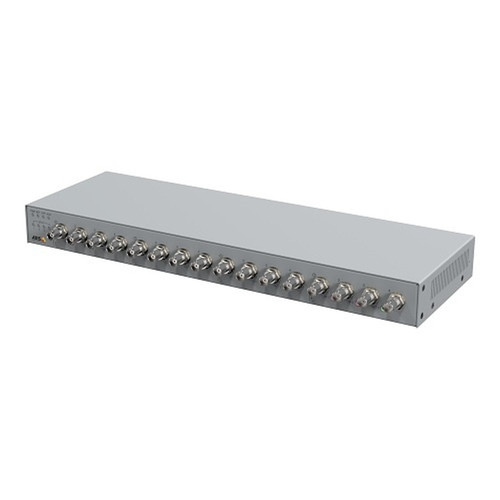
Axis
Axis P7316 16-Channel Video Encoder - 02037-004
02037-004
Axis P7316 — HD analog inputs to 8MP plus 8 audio inputs / 4 outputs, full-duplex. For sites where audio must migrate too. $1,559.99.
Also Consider
Brand-standard, rackmount, and smaller-channel-count options.
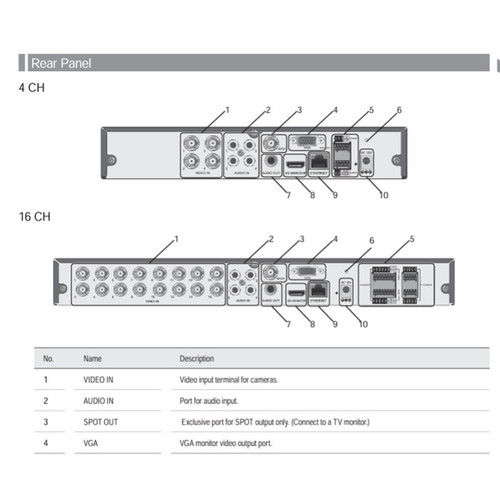
Pelco
Pelco NET6516-US 16-Channel Analog-to-IP Encoder
NET6516-US
16 BNC, H.265, ONVIF Profile S, independent stream per channel. The pick where Pelco VMS is the site standard. Available to order.
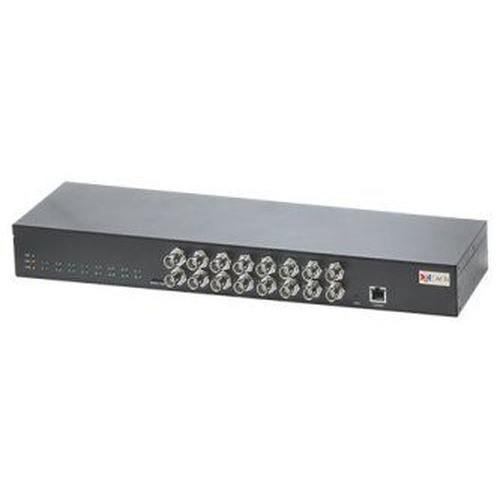
ACTi
Acti V32 Rackmount 16-Channel Video Encoder
V32
ACTi V32 — 16-channel rackmount, PoE-powered, H.264 at D1/960H. For SD plants going into racks. Available to order.
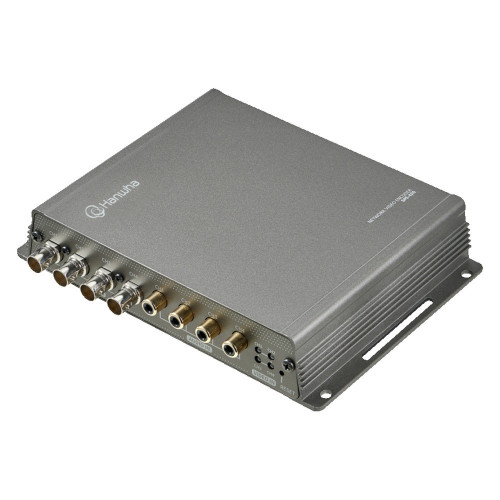
Hanwha
Hanwha SPE-420 4-Channel Video Encoder
SPE-420
Hanwha SPE-420 — the SPE-1630's 4-channel sibling. H.265, HD-analog auto-detect to 5MP, PoE or 12V DC. $346.99, in stock.
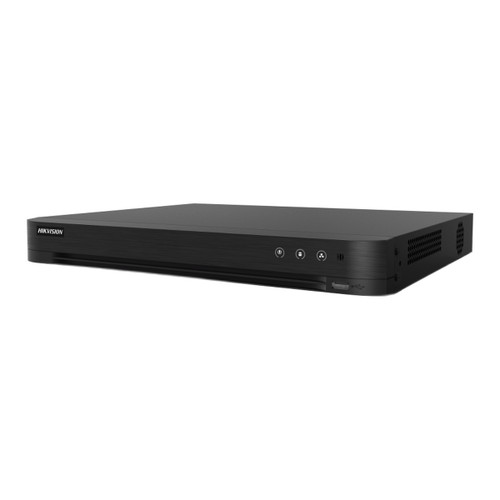
Hikvision
Hikvision IDS-6704HUHI-M 4-Channel 8MP Video Encoder
IDS-6704HUHI-M
Hikvision iDS-6704HUHI-M — 4-channel, TurboHD inputs to 8MP, H.265 Pro+. For small HD-analog counts on Hikvision coax. Available to order.
Frequently Asked Questions
What does a 16-channel video encoder actually do?
It digitizes sixteen analog coax camera feeds and serves them as standard IP streams (RTSP/ONVIF) that any modern NVR or VMS records like IP cameras. Existing cameras and coax stay; only the recording side changes.
Will an encoder work with my HD-over-coax (TVI/CVI/AHD) cameras?
Only if the encoder supports HD analog input. Hanwha SPE-1630 auto-detects TVI/CVI/AHD/CVBS up to 5MP per channel. Legacy-focused encoders like the Axis M7116 handle SD CVBS only — connected to TVI cameras they record nothing usable. Identify the signal on the coax first.
Should I buy an encoder or just replace the analog cameras with IP?
Encoder when the coax plant is expensive to replace (trenched runs, hard ceilings) and the cameras still produce acceptable images — you migrate recording now and replace cameras per-position later. Straight to IP cameras when image quality is the actual complaint, since an encoder cannot add resolution the camera never captured.
Do video encoders work with any NVR or VMS?
Every pick here is ONVIF-conformant and works with mainstream VMS platforms (Milestone, Genetec, Wisenet WAVE, Axis Camera Station). Brand-matched pairs integrate deepest — Axis encoders in Camera Station, Hanwha in WAVE, Pelco in Pelco VMS.
What about 16-channel HDMI or IPTV streaming encoders?
Different product class. Those take HDMI/SDI sources and stream H.264/H.265 for TV distribution or live streaming — not BNC camera inputs for surveillance recording. The encoders on this page are CCTV analog-to-IP encoders. If your project is AV-over-IP or IPTV headend distribution, talk to a specialist about a separate quote.
Is the Hanwha SPE-1610 still available?
It is the previous generation (H.264, 4MP max) and no longer stocked. Its successor, the SPE-1630, adds H.265 and 5MP HD-analog auto-detection in the same 16-channel form factor for $892.99.
No Bots, Just Experts
No bots, just experts. Free pre-sales support for every customer — product questions, BOM quotes, compatibility checks, price confirmation — typically answered within one business day. Paid services available like full system design, remote installation, and more. Got a list of products? Free BOM quote. Need help figuring out what to buy? Buy engineering time by the hour — $175/hour, qty 1 = 1 hour. Tell us about your project, we scope how many hours it needs, you purchase that quantity. Hardware buyers get up to one hour ($175) credited back against their order as a thank-you.