Pelco NET6516-US 16-Channel Analog-to-IP Encoder
The Pelco NET6516-US is a professional analog-to-IP video encoder designed to extend the operational life of legacy CCTV infrastructure by converting 16 analog BNC camera feeds into independent H.264 and MJPEG IP streams. Organizations with mature analog camera plants can migrate to modern VMS platforms—Pelco VideoXpert, Genetec, Milestone, or any ONVIF Profile S–compliant system—without wholesale camera replacement. Each of the 16 inputs appears as a distinct networked video source, enabling per-camera recording policies, motion detection, and forensic search within the host VMS.
Key Features
- 16 Independent Analog Inputs: 16 BNC connectors, each encoded and streamed as a separate IP camera. Eliminates the need to maintain parallel analog and IP infrastructure during transition periods.
- Dual Codec Support: H.264 and MJPEG encoding. H.264 reduces bitrate 40–50% versus MJPEG on equivalent quality, critical for bandwidth-constrained networks with 16 concurrent streams.
- ONVIF Profile S Compliance: Native ONVIF support ensures compatibility with all major VMS platforms (VideoXpert, Genetec, Milestone, Avigilon, ExacqVision) without proprietary middleware.
- 1080p Resolution Support: Each input can encode up to 2 MP (1080p), subject to source analog camera quality. Resolution scaling is determined by the source signal and encoder settings.
- NDAA Section 889 Compliant: Meets U.S. federal procurement requirements for critical infrastructure and government deployments. No banned components, no supply-chain risk mitigation delays.
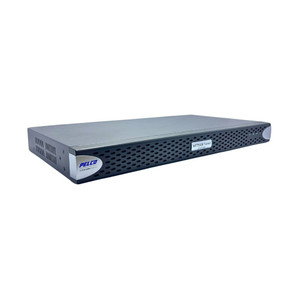
- Rack-Mount Form Factor: 1U rackmount chassis (1.5 kg) fits standard 19" equipment racks. White housing, engineered for NOC and server-room deployment alongside NVRs and core network gear.
- 5-Year Limited Warranty: Factory warranty covering defects in materials and workmanship, aligning with enterprise-class infrastructure lifecycle expectations.
- Audio Pass-Through: Single-channel audio output (600Ω impedance, 2.8Vpp max) per channel—mono audio integration for critical zones (lobbies, perimeter gates) without separate audio appliances.
Deployment Architecture and Migration Path
The NET6516-US sits at the boundary between analog and IP surveillance, functioning as a protocol translator rather than a recording device. Each analog camera input is individually encoded and streamed over the network on its own multicast or unicast address, allowing the host VMS to subscribe only to streams it needs. This decouples analog camera lifespan from IP infrastructure decisions: upgrade cameras one zone at a time, retire the encoder only when the last analog input is decommissioned. In a 200-camera retail or logistics facility with analog cameras deployed over 5–10 years, the encoder enables a phased migration (50 cameras per year) without forklift replacement.
Network bandwidth is the principal constraint. A single H.264 1080p stream at 4 Mbps will consume 64 Mbps for the full 16 channels at full frame rate. Most enterprise switching architectures (Gigabit core, 100 Mbps edge) can absorb 16 streams if codec and frame-rate settings are tuned: H.264 at 15 fps or MJPEG at 8 fps typically stays under 30 Mbps per encoder. Plan ingress bandwidth and NVR storage before provisioning; validate with a pilot deployment on one or two analog cameras first.
Integration and Operational Benefits
Once the encoder is on the network and registered to the VMS, each input behaves like a native IP camera: motion detection runs on the encoder or the VMS, two-way audio can be configured for channels with audio input, and remote live view and playback work identically to IP cameras. The ONVIF interface eliminates lock-in to Pelco VideoXpert; if your organization uses Genetec or Milestone, the encoder is a drop-in accessory. Metadata (motion, audio signal) can be forwarded to the VMS for alerting and forensic tagging. Some VMS platforms allow per-input codec selection, so you can run H.264 on bandwidth-constrained zones and MJPEG on high-motion areas without codec switching at the encoder.
The encoder does not provide PoE to analog camera inputs—each analog camera must have its own power supply (typically 12V DC or 24V AC, depending on camera). Plan power-supply consolidation or replacement during installation; running separate power to 16 analog cameras in a retrofit scenario is often the largest labor cost. The encoder itself draws minimal power (typical consumption under 30W) and is PoE-independent, so it can sit anywhere on your wired network with standard AC or DC input.
Compliance and Procurement
The NET6516-US carries UL, cUL (Canada), FCC, CE (EU), UKCA (UK), and KC (South Korea) certifications, satisfying most regional safety and EMC requirements. NDAA Section 889 compliance is particularly valuable for organizations selling to U.S. federal, state, and local government agencies: it eliminates sourcing and procurement delays tied to supply-chain risk review. For private-sector deployments, the 5-year warranty and established Pelco support infrastructure (technical documentation, firmware updates, integration with VideoXpert) reduce operational risk. Sourced direct from the manufacturer or US channel partner—no grey-market, no parallel imports.
Ted PerryPerspective based on aggregated IP Security Depot and affiliated engineering team experience.
We've deployed the NET6516-US in dozens of analog-to-IP migrations across retail, logistics, and municipal facilities. The real value isn't the encoding—any competent appliance can do that—it's the operational simplification and cost recovery on existing cameras. A typical scenario: a 150-camera retail chain with analog DVRs from 2010–2012 reaches the end of useful life. Full IP replacement (cameras, NVR, cabling) costs $180k–$220k. A pair of NET6516 encoders ($4k total), a Pelco VideoXpert NVR or Genetec Stratocast subscription, and phased camera upgrade ($40k over three years) gives the same forensic and alerting capability at 60% lower total cost of ownership. The trade-off is operational overhead: you're managing two video architectures in parallel for 18–36 months. We've seen integrators staff an extra technician during the transition; that's real cost you need to budget. Once the last analog camera is retired, the encoder gets recycled or repurposed, and you're left with pure IP. The ONVIF compliance is non-negotiable—it means you aren't locked into VideoXpert. We've placed these units into Genetec environments, Milestone shops, and even generic Hikvision NVRs running ONVIF mode. H.264 bitrate efficiency is measurable: 16 channels at 1080p, 25 fps, H.264 at 4 Mbps per channel = 64 Mbps total. The same streams in MJPEG would be 80–120 Mbps. On a gigabit backbone that's fine, but if you're feeding a 100 Mbps uplink to a central office, you'll feel it. We typically recommend H.264 as the default, MJPEG only for high-motion zones or where codec transcoding is happening downstream.
Technical Highlights:
- H.264 + MJPEG Dual Codec: H.264 achieves 40–50% bitrate reduction versus MJPEG at equivalent quality. For 16-channel deployments, that's the difference between 64 Mbps and 100+ Mbps on a gigabit network. Vendor flexibility: if your VMS prefers MJPEG transcoding, you can send H.264 and let the VMS decode and re-encode for edge analytics without hitting the encoder twice.
- ONVIF Profile S Native: Profile S is the baseline—live view, recording, motion. Profile T (H.265 + metadata streaming) is not listed, which is fine; most VMS platforms still standardize on Profile S anyway. Guarantees zero vendor lock-in: move from VideoXpert to Genetec or Milestone without re-encoding.
- 16 Independent Outputs: Each BNC input becomes its own unicast or multicast stream. Bandwidth isolation means one high-bitrate camera (or one misconfigured zone) doesn't starve the others. Typical integrators set 15 cameras to H.264 10–15 fps, one entrance camera to H.264 25 fps, and let the VMS handle selective frame-rate upsampling on playback.
- NDAA Section 889 Certification: Eliminates procurement friction for federal, state, local, and tribal government bids. No waiting for supply-chain risk reviews. Direct path from RFQ to PO. For private security, less critical; for regulated sectors (airports, ports, DHS-adjacent), essential.
- Audio Passthrough per Channel: Single mono audio output (600Ω impedance) lets you tie in analog audio feeds from intercoms or area mics. Real-world use: entrance vestibule camera with a two-way intercom microphone, or loading dock camera linked to a dock speaker. Keeps audio and video in-sync at the VMS.
Deployment Considerations:
- Analog Camera Power Supply Separation: The NET6516 does NOT provide power to BNC inputs. Each analog camera needs its own 12V DC or 24V AC supply. In retrofit scenarios, this is often the largest installation cost. Plan to consolidate power supplies, use a centralized 16-port 12V distribution board, or stage camera replacement alongside power infrastructure upgrades.
- Network Bandwidth Planning Critical: 16 streams at 1080p, 25 fps, H.264 4 Mbps per channel = 64 Mbps aggregate. Test with pilot cameras first. If your site has older 100 Mbps switches or saturated wireless backhaul, you'll need network upgrades before rollout. Document baseline utilization before adding the encoder.
- Encoder Placement and Cooling: Rack-mount form factor assumes a NOC or server room environment. If you're placing it in a remote location (parking garage, warehouse), ensure ambient temp stays under 40°C (datasheet thermal specs not provided here, but assume industrial standard). No fan noise issues; minimal power draw (~30W typical).
- Firmware and VMS Compatibility Validation: ONVIF Profile S is standard, but edge cases exist: some older Milestone versions had quirks with multicast discovery, some Genetec installs preferred unicast. Request a compatibility matrix from Pelco or your integrator. Factory firmware is typically stable; patch only if you hit a known bug.
- Analog Signal Quality and Resolution Ceiling: Encoder resolution is limited by source analog camera. A 540TVL analog camera (typical legacy spec) will produce soft 1080p output—the encoder can't create resolution that isn't in the source. Expect 480p–720p effective output from 10+ year old CCD/CMOS cameras. New analog cameras (540–600 TVL) will hit true 1080p. Audit your camera plant before expecting full 2MP output.
The NET6516-US is the right choice if you have a sprawling analog camera base (100+ cameras), the budget to migrate phased over 2–3 years, and the operational discipline to manage hybrid architecture during transition. It's overkill for a small 4–8 camera retrofit (use a single-channel encoder instead). It's the wrong tool if you're building new-build IP surveillance from scratch—just spec native IP cameras. For organizations facing analog DVR end-of-life, regulatory mandate for remote monitoring, or legacy camera refresh on a budget, this encoder pays for itself in the first year. Explore the Pelco catalog for complementary NVRs, VideoXpert licensing, and analytics appliances.