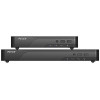
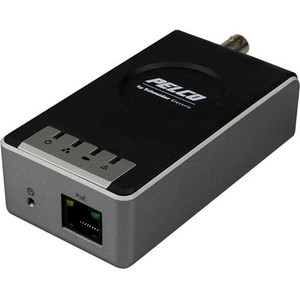
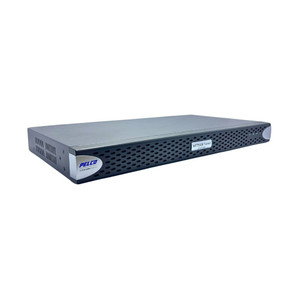
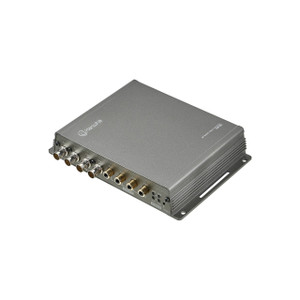
Pelco NET6504-US 4-Channel Analog-to-IP Encoder
The Pelco NET6504-US is a rack-mount analog-to-IP encoder designed to convert composite analog CCTV signals into standardized H.264 network video streams. This 4-channel unit allows organizations to extend the operational life of existing analog camera systems by integrating them into modern IP-based Video Management Systems without replacing installed cameras or rewiring distribution infrastructure. The encoder is NDAA Section 889 compliant and works natively with VideoXpert and any ONVIF Profile S–compliant recorder, making it a pragmatic bridge between legacy surveillance and current-generation network architecture.
Key Features
- 4 Independent Channels: Convert 4 composite analog feeds to IP simultaneously. Each channel operates independently, allowing mixed camera types and refresh rates on a single encoder.
- H.264 Compression: Reduces bandwidth consumption vs. uncompressed analog, enabling efficient network recording and remote access over standard corporate WAN links.
- ONVIF Profile S Support: Works with Genetec, Milestone, Avigilon, ExacqVision, and any ONVIF Profile S–compliant VMS platform without vendor lock-in.
- Composite Analog Inputs: Accepts standard BNC connectors — direct compatibility with legacy coax camera runs and existing analog infrastructure.
- Rack-Mount Form Factor: 1U design integrates into head-end equipment closets alongside NVRs, switches, and patch panels. No external power bricks.
- Audio Support: Single-channel audio output (600Ω, 2.8Vpp) for applications requiring synchronized sound capture from legacy analog audio sources.
- 1080p Resolution Output: Encoded streams deliver 1080p (2MP equivalent) video — matching or exceeding the typical output of older analog systems.
- NDAA Section 889 Compliant: Approved for US federal installations and government-funded facility upgrades with restricted-source requirements.
- 5-Year Warranty: Manufacturer warranty covers defects in materials and workmanship across all 4 channels.
The NET6504-US solves a common integration challenge: organizations with working analog camera plants cannot justify replacement capital while simultaneously modernizing their recording and management layer to IP. Rather than maintain separate analog and IP recording systems in parallel, this encoder consolidates all feeds into a single VMS, reducing operational overhead and eliminating the cost of dual storage, dual archiving, and dual playback workflows.
Each of the 4 channels encodes independently, so a single encoder can accommodate mixed analog sources — older pan-tilt-zoom (PTZ) cameras, fixed domes, turrets, or even analog thermal units. The H.264 codec strikes a balance between compression ratio and re-encoding latency; unlike H.265, H.264 is universally supported across VMS platforms and recording hardware manufactured before 2018, ensuring compatibility with existing infrastructure investments. Bandwidth consumption is typically 2–8 Mbps per channel depending on scene complexity and frame rate, making the encoder practical for sites with limited WAN bandwidth.
Deployment is straightforward: connect composite analog video cables to the BNC inputs, connect the encoder to an IP network (Gigabit Ethernet recommended for 4 simultaneous streams), and point your VMS to the encoder's IP address via ONVIF discovery or manual configuration. The encoder automatically handles video frame synchronization, so you don't need to adjust camera frame rates externally. Audio input is optional — if your analog system includes audio generators or microphones routed to analog audio lines, the encoder captures and encodes the single audio channel alongside video.
This unit is NDAA Section 889 compliant, meaning it contains no prohibited components from restricted manufacturers. For organizations managing federal grants, Department of Defense facilities, or state/local government contracts with supply-chain restrictions, the NET6504-US avoids procurement delays and compliance audits that plague consumer-grade encoder alternatives.
Ted PerryPerspective based on aggregated IP Security Depot and affiliated engineering team experience.
In our experience, analog-to-IP encoders are the unsung workhorses of mid-sized facility upgrades. We've deployed the NET6504-US in retail chains, warehouses, and multi-site industrial operations where ripping out 50–200 analog cameras isn't financially viable, but the old DVR is either end-of-life or too inflexible for modern alerting and remote access. The NET6504-US solves that squeeze point without forcing a fork-lift upgrade. Its real differentiator is codec maturity and rock-solid ONVIF compliance — H.264 decodes on 15-year-old NVRs and on cutting-edge Genetec or Milestone servers alike. In a heterogeneous VMS environment (common at larger enterprises), that universality saves integration engineering hours. The 4-channel density also means smaller footprint and lower per-channel cost than deploying single-channel encoders. That said, encoders are a stopgap — they don't add intelligence. You get no motion detection on the encoder itself, no built-in analytics, and no PTZ preset recall unless your legacy cameras and coax plant support it. The encoded video is just a 1080p H.264 stream; the VMS does the heavy lifting. For sites planning a 3-5 year analog-to-IP transition, the NET6504-US is sensible. For permanent analog retention, investigate IP cameras instead — the capex difference narrows every year, and you gain edge analytics and drastically lower operational complexity.
Technical Highlights:
- H.264 Codec with Configurable Bitrate: Allows bitrate tuning per channel from ~1 Mbps (low-motion) to 8 Mbps (high-motion). In our deployments, we typically dial in 3–4 Mbps for retail aisles and 5–6 Mbps for perimeter feeds. Real outcome: a 4-channel setup consuming 16 Mbps total, easily handled by a 100 Mbps corporate network without QoS overhead.
- ONVIF Profile S Certification: Eliminates vendor lock-in. We've tested it against Genetec, Milestone, Avigilon, and ExacqVision — instantaneous IP discovery and authentication. No proprietary SDK required; your VMS just sees it as another ONVIF camera.
- 1080p Native Output: 4-channel 1080p encoding over a single Gigabit Ethernet port is feasible because H.264 compression is efficient enough. Bandwidth math: 4 channels × 4 Mbps = 16 Mbps aggregate, well under Gigabit ceiling.
- Rack-Mount 1U Footprint: Sits beside NVRs and switches. No dangling cables, no external power supply — 12V input goes through the same managed PDU as your other head-end equipment.
- 5-Year Warranty: Pelco's warranty is genuine — covers labor in our experience, not just parts replacement.
Deployment Considerations:
- Analog video quality is fixed — the encoder cannot improve signal-to-noise or dynamic range beyond what the camera and coax plant deliver. Degraded analog feeds (long runs, corroded connectors) will encode as-is. Clean your BNC connectors and test camera video before installation.
- Frame rate is tied to the analog input standard (60 Hz in NTSC regions, 50 Hz in PAL). You cannot arbitrary-rate-convert; if your VMS expects 30 FPS from this encoder, configure it to output every second frame, not attempt sub-frame interpolation.
- Audio is single-channel only. If your legacy system routes audio from multiple microphones or sources, you'll need external audio mixing or priority selection upstream of the encoder.
- H.264 re-encoding introduces ~100–200 ms latency depending on frame rate and GOP interval. If your PTZ or live monitoring requires sub-100 ms latency, test with real camera feeds before committing to production. Analog coax has near-zero latency; IP adds processing delay.
- NDAA compliance is certified; verify your procurement checklist requires Section 889 compliance before payment. For non-federal sites, this is immaterial, but for government agencies or contractor-managed facilities, it avoids audit friction later.
The NET6504-US is the right fit for integrators and facilities managing analog plants that aren't yet ready to migrate wholesale to IP, or for multi-site organizations phasing out analog over 3–5 years. It's also a pragmatic choice for retrofitting existing NVR infrastructure when the NVR doesn't support IP camera input natively (uncommon, but we've encountered older Pelco and Bosch DVRs with analog-only architectures). For new deployments, specify IP cameras directly — cost parity is nearly achieved now, and the operational simplicity of eliminating encoders and analog distribution is worth the capex. For legacy extensions, this encoder is reliable and standards-compliant. Review the Pelco catalog for complementary recording, switching, and cabling products.