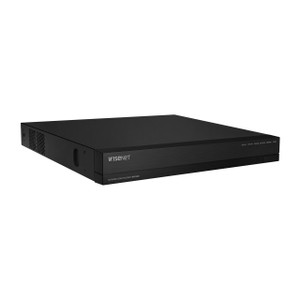
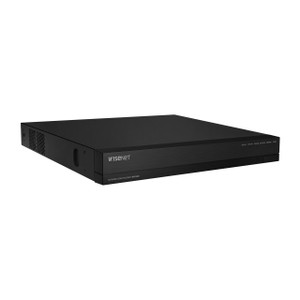
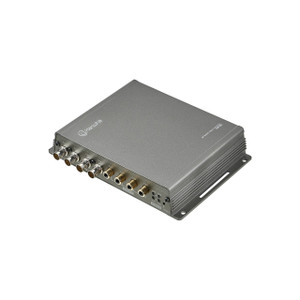
Hanwha SPE-1630 16-Channel Video Encoder
Overview
The SPE-1630 is a professional 16-channel video encoder that solves a critical infrastructure challenge: migrating analog camera systems to IP-based networks without replacing working cameras. If you have coaxial cabling and composite video cameras deployed across facilities, the SPE-1630 converts those signals to network video in real time, eliminating costly camera overhauls and preserving your existing investment.
This encoder accepts analog video from NTSC/PAL sources and outputs standard IP streams compatible with major network video recorders and management software. It supports multiple analog standards—CVBS, AHD, CVI, TVI—with automatic format detection, so you don't need to manually configure each input.
Key Features
- 16 BNC composite video inputs: Accepts NTSC/PAL at 1.0 Vp-p / 75Ω impedance, letting you directly connect existing coaxial camera infrastructure without adapters or preconditioning.
- Multi-format auto-detection (up to 5MP): Automatically recognizes CVBS, AHD, CVI, and TVI signals on each input. Saves installation time and reduces configuration errors in large deployments.
- H.265, H.264, and MJPEG codec support: H.265 cuts bandwidth and storage requirements roughly in half compared to H.264 for the same visual quality—a meaningful cost reduction on 24/7 recording across 16 channels. Bandwidth-constrained sites benefit most from this codec flexibility.
- Multiple streaming profiles (up to 3 per channel): Stream the same camera at different resolutions and frame rates simultaneously—high-quality primary stream for local recording, lower-bitrate secondary stream for remote mobile access over congested networks.
- 16-input / 4-output alarm I/O with intelligent triggers: Motion detection, video loss, tampering alerts, and network disconnect triggers route directly to external relays or NVR integration. Ensures security operations centers see anomalies in real time without polling.
- 4-channel audio input, 1-channel output with G.711 u-law: Integrates coaxial audio from analog systems; G.711 compression fits within standard IP bandwidth budgets for small VoIP-style audio streams.
- RS-485 half-duplex and coaxial PTZ control (SAMSUNG-T, PELCO-P/D protocols): Existing PTZ dome control wiring and command protocols remain functional—no need to rewire PTZ systems or replace legacy controllers.
- 1 HDMI output at 1920×1080: Local multi-image display directly on a monitor for on-site monitoring without requiring a separate NVR or display server.
- Gigabit Ethernet (10/100/1000 Base-T) with IPv4/IPv6: Future-proof network layer; supports both legacy and modern IP addressing schemes. Gigabit speed essential for sustained 16-channel streaming without congestion.
- Enterprise-grade security (HTTPS/SSL, 802.1X, IP filtering, user logs): Meets corporate access-control and audit requirements. Digest authentication prevents cleartext credential exposure on the network.
Resolution and Frame Rate Performance
The SPE-1630 handles resolutions from 352×240 up to 2560×1920. Frame rates are resolution-dependent: 30 fps at 1080p/720p, 15 fps at 4MP, and 12 fps at 5MP maximum input resolution. This tiering reflects the practical trade-off between image quality and network throughput. For moving-subject forensics (retail, transportation), 30 fps at 1080p is sufficient; for fixed-scene monitoring (warehouses, parking), 12–15 fps often meets compliance requirements. Adaptive de-interlacing smooths playback from interlaced analog sources, reducing motion artifacts common in legacy surveillance tape-style footage.
Network Streaming and Interoperability
The encoder supports ONVIF Profile S, ensuring compatibility with third-party NVRs and VMS platforms. It handles TCP/IP, UDP, RTP, RTSP, HTTP/HTTPS, SMTP, FTP, DHCP, DNS, DDNS, and SNMP—a complete protocol suite for centralized deployment and remote diagnostics. Supports up to 48 concurrent RTP/RTSP users (4 per channel) and 32 HTTP users, adequate for security operations centers with multiple simultaneous workstations and mobile clients.
Multicast and unicast streaming modes let you optimize for local network efficiency (multicast reduces redundant bandwidth on high-user-count deployments) or public internet resilience (unicast works reliably across firewalls).
Physical and Environmental Specifications
The SPE-1630 measures 370 × 44 × 320 mm and weighs 2.32 kg—compact enough to mount in equipment racks or control room cabinets. Power consumption peaks at 20W via 12V DC 5A supply, enabling integration into standard UPS-backed facility power. Operating temperature range is −10°C to +50°C, suitable for climate-controlled indoor data centers and telecom closets; outdoor or non-temperature-controlled enclosures may require external thermal management.
Web Access and Software Compatibility
Plugin-free web viewer works on Windows 10+, macOS 10.13+, Chrome 80+, Firefox 72+, Safari 11+, and MS Edge 83+. No Java or proprietary client installation required—lowers administrative overhead on enterprise networks with strict software policies. Localized interfaces in 16 languages (English, Chinese, Japanese, Korean, and European variants) suit multinational organizations.
Compatible with Hanwha NVR series (P, X, Q, L models) and SmartViewer software, enabling seamless integration if you standardize on Hanwha infrastructure.
When to Choose a Different Encoder
If your facility requires encoding of IP cameras (rather than analog sources), you do not need an encoder—deploy an NVR directly. If you need fewer than 4 channels and cost is a concern, look for lower-channel-count variants in the same family. The SPE-1630 is sized for mid-to-large facilities with 16+ camera sites; smaller operations may find a 4- or 8-channel encoder more economical.
Frequently Asked Questions
Q: Does the SPE-1630 support ONVIF Profile S?
A: Yes. ONVIF Profile S compliance ensures interoperability with major third-party NVRs and VMS platforms, giving you flexibility in system architecture without vendor lock-in.
Q: What is the maximum number of concurrent users the SPE-1630 can handle?
A: Up to 48 concurrent RTP/RTSP users (4 per channel) and 32 HTTP users. This capacity supports large security operations centers with multiple simultaneous workstations and mobile clients.
Q: Can the SPE-1630 work with existing PTZ camera control systems?
A: Yes. The encoder supports RS-485 half-duplex (SAMSUNG-T, PELCO-P/D protocols) and coaxial PTZ control, preserving your existing PTZ wiring and command infrastructure without replacement.
Q: What codecs does the SPE-1630 support, and which should I use?
A: H.265, H.264, and MJPEG. H.265 cuts bandwidth and storage roughly in half versus H.264 for the same image quality—use it if network capacity is limited. H.264 offers broader third-party compatibility; MJPEG works well for archive or low-bandwidth scenarios.
Q: Is the SPE-1630 suitable for outdoor deployment?
A: The operating temperature range is −10°C to +50°C, suitable for climate-controlled indoor locations. Outdoor or non-temperature-controlled enclosures require external thermal management (e.g., equipment cabinet heating or cooling).
Q: What is the maximum resolution and frame rate the SPE-1630 can encode per channel?
A: Up to 5MP (2560 × 1920) at 12 fps, 4MP at 15 fps, and 1080p/720p at 30 fps. Frame rate depends on input resolution. Multi-profile streaming allows you to encode the same input at multiple resolutions and frame rates simultaneously.
Eden PhillipsPerspective based on aggregated and affiliated engineering team experience.
The SPE-1630 directly addresses a widespread infrastructure gap: organizations with substantial analog camera investments facing pressure to migrate to IP systems. Its auto-detection capability across CVBS, AHD, CVI, and TVI formats eliminates manual per-channel configuration complexity, a real time-saver on 16-input deployments. H.265 codec support is the key differentiator—cutting bandwidth and storage requirements roughly 40–60% compared to H.264 makes this encoder essential for facilities with limited network capacity or high 24/7 recording retention demands.
Technical Highlights:
- H.265 compression: Reduces bitrate 40–60% versus H.264 at identical resolution and frame rate. On a 16-channel encoder running continuous recording, this translates to measurable storage and network cost reduction.
- 48 concurrent RTP/RTSP users (4 per channel): Supports large security operations centers without requiring load balancing or secondary encoding servers. Essential for facilities with multiple simultaneous monitoring workstations and remote mobile access.
- ONVIF Profile S certification: Guarantees compatibility with Milestone, Genetec, Hanwha, and other major NVR platforms. No proprietary software lock-in; your system architecture remains flexible as business needs change.
- RS-485 and coaxial PTZ control: Existing SAMSUNG-T and PELCO-P/D PTZ commands continue to work without rewiring or protocol translation. Reduces integration friction when upgrading legacy surveillance infrastructure.
Deployment Considerations:
- Frame rate is resolution-dependent (12 fps @ 5MP, 15 fps @ 4MP, 30 fps @ 1080p). Ensure your use case (forensics vs. compliance monitoring) aligns with the frame rate tier you select.
- Operating temperature range −10°C to +50°C is suitable for indoor data centers and climate-controlled telecom closets only. Non-conditioned equipment rooms or outdoor enclosures require active thermal management.
- 20W maximum power consumption enables UPS integration without oversizing backup capacity; factor this into facility power budgets.
The SPE-1630 is optimized for mid-to-large retail chains, transportation hubs, and municipal deployments with coaxial infrastructure and 24/7 recording—scenarios where bandwidth and storage costs directly impact operational budgets. Pair it with an ONVIF-compatible NVR and expect a straightforward installation with minimal configuration overhead.
Choosing a 16-channel encoder? See our
Best 16-Channel Video Encoders guide for picks by coax signal type (TVI/CVI/AHD vs legacy CVBS), codec, and power architecture.