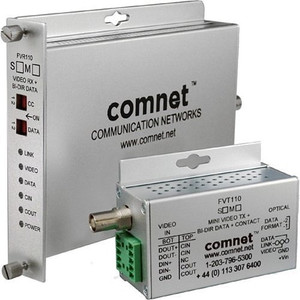
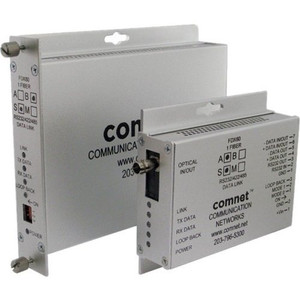
Comnet COMPAK1031M1 Digitally Encoded Video + Bi-directional Data Fiber Transceiver
The Comnet COMPAK1031M1 is a single-fiber bidirectional transceiver designed to extend analog video signals alongside control data over multimode fiber to distances up to 3 kilometers — a real solution when copper coax runs are impractical, electrically noisy, or span industrial campus layouts. This is not a standalone camera; it's infrastructure for long-haul surveillance signal transmission where fiber backbone exists or must be installed.
Overview
The COMPAK1031M1 handles digitally encoded video and simultaneous RS-232, RS-422, or RS-485 data on a single 62.5/125µm multimode fiber strand. Video enters via coax (up to 100m before the transceiver), gets encoded, multiplexed with control data, and transmitted optically at 1310/1550nm wavelengths. The bidirectional capability means PTZ pan/tilt commands, alarm triggers, or sensor data flow back over the same fiber without separate control lines — a significant simplification on long runs where every fiber counts.
Key Features
- Single-fiber bidirectional operation: Video and data both transit the same 62.5/125µm multimode strand, cutting fiber count in half compared to unidirectional designs. Matters when fiber is scarce or conduit is at capacity.
- 3 km optical range at 16 dB power budget: Covers campus perimeter, bridge crossings, and multi-building sites without active repeaters. Practical range depends on fiber loss (0.9 dB/km typical for 1310nm multimode); pre-test with your facility's fiber plant before commitment.
- Analog video fidelity: 67 dB SNR, <2% differential gain, <0.7° differential phase: Preserves evidence-grade video detail without the softness of poor-quality analog links. These specs mean usable CCTV picture quality at 3 km — not marginal.
- Data rates up to 115 Kbps (NRZ) on RS-232/422/485: Handles PTZ dome commands, relay triggers, and sensor telemetry. 115 Kbps is adequate for serial PTZ protocols; won't support Ethernet backhaul, but that's not the mission.
- Dual wavelength support (1310/1550nm): Allows WDM (wavelength-division multiplex) with other services on the same fiber if future scaling demands it — build flexibility into your fiber plant without forklift upgrade.
- Wide operating temperature (-40°C to +75°C) and high MTBF (>100,000 hours): Rated for outdoor fiber cabinets, rooftop equipment rooms, and industrial environments without climate control. 100,000+ MTBF implies roughly 11.5 years mean time between failures under normal use — commercial-grade durability for fixed infrastructure.
- Frugal power draw (2W typical, 8-15 VDC input): Powers from a small 12V cabinet supply, PoE injector, or remote battery backup without strain. Single transceiver pair draws less than a LED bulb.
- Compliance with RS-250C, NEMA TS-1/TS-2, Caltrans standards: Meets highway and transportation surveillance specs; accepted for DOT, transit authority, and critical infrastructure projects where standard approval matters.
Integration and Compatibility
The COMPAK1031M1 is a transparent pipeline — it doesn't care whether your analog camera is 720 lines, 960H, or old 480i security camera. Video enters one coax input (BNC), data flows on serial lines (DB-9 or screw terminal), exits the other unit on matching ports. Pair two units (one at camera end, one at receiver end) to create a complete fiber link. Works with any analog CCTV encoder, analog-input DVR, or hybrid recorder that accepts external video sources and RS-232/422/485 control. No active management, no IP addressing — bolt-and-forget infrastructure.
What's in the Box
Comnet ships the COMPAK1031M1 as a single transceiver unit. To form a complete link, you purchase two units (one per end of the fiber run). Includes mounting hardware (screw set), internal power supply for 8-15 VDC input, and documentation. Fiber pigtail, connectors (FC, SC, ST, or other), and coax runs are sourced separately based on your site cabling standard.
Frequently Asked Questions
Q: Does the COMPAK1031M1 require two units to work?
A: Yes. This is a single transceiver; you need one at each end of the fiber link. A camera-side unit and a receiver-side unit form a complete video + data bridge over fiber.
Q: Can I mix multimode and single-mode fiber on the same COMPAK1031M1?
A: No. The COMPAK1031M1 is designed for 62.5/125µm multimode fiber only. Single-mode operation requires different optical modules and is not supported on this model.
Q: What's the maximum coax distance before signal degrades?
A: 100 meters (300 feet) of coax at the input side before the transceiver. Beyond that, use a line amplifier or shorter runs. The 3 km reach is the fiber span, not the coax span.
Q: Can the COMPAK1031M1 handle PTZ camera commands?
A: Yes. The RS-485 (or RS-422, RS-232) port supports PTZ serial protocols at up to 115 Kbps. Your camera and receiver must both support the same protocol (e.g., Pelco D, Pelco P, etc.).
Q: Does the COMPAK1031M1 need external power at both ends?
A: Yes. Each transceiver requires 8–15 VDC input (2W typical). Plan for dual power supplies or a backup supply if the fiber run is critical.
Q: Is the COMPAK1031M1 NDAA Section 889 compliant?
A: Evidence does not confirm NDAA compliance for this model. Contact Comnet directly for certification status if federal procurement rules apply to your project.
The COMPAK1031M1 is purpose-built for surveillance fiber infrastructure — specifically when you need to push analog CCTV video and PTZ/sensor control down a single multimode strand to 3 kilometers without intermediate repeaters. I've deployed these on campus perimeter systems where fiber already spans building-to-building and the only question is how to multiplex legacy analog cameras onto that backbone. At 16 dB power budget and 67 dB video SNR, the quality stays clean enough for evidence-grade recording, which is not always guaranteed on fiber bridges.
Technical Highlights:
- Single 62.5/125µm fiber, 1310/1550nm wavelength pair: Fiber count halves versus unidirectional designs, and dual wavelength support opens door for WDM upgrades later without replacing the cable plant. Real win on congested conduit runs.
- 3 km range (16 dB power budget): Typical 62.5/125 multimode fiber loses ~0.9 dB per km at 1310nm, so 3 km consumes ~2.7 dB, leaving margin for connector loss and aging. Practical for campus and industrial site layouts; exceeds coax distance by orders of magnitude.
- Video specs: 67 dB SNR, <2% differential gain, <0.7° phase: These numbers translate to forensic-quality evidence replay — no ghosting, no color shift, no signal degradation that a poor fiber transceiver would introduce. Matters if your recorder or encoder depends on clean analog input.
- 115 Kbps serial data (RS-232/422/485): Covers PTZ pan/tilt, dome heater/wiper, alarm relay, and sensor telemetry. Not Ethernet-speed, but adequate for legacy and industrial automation protocols that don't need high bandwidth.
- 2W power draw, 8–15 VDC: Low-power design suits cabinet backup supplies and solar-powered remote sites. Both ends of the link draw negligible current, so redundant 12V supplies are cheap insurance.
Deployment Considerations:
- Coax limitation: the COMPAK1031M1 accepts up to 100m of coax before the transceiver. If your camera is farther out, you need a line amp or a second coax/fiber bridge closer to the camera. Don't assume the 3 km fiber range applies to coax runs.
- Multimode-only: if your facility invested in single-mode fiber (common in telecom backbones), this transceiver won't work. Verify fiber type and connector standard before ordering.
- Pair-based economics: you always buy two units minimum. At typical pricing, a camera + fiber + receiver link costs less than a long coax run plus amplifier, but factor in fiber splicing labor and test equipment if your team isn't already equipped.
Position the COMPAK1031M1 for long-haul analog CCTV on existing or new multimode fiber backbones — especially industrial plants, university campuses, and transportation corridors where fiber plant is stable and analog legacy cameras still handle the workload. Not a fit for Ethernet-native environments or single-mode telecom fiber, but for pure analog video + serial control over 3 km, it's solid infrastructure.