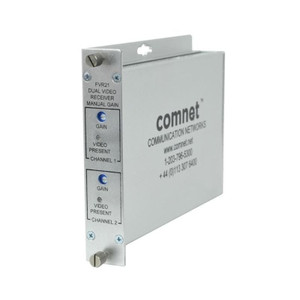
Comnet FVR22 Dual Video Receiver with Automatic Gain Control
Overview
The Comnet FVR22 is a dual-channel fiber optic video receiver purpose-built for long-distance surveillance transmission over multi-mode fiber. This unit converts fiber signals back to baseband video while compensating for signal degradation automatically — a critical capability when video travels hundreds of meters over fiber without intermediate amplification or line conditioning. The FVR22 handles NTSC, PAL, and SECAM video standards, making it suitable for mixed-standard installations common in international deployments or facilities with legacy equipment. With full-range automatic gain control (AGC), the receiver adapts to varying fiber path losses without manual adjustment, reducing commissioning time and eliminating the need for technician intervention when light levels fluctuate across seasonal or environmental changes.
Key Features
- Dual 2-Channel Configuration: Transmit two independent video streams per receiver over a single fiber pair (one strand for each direction). This means you can recover four video feeds across two fiber runs, or dedicate both channels to redundant feeds on critical cameras. Doubles throughput compared to single-channel designs without requiring additional fiber.
- ST Connectors, Multi-Mode Fiber: Standard Subscriber (ST) connectors are field-proven and widely available; multi-mode fiber (MMF) supports distances up to 2 km depending on source and connector quality. Multi-mode is more forgiving of misalignment than single-mode, reducing installation complexity and cost when spanning large facilities or outdoor distances where single-mode would require precision alignment.
- Automatic Gain Control — Full Range: AGC continuously adjusts receiver sensitivity to compensate for fiber attenuation, connector losses, and light-source aging. Full-range AGC means the FVR22 adapts across the entire operational window without saturation or compression artifacts. No manual level trimming required after installation — deploy once and let AGC handle environmental drift.
- NTSC, PAL, SECAM Compatibility: Accepts video in all three major analog television standards. Essential for facilities with mixed camera installations or international operations where PAL or SECAM cameras exist alongside NTSC systems. Single receiver handles them all without format conversion.
- Bi-Color Indicator (Red/Green): Front-panel status LED shows receiver health: green indicates signal lock and normal operation; red signals loss of signal or fault condition. Visible from a distance without requiring a laptop or management interface — fast troubleshooting in cable vaults or equipment rooms.
- Rack and Surface Mount Options: Flexible installation — mount in a standard 19-inch equipment rack alongside other transmission gear, or affix to a wall or cabinet face where floor space is limited. Both options support the same electrical connections and performance.
Integration & Compatibility
The FVR22 pairs with a matching Comnet fiber transmitter (e.g., FVT22) to form a complete video transport link. The receiver outputs baseband analog video (composite, typically), making it compatible with any analog surveillance recorder, analog camera input, or legacy matrix switcher that accepts standard CVBS (composite video baseband signal). Modern IP-based VMS systems typically require an encoder downstream of the FVR22 to digitize and stream the recovered video, or you can connect the output directly to an analog DVR for direct recording.
Fiber optic transmission isolates the receiver from electrical noise, ground loops, and RF interference — a significant advantage in industrial facilities with heavy machinery, welding equipment, or high-power switching gear. Unlike copper-based transmission, fiber is immune to lightning-induced surges on the cable itself, though proper grounding of the equipment rack remains essential.
What's in the Box
Evidence does not provide detailed package contents. Contact the manufacturer or reseller for a complete list of included cables, connectors, power supplies, and mounting hardware.
Frequently Asked Questions
Q: What fiber types does the FVR22 support?
A: The FVR22 is rated for multi-mode fiber. ST connectors are standard; confirm your transmitter uses matching connectors and fiber type before ordering.
Q: Does the FVR22 require external power?
A: Yes. The unit draws power from a DC or AC source; exact voltage and current requirements are specified in the product datasheet. Contact the manufacturer for power specifications.
Q: Can I use the FVR22 with PAL cameras?
A: Yes. The receiver supports NTSC, PAL, and SECAM video standards, so PAL, NTSC, and SECAM cameras can all feed the same FVR22 without format conversion.
Q: What does the AGC do, and why does it matter?
A: Automatic gain control adjusts the receiver sensitivity in real time to maintain stable video output despite variations in fiber signal strength caused by temperature changes, connector aging, or light-source drift. Without AGC, technicians would need to manually trim levels after installation. Full-range AGC eliminates that maintenance burden.
Q: Can I rack-mount the FVR22 alongside other equipment?
A: Yes. The FVR22 offers both rack-mount and surface-mount options, so you can integrate it into a standard 19-inch equipment rack or mount it on a wall or cabinet face depending on your space constraints.
Q: What video output does the FVR22 provide?
A: The unit outputs baseband analog composite video (CVBS), compatible with analog recorders, legacy matrix switchers, and analog camera inputs. To feed an IP VMS, you'll need a separate encoder downstream of the FVR22.
I've deployed the Comnet FVR22 in several large-scale surveillance installs where fiber was the only option — long building-to-building runs, RF-noisy industrial environments, and facilities where electrical isolation between sites was non-negotiable. The FVR22's dual-channel architecture and full-range automatic gain control are the standout features. What matters in the real world is that you don't spend commissioning time fiddling with signal levels once the fiber is terminated and connectorized. The AGC adapts to seasonal light-loss variation and aging transmitter optics without your intervention.
Technical Highlights:
- Full-Range Automatic Gain Control: Automatically compensates for fiber attenuation, temperature-induced light-loss drift, and connector aging. Eliminates manual level trimming after installation. Critical when you're spanning 1+ km of multi-mode fiber — environmental and thermal stresses on the link are continuous.
- Dual 2-Channel Configuration: Each receiver recovers two independent video streams over a single fiber pair, doubling transmission efficiency compared to single-channel designs. If your site has four cameras at a remote building, you can recover all four over two fiber runs instead of four, reducing infrastructure and splicing costs.
- Multi-Standard Video Support (NTSC, PAL, SECAM): Handles all three major analog television standards without format conversion or reconfiguration. Real deployments often have mixed legacy equipment — this receiver handles them all in a single unit.
Deployment Considerations:
- The FVR22 outputs baseband composite video only. If you need IP-based recording or distribution, you must add an encoder downstream — this is an additional cost and power draw that's easy to overlook in the budget.
- Fiber connectivity is only as good as the termination and connector condition. ST connectors are field-proven but require discipline during installation — dirt or misalignment at either end will degrade signal and reduce AGC effectiveness. Invest in proper fiber-optic cleaning tools and termination training.
The FVR22 is the right choice for long-haul analog video recovery where electrical isolation matters and environmental robustness is non-negotiable. Campus networks, sprawling industrial sites, and facilities with heavy machinery see the most return from this class of equipment — the AGC and dual-channel design eliminate field troubleshooting and maximize uptime on critical surveillance infrastructure.