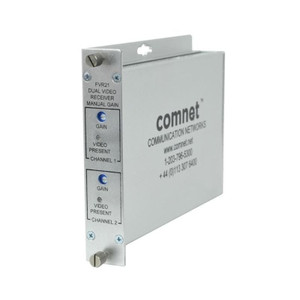
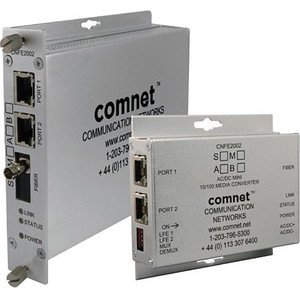
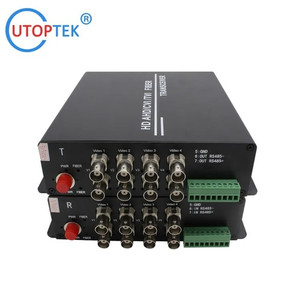
Comnet FVR1001M1 10-Bit Digital Video Receiver
The Comnet FVR1001M1 is a 10-bit digitally encoded video receiver designed for short-haul CCTV transmission over single-fiber multimode or single-mode optical cable. This module decodes video transmitted by a paired FVT1001 transmitter, delivering RS-250C-grade video quality over distances up to 3 km (2 miles) on multimode fiber—eliminating electrical noise, impedance issues, and ground loops that plague traditional RG-59 coax runs. Plug-and-play design requires no in-field electrical or optical adjustments, making it practical for integrators working in retrofit or new-build surveillance networks.
Key Features
- 10-Bit Digital Video Encoding: Converts analog video to 10-bit digital format for transmission, preserving luminance and chrominance detail without analog degradation. Critical when video must travel 300+ feet from camera to fiber converter without loss of definition.
- Multimode and Single-Mode Support: Accepts either 62.5/125 µm multimode fiber (3 km maximum distance, 16 dB power budget) or 9/125 µm single-mode fiber (69 km maximum distance, 23 dB power budget). Single-mode distances are particularly useful for large campus installations or connecting remote traffic signals without repeaters.
- RS-250C Short-Haul Compliance: Exceeds industry-standard short-haul video specifications. Differential gain <2%, differential phase <0.7°, and tilt <1% ensure that video quality remains forensically usable through compression and long-term recording.
- Signal-to-Noise Ratio >67 dB: Excellent noise floor means video streams through nighttime or low-illumination scenes without excessive artifacts. Particularly valuable when recording from low-light corridors or parking areas into NVR systems.
- Bandwidth 5 Hz to 10 MHz: Supports full NTSC, PAL, and SECAM composite video signals without pre-filtering. The upper 10 MHz boundary is sufficient for color subcarrier and synchronization information, maintaining full color fidelity across all standard analog video formats.
- Automatic Resettable Fuses and Transient Protection: Solid-state current limiters on power lines and voltage transient protection on all signal inputs eliminate nuisance shutdowns during power surges. Essential in outdoor or industrial environments where lightning or electrical switching can damage unprotected equipment.
- NEMA TS-1/TS-2 and Caltrans Certified: Tested and certified for traffic signal control equipment standards, including ambient temperature extremes (-40°C to +75°C operating, -40°C to +85°C storage), mechanical shock, vibration, and humidity with condensation. Suitable for roadside, highway, and outdoor municipal surveillance applications.
- Bi-Color LED Status Indicators: Red/Green LEDs rapidly indicate optical signal presence and power status, allowing field technicians to diagnose link integrity without accessing a VMS or test equipment.
- Low Power Consumption (2W @ 8-15 VDC): Draws minimal current, enabling operation from battery-backed power supplies or extended runs on PoE midspan injectors without overloading the power distribution.
- Hot-Swappable Module Design: Packaged in ComNet ComFit housing for wall, rack, or DIN-rail mounting (with optional DINBKT1 adapter). Modules can be installed or removed without powering down the entire system.
- Integrated WDM (Wavelength Division Multiplexing): Enables bidirectional transmission over a single fiber pair when paired with a complementary WDM transmitter, reducing fiber count in congested cable routes.
- MTBF >100,000 Hours: High mean time between failures (>11 years at continuous operation) supports long-term surveillance deployments with minimal replacement cycles.
Integration and Compatibility
The FVR1001M1 pairs exclusively with the Comnet FVT1001 series transmitter (multimode FVT1001M1 or single-mode FVT1001S1). Video output is standard BNC (gold-plated center pin) for direct connection to legacy analog DVRs, hybrid NVRs with analog video capture cards, or analog-to-digital converter boxes feeding modern IP-based systems. Power input uses terminal block connectors rated for 8–15 VDC. A 9V DC plug-in power supply is included; alternatively, extend power over long cable runs using a 24V source and a step-down buck converter to maintain the 8–15V window.
Optical connectors are ST-type; the system requires a minimum 30 dB connector return loss per the datasheet. Comnet recommends Super Polish Connectors to achieve this specification reliably. Maximum RG-59 coax distance from camera to fiber converter is 100 meters (300 feet) while maintaining 6 MHz bandwidth—distances beyond this require distribution amplifiers or migration to fiber at the camera itself.
What's in the Box
- 1x FVR1001M1 receiver module (ComFit housing)
- 1x 9V DC plug-in power supply (90–264 VAC input, 50/60 Hz)
Frequently Asked Questions
Q: What is the difference between the FVR1001M1 and FVR1001S1?
A: The FVR1001M1 is designed for multimode fiber and supports distances up to 3 km (2 miles) with a 16 dB power budget. The FVR1001S1 is for single-mode fiber and extends distances to 69 km (43 miles) with a 23 dB power budget. Choose based on your fiber installation type and distance requirements.
Q: Does the FVR1001M1 require any field adjustments or calibration?
A: No. The FVR1001M1 is a plug-and-play module. No electrical or optical adjustments are required in the field. Simply connect power, fiber, and video output and the unit operates immediately.
Q: Can I use the FVR1001M1 with an analog DVR or NVR?
A: Yes. The BNC video output is standard composite video (1V peak-to-peak at 75 ohms), compatible with any legacy analog DVR, hybrid DVR with analog cards, or NVR equipped with analog video capture modules.
Q: What mounting options are available for the FVR1001M1?
A: The module comes in ComNet ComFit housing and can be wall-mounted, rack-mounted (requires 1 rack slot), or DIN-rail mounted. DIN-rail mounting requires the optional DINBKT1 adapter plate kit (ordered separately).
Q: What is the warranty on the FVR1001M1?
A: Comnet provides a lifetime warranty on this product. Contact Comnet technical support at 1.888.678.9427 for warranty claims or service.
Q: Is the FVR1001M1 certified for outdoor or hazardous environments?
A: The FVR1001M1 is NEMA TS-1/TS-2 and Caltrans certified for traffic signal control equipment, indicating suitability for outdoor, temperature-extreme, and high-vibration environments. Operating temperature range is -40°C to +75°C. For condensing humidity environments, order the conformal-coated variant (suffix /C).
The FVR1001M1 solves a real problem in surveillance networks where long camera-to-DVR distances would normally force you into expensive fiber converters or lossy analog runs. I've deployed pairs of these in municipal traffic control and warehouse perimeter builds where a single fiber run is cheaper than trenching parallel power and coax. The 10-bit encoding is the key detail here—it preserves full video depth through the optical path, so you're not bottlenecking your analog cameras to 8-bit quality midway to the recorder.
Technical Highlights:
- Signal-to-Noise Ratio >67 dB: Night-mode scenes (parking lots, loading docks, dark corridors) stay clean in the recorded stream. At 67 dB, you're seeing luminance and color detail that would be buried in noise on a standard analog run beyond 300 feet.
- Differential Gain <2%, Differential Phase <0.7°, Tilt <1%: These are RS-250C short-haul specs—they matter when your recorded video feeds into analytics or legal chain-of-custody review. Tight specs mean colors stay true and brightness gradients don't distort across the image.
- Bandwidth 5 Hz to 10 MHz: Full support for NTSC, PAL, and SECAM composite video without pre-filtering. If you're integrating legacy analog cameras or regional standards, this unit doesn't force you to choose.
- Automatic Resettable Fuses and Transient Protection: Surge events on power or signal lines won't latch you into a hard fault. The solid-state limiters reset automatically, crucial for outdoor sites subject to lightning or switching transients.
- NEMA TS-1/TS-2 and Caltrans Certified: Independent lab testing for -40°C to +75°C operation, mechanical shock, and humidity with condensation. If this unit is going on a traffic signal pole or exposed warehouse roof, those certifications are your proof it will survive the extremes.
Deployment Considerations:
- Fiber type commitment: Multimode vs. single-mode is a one-time choice at installation. Verify your fiber type (62.5/125 µm for multimode, 9/125 µm for single-mode) before ordering the transmitter. Mismatches will not work.
- Connector return loss is critical: Datasheet specifies minimum 30 dB return loss at the optical connector. Use Super Polish Connectors and verify with an OTDR during commissioning. Poor connectors will truncate your distance budget and introduce signal errors.
- RG-59 distance limit: 100 meters (300 feet) from camera to transmitter while maintaining 6 MHz bandwidth. Beyond that, you need a distribution amplifier or fiber at the camera enclosure—plan your run accordingly.
- Power supply voltage window: 8–15 VDC is narrow. A 12V supply is ideal; if you're running long power lines, factor in voltage drop and use regulated or buck-converted supplies to stay in band.
Deploy the FVR1001M1 in traffic management networks, campus perimeter surveillance on multimode fiber runs under 3 km, or as the receiver half of a long-distance single-mode fiber link spanning 40+ km without repeaters. Pair it with the matching FVT1001 transmitter and you've eliminated ground loops and EMI noise that would degrade a coax-only system over distance.