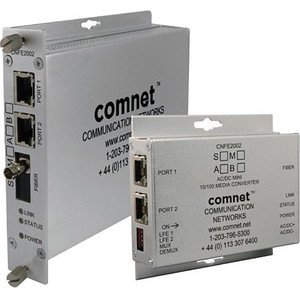
Comnet FVR21-LV Dual Video Receiver with Manual Gain Control
The Comnet FVR21-LV is a dual-channel fiber optic video receiver designed for long-distance analog video transmission over multi-mode fiber. This unit converts incoming fiber signals back to composite video, making it the receive-end component in extended video distribution systems where copper cabling is impractical or impossible—think across a warehouse campus, between building complexes, or in environments with electromagnetic interference concerns.
Overview
The FVR21-LV (often searched as FVR21 LV) handles 2 independent video channels over a single multi-mode ST fiber connection, delivering a significant space and cost advantage over separate single-channel units or running parallel fiber runs. Manual gain control lets you fine-tune signal strength at installation, which matters when fiber routes vary in distance or when splitters attenuate the signal. The built-in video loss relay provides a failsafe contact closure output if either channel loses signal—useful for triggering alarms, switching to backup cameras, or notifying a control system that transmission has been interrupted.
Key Features
- Dual 2-Channel Configuration: Two independent video channels over a single multi-mode fiber pair eliminates the need for separate fiber runs per channel—cost-effective for larger deployments where fiber infrastructure is already installed or where conduit space is constrained.
- ST Multi-Mode Fiber Connectors: ST connections are industry-standard for security transmission and offer quick disconnect capability—familiar to integrators and simplifies field replacement without special alignment tools.
- Manual Gain Control: Adjustable input gain at the receiver compensates for fiber attenuation across various distances, preventing over-driven or washed-out video. Essential when transmitter and receiver separations vary or when splitters are in the signal path.
- Video Loss Relay Output: Dry contact relay (NO/NC configurable) activates on signal loss, enabling integration with building management systems, NVR alarms, or remote notification—gives you active monitoring of link status rather than silent failure.
- Rack Mount or Surface Mount: Flexible mechanical options let you integrate into 19-inch rack frames for data centers or mount directly to a wall/cabinet for smaller installations—no single form factor constraint.
- Serial Data and Video Over Fiber: Supports both video and serial data transmission on the same fiber pair, allowing bi-directional PTZ or other control signals to flow back to cameras or transmitters without separate copper infrastructure.
Integration and Compatibility
The FVR21-LV is a passive, vendor-agnostic receiver designed to pair with any Comnet fiber transmitter outputting composite video over multi-mode ST fiber. It does not include integrated switching, routing, or active VMS connectivity—it is a point-to-point fiber extension tool. Integrators should verify that the corresponding transmitter model supports the same fiber type and connector standard. The video loss relay is a dry contact output suitable for integration into access control panels, fire alarm panels, or generic building control systems that accept 24V relay inputs.
What's in the Box
The FVR21-LV ships as a standalone receiver unit. Verify packaging contents with your order confirmation, as fiber connectors, mounting hardware, or cables are often ordered separately to match your specific site requirements.
Frequently Asked Questions
Q: What type of fiber does the FVR21-LV require?
A: Multi-mode fiber (typically OM3 or OM4 rated for longer distances and higher bandwidth). Single-mode fiber requires a different receiver module and is not compatible with this unit.
Q: Can I daisy-chain or split the video signal on the FVR21-LV output?
A: No. The receiver outputs composite video directly to a monitor or DVR input. If you need to distribute the recovered video to multiple destinations, use a separate composite video splitter or distribution amplifier downstream.
Q: What distance can the FVR21-LV handle?
A: Multi-mode fiber distance depends on the transmitter model and fiber grade. Typical ranges are 2–5 km for OM1/OM2, extending to 10+ km for OM3/OM4. Consult the paired transmitter specifications and perform a link-loss budget calculation before installation.
Q: Does the video loss relay contact output a normally-open or normally-closed state?
A: The relay is configurable for both NO (normally open) and NC (normally closed) operation. Verify the jumper or dipswitch settings during commissioning to match your alarm system's input expectations.
Q: Can serial data (e.g., PTZ commands) pass through the same fiber as video?
A: Yes. The FVR21-LV supports bi-directional serial data and video on the same fiber pair—allowing control signals to reach a transmitter-mounted camera head without a separate control wire.
Q: Is the FVR21-LV NDAA-compliant?
A: Compliance status is not confirmed in available documentation. Contact your supplier or Comnet directly to verify NDAA Section 889 compliance for your project requirements.
The Comnet FVR21-LV is built for one job: recovering composite video from a long fiber run and feeding it back into your recording or monitoring infrastructure. If you're working on a campus-wide deployment where running 1000+ feet of RG-59 is neither practical nor cost-effective, the FVR21-LV's dual-channel design over a single multi-mode fiber pair cuts your fiber infrastructure footprint in half compared to stacking two single-channel receivers.
Technical Highlights:
- ST Multi-Mode Connectors: Quick-disconnect ST connectors are the surveillance industry standard—swap a receiver in the field without crimping or fusion splicing. If your site is running OM3 or OM4 fiber, you're ready to connect and commission within minutes.
- Manual Gain Control: This is the control that keeps your video from saturating or fading across variable fiber distances. Set it during commissioning and you won't touch it again, but it's critical for installations where fiber runs exceed 5 km or where splitters attenuate the signal.
- Video Loss Relay: A dry contact output that activates the moment either of the two channels loses signal. Wire it into your access control panel or building management system—you get proactive notification instead of discovering a dead camera feed during a review.
Deployment Considerations:
- The FVR21-LV is a receive-only device—you must pair it with a matching Comnet transmitter at the camera end. Mixing vendors without a validated fiber optic protocol is a gamble you don't want to take.
- Multi-mode fiber distance is not unlimited. At 2–5 km, multi-mode ST systems are cost-effective; beyond that, single-mode fiber becomes the better choice, and this unit won't work. Do a link-loss budget calculation before you order.
Deploy the FVR21-LV when you're building out a campus perimeter system or connecting remote building PTZ turrets back to a central NVR facility—exactly the scenario where fiber avoids the noise and distance limitations of analog coax, and where a dual-channel receiver saves you conduit space and installation labor.