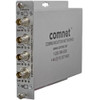
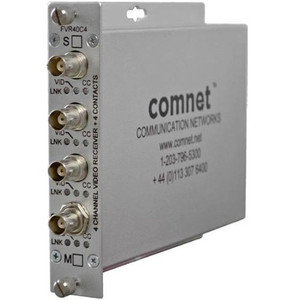
Comnet FVR20C2S2 Dual Digital Video Receiver
Overview
The Comnet FVR20C2S2 is a dual digital video receiver designed for fiber-optic surveillance installations where encoded video and contact-closure signaling must travel over extended distances. This unit decodes two independent video streams arriving via 2 singlemode fibers, reconstructs dual simplex contact-closure channels, and outputs standard video signals at the receiving end—eliminating the distance limitations of copper-based video runs and simplifying cabling in large facilities, campuses, or utility substations.
Key Features
- Dual Digital Video Decoding: Two independent encoded video channels arrive on separate singlemode fibers and are decoded simultaneously. This architecture keeps video paths isolated from one another, reducing cross-talk and allowing independent recording or playback of each video source without codec contention.
- Singlemode Fiber Support: Uses 9/125 µm singlemode fiber rather than multimode, supporting much longer transmission distances (tens of kilometers vs. a few hundred meters on multimode). Deployed in utility, transportation, and large industrial sites where camera distances exceed standard coax or twisted-pair budgets.
- 10-Bit Color Depth: Decodes 10-bit video data, preserving finer color gradation and tonal separation compared to 8-bit streams. Particularly valuable in forensic or evidence-based surveillance where color differentiation (clothing, vehicle paint, signage) directly impacts investigative outcomes.
- Dual Simplex Contact Closure: Two independent contact-closure channels are transmitted alongside video over the same fiber pair. Common use cases include alarm triggers, door access signals, or relay status feedback from remote equipment—eliminating the need for a separate copper control line.
- Industrial-Grade Fiber Architecture: Comnet's fiber transmission approach is purpose-built for environments where electromagnetic interference, ground loops, or long cable runs degrade or corrupt video. Fiber is immune to EMI and RF noise, a critical advantage in substations, refineries, or rail yards.
- Compact Receiver Module Form Factor: The FVR20C2S2 is engineered as a standalone receiver unit, designed to mount in standard 19-inch racks or wall-mount enclosures alongside other Comnet fiber transmitters, switches, and media converters, simplifying system architecture and reducing deployment complexity.
Integration & Compatibility
The FVR20C2S2 is the receiver half of a fiber-based video transmission link. It pairs with a Comnet FVT series fiber video transmitter (matched for bit depth and contact-closure channel count) on the camera or source end. The transmitter encodes analog or digital video and contact signals into a digital bitstream, sends it over one or two singlemode fibers, and the FVR20C2S2 decodes and reconstructs those signals at the receiving console, NVR, or monitoring station.
Integration assumes you have singlemode fiber already installed or planned between the transmitter site and receiver location. Fiber patch panels, SFP-to-LC jumpers, and fiber termination hardware are standard commercial items; Comnet provides compatibility guidance and application notes to simplify system design. The contact-closure outputs connect to standard dry-relay or supervised input terminals on access-control panels, alarm receivers, or VMS event triggers.
What's in the Box
Exact package contents are not specified in the available documentation. Refer to the installation manual (available from Comnet) for a definitive list of included cables, mounting hardware, and any termination or test accessories.
Frequently Asked Questions
Q: Does the FVR20C2S2 require a matching transmitter on the source end?
A: Yes. Video and contact-closure signals are encoded by a Comnet fiber transmitter (FVT series) and decoded by the FVR20C2S2 receiver. The transmitter and receiver must be matched for video format and contact-closure channel count. Consult Comnet's product compatibility documentation to confirm the correct transmitter model for your application.
Q: Can I use multimode fiber with the FVR20C2S2?
A: No. The FVR20C2S2 is designed for singlemode (9/125 µm) fiber. Multimode fiber (50/125 µm or 62.5/125 µm) will not support this receiver. Singlemode fiber enables the longer transmission distances that justify fiber-based architectures.
Q: What distances can I achieve with singlemode fiber?
A: Singlemode fiber supports distances of several kilometers to tens of kilometers depending on transmitter optical power and receiver sensitivity. Your exact maximum distance is determined by the paired transmitter model and fiber loss characteristics. Comnet application notes specify distance budgets for standard fiber grades and transmitter/receiver pairs.
Q: How do I terminate the singlemode fiber connections?
A: The FVR20C2S2 uses standard singlemode fiber connectors (typically LC or ST, depending on your installation standard). Fiber termination is performed by a qualified fiber technician using mechanical splices or fusion splices. Comnet's installation manual provides pinout and connector guidance.
Q: Does the FVR20C2S2 support video compression formats like H.264 or H.265?
A: The FVR20C2S2 is a transparent video transport device. Video encoding (H.264, H.265, or uncompressed) is handled by your video source and NVR. The receiver simply reconstructs the digital bitstream transmitted by the paired fiber transmitter. Compression is independent of the fiber transport layer.
Q: What is the operating temperature range for the FVR20C2S2?
A: Consult the datasheet (available from Comnet's product page) for precise operating and storage temperature specifications. Industrial fiber receivers typically operate from -40°C to +60°C or similar wide ranges suited to outdoor or utility deployments.
I spec the Comnet FVR20C2S2 into utility-scale installations where cameras sit kilometers from the control room and copper video cable simply won't survive EMI or distance degradation. The 10-bit color depth on the FVR20C2S2 matters more than marketing claims suggest—when a forensic investigator needs to distinguish between two similar vehicles or verify signage text in low-contrast lighting, those extra color levels are the difference between a usable image and a dead-end. Pair it with the right FVT transmitter, lay singlemode fiber, and you've got a video link that shrugs off ground loops and RF noise that would trash coax in the same environment.
Technical Highlights:
- 10-Bit Color Decoding: Preserves 1.07 billion color combinations versus 16.7 million on 8-bit. Visible difference in forensic playback when you're differentiating fabric colors, paint chips, or signage under mixed or dim lighting.
- Dual Simplex Contact Closure: Two independent 1-amp dry-relay or supervised-input channels travel over the same fiber pair as video—no separate copper control runs needed. Eliminates ground-loop risk on long contact-closure paths.
- Singlemode Fiber Architecture: Supports multi-kilometer distances where multimode (300–500 m max) would require repeaters or intermediate receivers. Fiber immunity to EMI is non-negotiable in refineries, rail yards, or power substations.
Deployment Considerations:
- Singlemode fiber installation requires skilled termination—fusion splicing or high-quality mechanical connectors. Plan for fiber-optic expertise in your deployment schedule or budget for contractor labor.
- The FVR20C2S2 is receiver-only; you must source a matching Comnet FVT transmitter on the source end. Verify transmitter model compatibility against your video format (analog or digital) and contact-closure channel count before ordering.
Deploy the FVR20C2S2 in long-distance, high-EMI surveillance architectures—parking-lot perimeter cameras on utility pole runs, remote gate/entrance monitoring at campuses, or substation/critical-infrastructure monitoring where fiber distance and noise immunity are non-negotiable constraints.