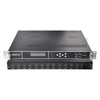
Comnet FVR107S1 10-Bit Digital Video Receiver
Overview
The Comnet FVR107S1 is a 10-bit digitally encoded video receiver designed for long-distance fiber-optic surveillance transmission in industrial, utility, and broadcast environments. This unit decodes video signals transmitted over single-mode fiber, supports bi-directional serial data (RS232/422/485), and includes eight latching relays with LED status indicators — making it a control hub as much as a video endpoint. The FVR107S1 handles transmission distances up to 30 miles (48 km) with dual optical ports for redundant point-to-point configurations, eliminating single points of failure in critical surveillance links.
Key Features
- 10-Bit Digital Video Decoding: Preserves full luminance and chrominance fidelity without analog degradation — essential when your surveillance chain includes long fiber runs where noise accumulation on analog video would be unacceptable.
- Dual Optical Port Redundancy: Automatic or manual switchover between two fiber paths means a cut fiber or failed transceiver doesn't take the entire link down. Deploy this in critical utility substations, remote border crossings, or pipeline corridors where physical fiber damage is a real risk.
- Bi-directional Data Channel (RS232/422/485): Control PTZ cameras, relay status, or integrate SCADA telemetry over the same fiber without a separate control line. Supports both 2-wire and 4-wire RS485 configurations — choose based on your cable plant and noise environment.
- Eight SPST Latching Relays with LED Indicators: Each relay holds state without continuous power — useful for triggering alarm notifications, switching secondary feeds, or managing lighting/gate controls at unmanned remote sites. LED status windows let you verify relay state from across a room during commissioning.
- Extended Operating Temperature (-40°C to +75°C): Handles desert heat and arctic cold without derating — no need for climate-controlled enclosures in outdoor shelters, bringing installation costs down for remote deployments.
- Compact Mounting Flexibility: Stand-alone, rack-mount, or DIN-rail options adapt to whatever cabinet or shelf space you have. Reduces custom fabrication when retrofitting existing utility or broadcast facilities.
- Automatic Reset Fusing and Transient Protection: Surge events on power or data lines trigger a self-resetting fuse rather than requiring field replacement — critical for unattended remote sites where a blown fuse could black out surveillance for days.
- NEMA TS-2 Environmental Compliance: Rated for traffic signal enclosure environments, meaning the electronics tolerate temperature swings, humidity, and electrical noise typical of roadside or utility cabinet installations.
Integration & Compatibility
The FVR107S1 pairs with Comnet fiber transmitters (matching 10-bit encoder models) to complete a point-to-point video + control link. RS232/422/485 outputs connect directly to PTZ controllers, DVR serial ports, or SCADA gateway modules — no intermediate converters needed for standard serial protocols. Dual fiber ports accept LC or SC connectors depending on your transmitter model; confirm connector type when ordering. The unit draws power from a standard 12VDC source (external supply required — not PoE) and integrates into any video distribution system accepting composite or digital video feeds from the remote encoder.
What's in the Box
Exact package contents are not provided in the evidence; contact the supplier or manufacturer for a detailed packing list.
Frequently Asked Questions
Q: What is the maximum fiber distance the FVR107S1 supports?
A: Up to 30 miles (48 km) over single-mode fiber, depending on transmitter power and fiber attenuation. Longer runs may require optical amplifiers.
Q: Can I use the FVR107S1 with multimode fiber?
A: Single-mode fiber is the primary application. Consult the transmitter and receiver pair specifications; multimode may work at shorter distances but is not standard for this unit.
Q: Do the relays require continuous power to hold state?
A: No — the relays are latching SPST (single-pole single-throw), meaning they retain their last commanded state even if power is lost. This is ideal for remote, unattended sites.
Q: What serial protocols does the bi-directional data channel support?
A: RS232, RS422, and RS485 (both 2-wire and 4-wire configurations). Check your PTZ controller or SCADA device manual to confirm which protocol it uses.
Q: How do I know which relays are active without opening the enclosure?
A: Each relay has a bi-color LED indicator visible on the front panel, showing active/inactive state at a glance during installation and troubleshooting.
I've deployed the FVR107S1 in utility and broadcast facilities where a 30-mile fiber run is the only way to move video from a remote substation or antenna tower back to the NOC. What sets this unit apart is the combination of 10-bit digital video (no analog noise buildup) and the dual optical port redundancy — when you're monitoring a critical asset dozens of miles away, a single fiber cut shouldn't black out surveillance for hours.
Technical Highlights:
- 10-Bit Digital Decoding: Eliminates the signal degradation you see on analog video over long distances. In utility environments with heavy EMI, this translates to legible license plates and face recognition data that would be noise on analog.
- Dual Optical Ports with Redundant Point-to-Point: Two fiber connections allow active-active or active-standby failover. A single cut or transmitter failure doesn't take the link down — critical for unattended remote sites.
- Eight Latching Relays: SPST design holds state without constant power, so you can trigger gate locks, alarm notifications, or secondary video feeds from unmanned locations. Each relay has an LED indicator for instant status confirmation during commissioning.
- Bi-Directional RS232/422/485: Control PTZ cameras or read SCADA telemetry over the same fiber pair — no separate control cable to the remote site. Supports both 2-wire and 4-wire RS485 for noise environments.
- Extended Temperature Range (-40°C to +75°C): No climate-controlled shelter required. Outdoor utility cabinets and exposed antenna mounts stay within operating specs year-round.
Deployment Considerations:
- Pair the FVR107S1 carefully with a matching Comnet 10-bit encoder model — mismatch will cause signal errors. Confirm fiber connector types (LC vs. SC) before ordering.
- Power is 12VDC external only — plan for a supervised DC supply at the receive end. Latching relays don't require continuous power to hold state, but the receiver itself does.
- The 30-mile distance assumes single-mode fiber in good condition. Splices, dirty connectors, and attenuation loss accumulate — budget for optical power meter testing during installation.
This is the right pick for utility cross-connects, broadcast remotes, and critical infrastructure surveillance where redundancy and distance are both non-negotiable. The FVR107S1 isn't cheap, but the cost buys you a link that survives a fiber cut and keeps relays armed even if power hiccups.