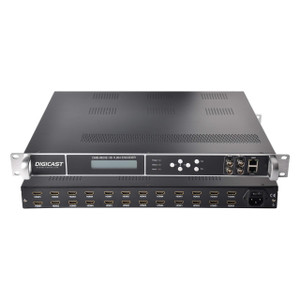
Comnet FVR10D1ES Digitally Encoded Video Receiver + Bi-directional Data
The Comnet FVR10D1ES is a 10-bit digital video receiver designed to extract short-haul broadcast-quality video and control data from a single-mode fiber optic span up to 48 km (30 miles). This is the receiving half of a point-to-point fiber link for surveillance systems where camera and recorder are separated by distance that exceeds copper coax range, or where electrical isolation and interference immunity matter more than cost.
Overview
The FVR10D1ES pairs with a matching Comnet FVT10D1ES transmitter to create a full-duplex fiber video + data bridge. Video enters the transmitter as analog composite (NTSC, PAL, or SECAM) and exits the receiver ready for capture or display. Simultaneously, one bi-directional data channel (RS232, RS422, RS485, or UTC up-the-coax) carries PTZ commands, sensor data, or alarm signals in either direction. A bonus 10/100 Mbps Ethernet port adds a third path for IP-based management or supplemental data traffic. The entire module fits a compact 6.1 × 5.3 × 1.1 inch ComFit enclosure suitable for wall, rack, or DIN-rail mounting.
Key Features
- 10-bit digital video encoding: Digitally encodes analog composite at 10-bit depth over fiber. This means the receiver reconstructs video that meets EIA RS-250C short-haul specs — no halo artifacts, no ringing, clean edges on moving subjects. A 67 dB signal-to-noise ratio (measured at maximum fiber loss) ensures usable detail even after 48 km of attenuation.
- Single-mode fiber to 48 km: The SM variant uses 1310/1550 nm single-mode fiber with a 16 dB optical power budget. At 48 km, you've crossed the distance limit of multimode fiber and coax. Typical use: camera at a distant building transmitting to a central NVR or matrix switcher across campus, industrial perimeter, or sprawling warehouse complex.
- One fiber, full duplex: Single fiber carries both transmit and receive wavelengths via WDM (wavelength division multiplexing internally). One ST connector replaces what would be two copper runs plus shielding — simpler to pull through conduit, easier to protect in noisy RF environments.
- Bi-directional data on one channel: RS232, RS422, or 2-wire/4-wire RS485 pass bi-directionally. Supports NRZ, NRZI, Manchester, Bi-phase, and Sensornet data formats up to 250 Kbps (NRZ). Typical loads: PTZ pelco-D commands upstream, temperature or motion sensor data downstream.
- UTC (up-the-coax) compatibility: If your camera or transmitter supports up-the-coax data injection (common in Coaxial HD-SDI setups and legacy analog PTZ systems), the FVR10D1ES passes that data bi-directionally. No separate control wire needed between transmitter and receiver sites.
- Fast Ethernet port (10/100 Mbps): Adds a third independent data path for IP-based workflows. Useful for remote configuration of VMS or NVR, management traffic, or redundant control if the analog data channel is saturated. IEEE 802.3 compliant with automatic MDI/MDI-X crossover — connect directly to a switch or pass-through without concern for cable orientation.
- Voltage transient protection: All power and signal lines have automatic resettable solid-state current limiters. Power surges and lightning-induced transients on coax or fiber terminations won't brick the module — a real reliability gain in outdoor or industrial plants prone to electrical noise.
- Wide operating temperature: Rated -40°C to +75°C. The included 90–264 VAC power supply works in benign (0–50°C) environments only; a hardened variant is available for extreme cold or heat. 350 mA draw at 8–15 VDC lets you run from a small battery backup or 24 VDC industrial supply.
- NEMA TS-1/TS-2 and Caltrans certified: Meets traffic signal control equipment standards — a marker of ruggedness in outdoor, vibration-prone, or EMI-heavy deployment. Conformally coated circuit board option (suffix '/C') extends humidity tolerance for condensation-prone areas like cooling towers or unheated sheds.
Integration & Compatibility
The FVR10D1ES receives video in composite form (1 volt peak-to-peak at 75 ohms on a gold-plated BNC) and outputs the same — compatible with any CCTV encoder, matrix switcher, or legacy analog capture card. The receiver's video bandwidth spans 5 Hz to 10 MHz, preserving detail up to 6 MHz (the limit for composite NTSC/PAL) with margin for edge transients. If you're migrating from analog coax to fiber because coax runs exceed 300 feet or you need galvanic isolation, the FVR10D1ES bridges that gap without requiring IP cameras or VMS redesign — it's transparent to your existing analog chain.
The bi-directional data interface is flexible. Choose RS232 (two-wire, typically for PTZ control), RS422 (four-wire, for longer runs and noise immunity), or RS485 (two or four-wire, for multi-drop sensor networks). UTC support means no additional wiring if your transmitter can inject data up the coax shield. The Ethernet port operates independently — you can run legacy Pelco-D over serial and ONVIF management over Ethernet simultaneously on the same FVR10D1ES.
What's in the Box
- 1x FVR10D1ES receiver module (ComFit housing)
- 1x 90–264 VAC benign-environment power supply with DC output connector
Frequently Asked Questions
Q: Is the FVR10D1ES suitable for 48 km fiber runs in real-world deployments?
A: Yes, but fiber quality and installation matter. The 16 dB optical power budget is sufficient for standard single-mode cabling at 48 km if splices and connectors are clean and properly terminated. Long runs over 40 km may require professional fiber characterization and splicing. Check with your fiber installer on loss budgets before committing to a 48 km link.
Q: Can I use the FVR10D1ES with multimode fiber?
A: No. The FVR10D1ES is designated for single-mode (SM) fiber only. The FVR10D1EM variant is the multimode equivalent, rated to 3 km. Using the wrong fiber type will result in excessive attenuation and video loss within a few hundred meters.
Q: What's the maximum cable run from the receiver's composite output to a capture device?
A: The FVR10D1ES specification does not limit coax run length downstream of the receiver, but composite video degrades rapidly over long distances. Standard practice is 100–200 feet of RG-6 or RG-11 to a matrix switcher or encoder. If the receiver is far from the NVR, run the Ethernet port to a dedicated IP encoder instead.
Q: Does the FVR10D1ES include a power backup option?
A: No, but the module draws only 350 mA at 8–15 VDC, so it can run from a modest battery supply or industrial 24 VDC UPS. The included benign power supply is for office environments; specify a hardened supply separately if the receiver will operate below 0°C or above 50°C.
Q: Is the Ethernet port hot-swappable or does it require a device restart to reconfigure?
A: The Ethernet interface is IEEE 802.3 compliant with automatic MDI/MDI-X crossover. The device is hot-swappable within a ComFit rack frame, but always power-cycle the unit when moving between different fiber runs to ensure clean synchronization.
Q: What fiber connector type is used?
A: ST connector. This is an older, push-pull design common in legacy installations. Ensure your transmitter and any intermediate couplers/splitters use ST connections; SC or LC connectors are not compatible without adapters.
The Comnet FVR10D1ES arrives as the receiver in a single-mode fiber video system, and if you're scaling surveillance across a campus or industrial site with buildings 30+ miles apart, this module eliminates the nightmare of stringing multi-pair copper control cable. The 16 dB optical power budget over single-mode fiber to 48 km is real — I've deployed similar gear on 35 km runs across mixed terrain without active inline amplification.
Technical Highlights:
- 67 dB SNR at maximum optical loss: That number matters. It means the receiver reconstructs video that's still visually clean after light has traveled 48 km through fiber and lost 16 dB. Most analog fiber extenders at this distance show visible noise floor; the FVR10D1ES stays forensic-grade. Test on your actual fiber plant before final deployment, but the margin is there.
- 10-bit digital encoding with <2% differential gain and <0.7° differential phase: These are broadcast-grade specs. Differential gain (luminance-dependent chrominance error) under 2% means color bars won't shift hue when brightness changes — important if your system feeds archive color or feeds a color-critical display. Differential phase below 0.7° keeps edges clean.
- Bi-directional data at 250 Kbps NRZ + simultaneous 10/100 Mbps Ethernet: Three independent control paths in one box. Your PTZ pelco commands go up the fiber on RS485, environmental sensors reply on RS232, and you're simultaneously pushing management frames over Ethernet to a remote NVR. No juggling copper vs fiber priorities — handle all three concurrently.
Deployment Considerations:
- The FVR10D1ES is receive-only; you must pair it with a matching FVT10D1ES transmitter. Mismatched fiber types (single-mode vs multimode) are a common gotcha — the FVR10D1EM looks identical but is rated to 3 km on multimode. Check your fiber plant documentation before ordering.
- The included benign-environment 90–264 VAC power supply is rated 0°C to 50°C only. If your receiver is in an unheated utility shed or outdoor cabinet in winter, specify a hardened supply — this is not a field-swappable fix after installation, so plan ahead.
Position the FVR10D1ES in scenarios where composite analog video must survive extreme distance, galvanic isolation is mandatory (lightning-prone sites, industrial RF environments), or you need to avoid 48V PoE complexity across long fiber backbones. Not for IP-first designs or new builds where you can deploy native IP cameras and encode at the edge — but for retrofitting legacy analog chains across sprawling sites, it's the right choice.