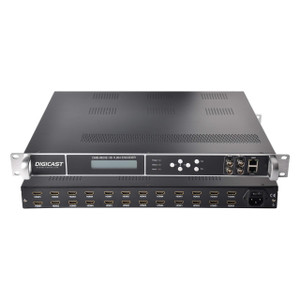
Comnet FVT107M1 10-Bit Digital Video Transmitter with Dual Optical Ports
Overview
The Comnet FVT107M1 is a digitally encoded video transmitter purpose-built for long-distance surveillance signal delivery over multimode fiber optic cable. It accepts composite video (NTSC, PAL, or SECAM standards) and converts it to a 10-bit digital format, then transmits across fiber with a dual optical port redundant configuration. This is the platform for integrators who need to extend analog camera signals 2+ kilometers without signal degradation, while simultaneously routing control data and alarm contacts through the same fiber run.
Key Features
- 10-Bit Digital Video Encoding: Converts composite video to 10-bit digital format before fiber transmission — eliminates noise and signal loss that plague analog cable runs over distance. You preserve the original image fidelity from the camera sensor whether the fiber span is 500 meters or 2 kilometers.
- Dual Optical Ports with Redundant Point-to-Point Topology: Two ST-connector multimode fiber ports allow automatic failover if one fiber strand is damaged or service is interrupted. No single fiber cut brings down your video feed — the transmitter switches to the backup path in real time. Critical for facilities where fiber routing through conduit or cable trays is unavoidable.
- 10 MHz Bandwidth: Sufficient for standard composite video signals (NTSC at 4.2 MHz luma, PAL at 5.5 MHz luma). Fiber bandwidth is not the constraint here; rather, the 10 MHz allocation accommodates the full baseband video spectrum plus overhead for the digital framing.
- Bi-Directional RS232/RS422/RS485 Data Channel: Transmits PTZ controller commands, telemetry, or alarm status back to the headend over the same fiber pair. You don't need separate twisted-pair cabling for camera control or sensor integration — one fiber bundle handles video + control + alarms.
- 8 SPST Latching Relay Contact Closures + 2 Alarm Relays: Connect door sensors, motion detectors, or discrete alarm inputs directly to the FVT107M1. Each closure triggers a latching relay that can be monitored at the remote receiver unit. No separate alarm wiring; the fiber carries everything. The two dedicated alarm relays isolate critical alerts from the general contact closures.
- Multimode Fiber with ST Connectors: Multimode fiber (MMF) is standard in security installations — lower cost than singlemode, easier to terminate in the field, and sufficient for distances up to 5 km depending on LED source power and receiver sensitivity. ST connectors are ruggedized, twist-lock, and widely stocked in security shops.
- NEMA TS-2 Environmental Compliance: Rated for outdoor and harsh-environment deployment. The -40°C to +75°C operating range covers arctic storage facilities to sun-baked rooftop cable vaults. This is not a shelf-stable office device; it's built to survive real-world site conditions.
- Rack Mount and DIN-Rail Mount Options: Configure the FVT107M1 vertically in a 19-inch telecom rack or horizontally on a 35 mm DIN rail inside an outdoor junction box or indoor utility cabinet. Flexibility for both centralized headend racks and distributed remote transmitter sites.
- RS-250C Video Standard Compliance: Follows the EIA RS-250C spec for composite video, ensuring compatibility with legacy NTSC/PAL/SECAM analog cameras and framebuffers still in service at many facilities.
Integration and Compatibility
The FVT107M1 is a transmitter half; it requires a matching receiver unit at the headend (typically a Comnet FVR107M1 or equivalent) to convert the digital fiber signal back to composite video for display or recording. The bi-directional data channel supports third-party PTZ controllers and alarm systems using RS232, RS422, or RS485 protocols — no proprietary middleware required. Verify receiver unit compatibility with your integrator before purchase, as fiber transmission products are often sold as matched pairs.
What's in the Box
The evidence provided does not include a detailed package contents list. Contact the manufacturer or your sales engineer for exact accessories (power supply specifications, mounting hardware, cable assemblies, and documentation).
Frequently Asked Questions
Q: What is the maximum fiber distance the FVT107M1 can transmit over?
A: Multimode fiber with the FVT107M1 typically supports distances of 2–5 km depending on the receiver unit sensitivity and LED launch power. Consult the matched receiver datasheet for the exact range specification.
Q: Can the FVT107M1 transmit HD or network video?
A: No. The FVT107M1 is designed for composite analog video (NTSC, PAL, SECAM). For HD or IP video over fiber, you would use a different Comnet module (such as an Ethernet fiber converter or an IP video transmitter). This unit bridges analog camera infrastructure.
Q: Does the FVT107M1 require redundant receiver units?
A: No. The dual optical ports on the transmitter side provide redundancy — two fiber paths from one transmitter to one receiver. If you need receiver-side redundancy, that is configured separately at the headend with additional receiver units and switching logic.
Q: What is the warranty on the FVT107M1?
A: The evidence provided does not specify a warranty duration. Contact the manufacturer or your supplier for warranty terms and coverage details.
Q: Can I mix and match ST and SC fiber connectors on the FVT107M1?
A: The FVT107M1 has dual ST-type optical ports. Use ST-to-ST fiber jumpers and ensure your receiving equipment also terminates with ST connectors, or use properly rated ST-to-SC adapters if transitioning to different connector types downstream.
Q: Does the FVT107M1 support the 8 contact closures and 2 alarm relays simultaneously?
A: Yes. All 8 latching relay closures and both dedicated alarm relays are active on the same unit. Route them through the bi-directional data channel or directly to the receiver's alarm interface.
The Comnet FVT107M1 solves a real problem in legacy analog camera infrastructure: how to extend composite video 2+ kilometers without noise, impedance mismatch, or expensive repeater amplifiers. The 10-bit digital encoding is the key differentiator here — once the composite signal is digitized at the transmitter end, fiber optics become a noise-free transport layer. No loss, no hum, no crosstalk across the fiber run. This is the right tool when you have existing NTSC/PAL cameras scattered across a campus or industrial site and you need to gather feeds to a central monitoring station without replacing the entire camera plant.
Technical Highlights:
- Dual ST Multimode Ports with Redundant Topology: Two independent fiber paths mean automatic failover without manual intervention or switching hardware. If a fiber strand degrades or is cut, the FVT107M1 sends video down the second path — your control room sees no interruption. Critical when fiber routing is unavoidable (buried, shared conduit, rooftop cable trays).
- Bi-Directional Data Channel (RS232/422/485): One fiber pair carries video, control, and alarms — no need to run twisted-pair camera control cables in parallel with the fiber. Your PTZ controller commands and sensor data travel the same 2 km path as the video itself, simplifying cable management at scale.
- 8 SPST Latching Relays + 2 Dedicated Alarm Relays: Integrate door sensors, motion detectors, or discrete alarm inputs directly into the fiber transport. Each relay latches until the receiver acknowledges it, preventing loss of short-duration alerts during transmission. The two dedicated alarm relays isolate high-priority events from general contact closures.
- Operating Range -40°C to +75°C (NEMA TS-2): Rated for outdoor headend cabinets, rooftop utility boxes, and unheated storage vaults. The wide temperature envelope means you can deploy the FVT107M1 in arctic warehouses or sun-baked loading dock cabins without derating.
Deployment Considerations:
- The FVT107M1 is a transmitter only — you must pair it with a matching Comnet fiber receiver (typically FVR107M1 or equivalent) at the headend to convert the digital signal back to composite video. Verify receiver compatibility before order.
- Multimode fiber supports 2–5 km depending on receiver sensitivity and power budget. For distances beyond 5 km or in high-loss conduit scenarios, consult the receiver datasheet or consider singlemode fiber alternatives (which require different optics on the FVT107M1).
This is the transmitter for analog camera networks where distance, noise immunity, and alarm integration matter more than raw bandwidth. Campus-wide surveillance rollouts, industrial facility monitoring, and utility infrastructure observation — scenarios where existing NTSC/PAL cameras are spread across many buildings and you need to consolidate feeds in one secure, noise-free, fiber-based architecture.