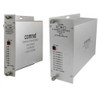
Comnet FVR801M1 8-Channel Fiber Optic Video Receiver
Overview
The Comnet FVR801M1 is an 8-channel digitally encoded video receiver designed to extract color video signals from a single optical fiber at distances up to 2 km (multimode) or 48 km (singlemode). Built on 10-bit digital encoding that exceeds EIA RS-250C short-haul transmission standards, this receiver delivers zero performance variation across the optical path — meaning video quality stays consistent whether you're 200 meters or 2 kilometers from the transmitter. The unit is purpose-built for unconditioned roadside installations, traffic control networks, and distributed CCTV systems where electrical isolation and immunity to ground loops matter more than compact form factor.
Key Features
- 10-Bit Digital Encoding: Eliminates analog degradation over distance. Each video channel is digitized at 10-bit resolution before transmission, meaning what arrives at the receiver is a clean, reconstructed signal — not attenuated analog video that decays with cable length. Particularly valuable in systems spanning hundreds of meters where traditional coax would require intermediate amplification and introduce cumulative noise.
- 67 dB Signal-to-Noise Ratio (Typical): Translates to usable video even in systems with moderate optical path loss. At this SNR, hum, quantization noise, and thermal artifacts remain below the visibility threshold for forensic review — critical for license-plate capture or facial identification at the receiving end.
- Differential Gain <2% and Differential Phase <0.7°: Maintains color fidelity and luminance linearity across the full video range. These are precision measurements that matter in multi-camera networks where color consistency feeds analytics pipelines or manual review. Poor differential gain creates visible color shifts in mid-tones; poor differential phase causes hue drift. The FVR801M1 stays within broadcast-grade tolerances.
- 1310 nm Single-Fiber Transmission: One optical fiber carries all 8 video channels bidirectionally (when paired with the FVT801M1 transmitter). This reduces infrastructure cost compared to eight separate fibers and simplifies field termination. The 1310 nm wavelength has lower attenuation in standard multimode fiber than 850 nm, extending range.
- 16 dB Optical Power Budget: Accommodates approximately 2 km of multimode fiber (FVR801M1) or 48 km of singlemode fiber (FVR801S1 variant). Budget accounts for connector losses and splice losses in real-world deployments. Verify your actual fiber path loss before installation; exceeding the budget results in bit errors and video degradation.
- Bi-Color (Red/Green) LED Status Indicators: Provides field-visible confirmation of optical signal presence and equipment health. Red/Green logic eliminates ambiguity — you can diagnose a fiber break or receiver fault from across the room without a PC or test equipment.
- Voltage Transient Protection on All Lines: Surge suppression on power and video outputs protects against lightning-induced transients and switching spikes common in roadside cabinet environments. The design includes automatic resettable solid-state current limiters, meaning a transient fault won't leave the unit permanently disabled.
- Operating Range -40°C to +75°C: Handles unheated roadside cabinets and outdoor environments where temperature swings are extreme. Storage range extends to +85°C, allowing pre-installation staging in warm warehouses without component degradation.
- MTBF >100,000 hours: Implies roughly 11-year mean time between failures under nominal conditions — realistic for a passive optical receiver with no mechanical moving parts. In practice, field failure is more often fiber connector contamination than component wear.
- Low Power Consumption (4W): Operates from 8–15 VDC, drawing only 4 watts. This allows dual-redundancy via small battery backup (12V, ~1Ah emergency supply) or operation from a roadside solar charging system without oversizing the regulator.
Integration and Compatibility
The FVR801M1 pairs with the Comnet FVT801M1 transmitter (or FVT801S1 for singlemode runs). Both units encode/decode on the same optical wavelength and bit-error handling, ensuring transparent video recovery at the receiver end. The receiver outputs eight BNC connectors (gold-plated center pins, 75-ohm), compatible with any video recorder, matrix switcher, or frame synchronizer that accepts 1 Vp-p composite video. The input bandwidth of 10 Hz to 6.5 MHz per channel preserves the full baseband of NTSC/PAL composite or S-Video without compression. Fiber optic isolation provides galvanic separation between transmit and receive sites — eliminating ground-loop hum in installations where camera feeders and monitoring facilities sit on different electrical grounds. The unit accommodates both multimode (62.5/125 µm) and singlemode (9/125 µm) fiber via the same ST connector, provided you pair the receiver with the matching transmitter variant.
Environmental and Mechanical
Housed in Comnet's ComFit enclosure (6.1 × 5.3 × 2.2 inches, weighing under 2 lbs), the receiver is compact enough for wall or shelf mounting yet rugged enough for vibration and humidity in traffic signal cabinets. The unit has been tested and certified for compliance with NEMA TS-1/TS-2 and Caltrans traffic equipment specifications — meaning it can withstand the thermal cycling, vibration, and humidity condensation of unheated roadside environments. Optional DIN-rail mounting via the DINBKT1 adaptor plate allows rack integration; the unit occupies 2 rack units when mounted horizontally in a 19-inch rack.
Installation Notes
Fiber installation requires connectors with a minimum 30 dB return loss; Super Polish (or better) ST connectors are recommended to minimize back-reflection and optical signal degradation. Verify continuity and insertion loss on your installed fiber run before deploying cameras. Power is supplied via terminal block (8–15 VDC); the included 9V DC plug-in supply (90–264 VAC, 50/60 Hz) handles AC-powered cabinet installations. The FVR801M1 is field-configurable for either stand-alone desktop use or rackmount; no firmware or software setup is required.
What's in the Box
- 1x Comnet FVR801M1 receiver module
- 1x 9V DC plug-in power supply (90–264 VAC, 50/60 Hz)
Frequently Asked Questions
Q: Can I use the FVR801M1 with singlemode fiber to extend range beyond 2 km?
A: No. The FVR801M1 is optimized for multimode fiber (62.5/125 µm) with a maximum range of 2 km. If you need singlemode range (up to 48 km), order the FVR801S1 receiver instead, paired with an FVT801S1 transmitter and 9/125 µm singlemode fiber.
Q: What video signal quality should I expect at the edge of the 2 km multimode range?
A: At 2 km with typical multimode path loss (~16 dB), the SNR is still around 67 dB typical. You will see a clean, usable video output on a monitor. However, if your actual fiber path loss exceeds 16 dB (due to extra splices, couplers, or poor connector quality), the SNR will degrade. Always measure your actual fiber insertion loss before installation.
Q: Does the FVR801M1 work with CAT5e or twisted-pair video transmission?
A: No. The FVR801M1 is the receiver half of an optical video link; it requires the FVT801M1 transmitter on the other end of a fiber optic cable. If your cameras are connected to the transmitter via coax (RG-59) at distances up to 100 m to maintain 6 MHz bandwidth, that is supported by the transmitter, but the fiber run itself must be optical.
Q: Is the FVR801M1 NDAA Section 889 compliant?
A: No NDAA or Section 889 claims are made for this product. If NDAA compliance is a requirement for your project, contact Comnet directly to confirm sourcing restrictions.
Q: What is the warranty on the FVR801M1?
A: Comnet provides a lifetime warranty on the FVR801M1. Verify the warranty scope and claims process directly with Comnet (tech support: 1.888.678.9427).
Q: Can the FVR801M1 be conformal coated for humidity-condensing environments?
A: Yes. Order the model as FVR801M1/C to add conformal coating to the circuit board, extending environmental tolerance to include condensation conditions. This incurs an extra charge; consult Comnet for pricing.
The Comnet FVR801M1 solves a specific problem: moving 8 channels of analog color video across a single fiber optic link without introducing the cumulative noise and dispersion that plague long coax runs. In traffic control and roadside cabinet deployments where fiber is already in place (or where ground-loop isolation is non-negotiable), the 10-bit digital encoding and 67 dB SNR of the FVR801M1 deliver clean, stable video recovery at ranges multimode fiber can reasonably reach — 2 km is realistic for cabinet-to-cabinet links in highway corridor installations.
Technical Highlights:
- Differential Gain <2% and Differential Phase <0.7°: These are precision measurements that directly impact color saturation and hue stability across the video range. In systems feeding analytics (license-plate readers, color-based detection), staying within broadcast-grade tolerances prevents false rejects and reduces manual review overhead.
- 16 dB Optical Power Budget (multimode): Accounts for two ST connectors (~0.5 dB each), one or two field splices (~0.3–0.5 dB each), and approximately 1.8 km of 62.5/125 µm fiber at 1310 nm. Plan for real-world losses; a contaminated connector can cost 1–2 dB, squeezing your margin. Use Super Polish or better connectors, and measure insertion loss during installation.
- 4W Power Consumption: Draws negligible current from an 8–15 VDC supply, leaving room for battery backup or solar charging systems in unmanned roadside cabinets. If you need redundancy, a small 12V / 1 Ah sealed lead-acid or lithium battery will keep video flowing during brief AC failures.
Deployment Considerations:
- Fiber installation quality is non-negotiable: minimum 30 dB return loss (RL) on all connectors. Standard or poor-quality ST connectors (15–20 dB RL) will introduce back-reflection and reduce the effective SNR. Budget for professional fusion splicing or qualified termination if your cable run has splices.
- The FVR801M1 outputs composite video (8 BNC connectors); if your monitoring backend is IP-based, you'll need a separate encoder or matrix switcher to bridge analog output to your VMS. This is not a limitation — it's a design tradeoff that keeps the receiver simple and non-dependent on network uptime — but factor it into your architecture.
The FVR801M1 is the right choice for traffic signal control networks, distributed CCTV spanning multiple roadside cabinets, or any environment where fiber infrastructure is already in place and electrical isolation matters more than real-time streaming. In those scenarios, the 10-bit digital encoding and broadcast-grade SNR will pay for the fiber investment by eliminating hum loops and signal degradation over distance.