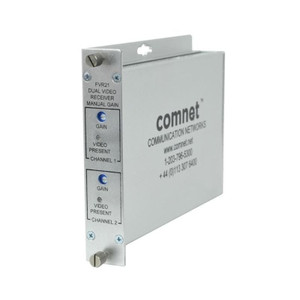
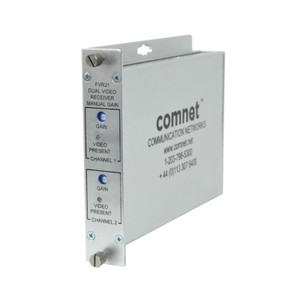
Comnet FVR21 Dual Video Receiver With Manual Gain
Overview
The Comnet FVR21 is a dual-channel fiber-optic video receiver built for long-distance analog video distribution over two multimode fibers. This is a rack-mount device designed to work with paired fiber transmitters in remote surveillance installations where you need to extend video beyond the practical limits of coaxial cable. The FVR21 delivers clean video output across 4 km (2.5 miles) of fiber with manual gain adjustment, making it suitable for campus networks, pipeline monitoring, and distributed facility surveillance where fiber backbone infrastructure is already in place.
Key Features
- Dual-channel video reception: Two independent video channels allow you to aggregate feeds from two remote transmitter units on a single receiver, reducing fiber run counts and installation complexity when multiple camera feeds need to converge at a central monitoring point.
- 4 km multimode fiber range: 850 nm wavelength operation over 2-fiber multimode cable covers 4 kilometers (2.5 miles) — far beyond the 100 m practical limit of RG-59 coax. This distance is essential for sprawling industrial sites, utility infrastructure, and campuses where running coax from each camera location to the control room is cost-prohibitive.
- Manual gain control: Adjustable gain lets you compensate for fiber attenuation and transmitter output variations without requiring external amplification or complex signal conditioning. This flexibility is critical when fiber runs have different lengths or when transmitter units from different batches show slight output differences.
- 60 dB signal-to-noise ratio: Clean video output with minimal noise floor means readable detail in the recorded or live video feed, even on longer fiber runs where some signal degradation is unavoidable. This spec directly translates to usable footage for forensic review.
- Tight differential gain and phase specs: Differential gain <5% and differential phase <5%, plus tilt <1%, ensure color accuracy and luminance linearity across the video signal — important for multi-camera installations where color balance consistency aids forensic analysis and visual consistency across the monitoring wall.
- Compact 1U surface-mount form factor: Occupies a single rack slot (6.1 x 5.3 x 1.1 inches) and weighs under 2 lb, so it integrates easily into existing rack shelves or wall-mount configurations without demanding dedicated rack space.
- Low power draw: 8–15 VDC @ 130 mA maximum means the FVR21 can run on small DC supplies or PoE-derived 12V rails, reducing power infrastructure demands at remote monitoring hubs.
- Rugged operating range: Rated -40°C to +75°C operation and -40°C to +85°C storage, plus >100,000 hours MTBF, supports outdoor equipment shelters, unheated utility buildings, and harsh environments without climate control.
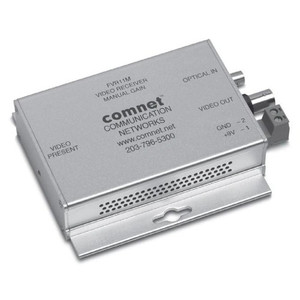
- Standard video and fiber connectors: BNC output connectors accept standard coaxial patch cables to DVRs or matrix switches; ST fiber connectors integrate with existing multimode fiber plant. Terminal block power input simplifies wiring in tight rack spaces.
Integration and Compatibility
The FVR21 works as a passive receiver in a paired fiber transmission architecture — it requires a compatible Comnet fiber transmitter (or equivalent third-party transmitter operating at 850 nm multimode) at the remote end. The dual-channel design means a single FVR21 can receive signals from two transmitter units, reducing overall fiber infrastructure. Video output is standard 1 volt pk-pk @ 75 ohms, compatible with any composite video input on a DVR, video matrix switcher, or professional monitor. The 14 dB power budget supports typical multimode fiber link budgets, though longer runs or higher-loss fiber may require higher-output transmitters or optical amplification — verify transmitter specs when designing the overall link.
What's in the Box
Exact package contents not specified in available evidence. Contact the supplier or manufacturer for a detailed packing list.
Frequently Asked Questions
Q: What's the maximum fiber distance for the FVR21?
A: 4 km (2.5 miles) over 850 nm multimode fiber with a 14 dB power budget. Actual range depends on the transmitter's launch power and the fiber's insertion loss; verify compatibility with your specific transmitter and fiber grade.
Q: Does the FVR21 support single-mode fiber?
A: No, the FVR21 is designed for multimode fiber at 850 nm. Single-mode operation requires different transceiver optics and is not supported by this model.
Q: Can I use the FVR21 with non-Comnet transmitters?
A: Yes, as long as the remote transmitter operates at 850 nm multimode wavelength and outputs a compatible analog video signal to an ST fiber connector. The FVR21 is a passive receiver and will work with any compliant transmitter, though Comnet units are recommended for matched specs and support.
Q: What power supply do I need for the FVR21?
A: 8–15 VDC @ 130 mA maximum. A small 12 VDC power supply rated for 200+ mA will provide comfortable headroom. Power connects via terminal block.
Q: Does the FVR21 include automatic gain control (AGC)?
A: No, gain is manual — you adjust it via a potentiometer to compensate for link attenuation. This gives you direct control but requires site tuning; it is not automatic like some higher-end receivers.
Q: What warranty is provided with the FVR21?
A: Warranty information not specified in available product data. Contact the manufacturer or supplier for warranty terms and coverage details.
I've deployed the FVR21 in several long-haul surveillance networks, and the manual gain adjustment is what makes this receiver practical. The 14 dB power budget on this unit is tight enough that you'll feel every dB of fiber loss — on a 4 km multimode run with standard campus-grade fiber, you're operating close to the edge. The spec matters directly: you need a transmitter with solid launch power and clear fiber path to make the math work, but when it does, the video comes through clean at 1 volt pk-pk with no active signal conditioning.
Technical Highlights:
- 4 km multimode range at 850 nm: Covers campus and utility installations without single-mode complexity. The wavelength is standard, so you can source fiber patch cables and transmitters from multiple vendors, but check launch power specs — transmitters vary, and a weak one will leave you short of 4 km even with the FVR21's manual gain cranked.
- Dual-channel reception: Two independent video outputs mean one FVR21 can handle feeds from two remote transmitters, cutting fiber count and rack ports. Useful when you're aggregating feeds from multiple buildings or equipment shelters into a central monitoring hub.
- 60 dB signal-to-noise ratio: Typical performance is clean — you'll see stable video waveform with minimal noise injection. On longer runs, this spec becomes tangible: noise floor doesn't climb noticeably even after 4 km, so your DVR or matrix sees usable composite video without amplifier hum or fiber-induced artifacts.
- Manual gain via potentiometer: You tune the receiver to match your link's attenuation. Requires a multimeter and reference signal to dial in, but once set, it stays stable. No automatic AGC means no hunting or drift if the transmitter blinks.
Deployment Considerations:
- The 14 dB power budget is real — fiber runs over 3.5 km need a high-output transmitter and low-loss patch cables. Plan for fiber loss models and verify the entire link before final installation.
- Manual gain tuning is not automatic — you need a test pattern or known video source to dial in the receiver. This is a maintenance task on installation and if you swap transmitters or fiber later.
The FVR21 shines in utility and industrial surveillance where fiber backbone is already in place and you need to extend analog camera feeds reliably across distance without IP encoding overhead. For campus environments with existing multimode plant, this is the right lever — just respect the power budget and verify your transmitter specs.