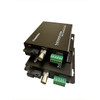
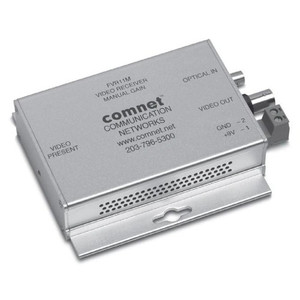
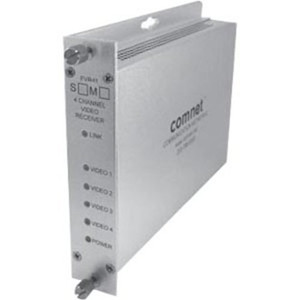
Comnet FVR11M Mini Video Receiver with Automatic Gain Control
Overview
The Comnet FVR11M is a single-fiber video receiver designed for long-distance analog video transmission over multimode fiber optic cable. This unit converts 850nm optical signals back into standard composite video, making it the receiving half of point-to-point or extended fiber-based surveillance links. It's built for integrators deploying cameras in environments where copper runs exceed practical limits — think remote perimeter fencing, campus networks, or industrial sites where EMI from power equipment would degrade coax-only systems.
Key Features
- Single-fiber ST interface (multimode 62.5/125µm): One fiber strand carries bidirectional data, cutting installation cost versus dual-fiber designs. The FVR11M handles the receive side; pair it with a matching transmitter on the camera end to complete the link.
- 4 km maximum distance over multimode fiber: At 2.5 miles, this covers most campus grids, industrial complexes, and perimeter zones without active repeaters. For shorter runs under 100 meters on coax, you have fallback routing options.
- Automatic Gain Control (AGC): The receiver adjusts input levels automatically, compensating for fiber attenuation drift and connector loss over temperature swings. This means you don't manually re-tune the link when ambient temperature shifts 40°C to 75°C; AGC keeps output consistent.
- 1 volt peak-to-peak composite video output via BNC: Standard surveillance-grade output voltage. Drives any VCR, DVR input, or frame grabber without additional buffering. The <5% differential gain and <5% differential phase specs ensure color and chroma fidelity within broadcast-quality tolerances.
- Optical power budget of 14 dB: This is the signal margin available before signal-to-noise degradation becomes visible. With 14 dB headroom, you can tolerate splice losses, connector degradation, and typical fiber bend losses — meaningful insurance on 4 km runs.
- 5 Hz – 10 MHz bandwidth with >55 dB SNR at 10 dB attenuation: Sufficient for standard NTSC/PAL composite video (4.2 MHz video bandwidth) plus sync and color subcarrier. The 55 dB signal-to-noise floor means clean playback without hum bars or visible noise, even when the optical signal has already lost 10 dB to path loss.
- Low-power operation: 8–15 VDC @ 60 mA: Under 1 watt consumption. Runs on a single 12V supply shared with other site equipment; no separate power conditioning needed.
- Wide operating temperature range: –40°C to +75°C: Handles outdoor cabinets, unheated shelters, and sun-baked equipment rooms without derating. MTBF >100,000 hours indicates field life of 11+ years at typical duty cycle.
- Compact form factor (4.0 × 3.7 × 1.0 inches): Fits in tight junction boxes, wall-mount enclosures, or DIN rails. Under 1 lb, so mounting brackets and cable strain relief are minimal.
Integration & Compatibility
The FVR11M pairs with any Comnet fiber transmitter module using matching wavelength (850 nm) and ST connectors — typically a single-fiber transmitter (FVT series) on the camera side. The composite BNC output connects directly to any analog surveillance input: legacy DVRs, multiplexers, matrix switchers, or hybrid systems with composite analog capture cards. Terminal block power input accepts 12V or 24V sourcing from standard industrial power supplies. No firmware, no IP stack, no integration overhead — this is transparent fiber extension, pure analog transport.
What's in the Box
Comnet does not publish a detailed package contents list in the specifications reviewed. Contact the distributor or manufacturer for exact accessories bundled with the FVR11M (e.g., power jumpers, ST dust caps, mounting bracket availability).
Frequently Asked Questions
Q: What is the maximum fiber distance for the FVR11M?
A: The FVR11M supports up to 4 kilometers (2.5 miles) over multimode 62.5/125 µm fiber at 850 nm wavelength. This assumes standard telecom-grade fiber and clean splices. High-loss jumpers or poor connectors will reduce usable distance.
Q: Can the FVR11M work over single-mode fiber?
A: No. The FVR11M is optimized for multimode 62.5/125 µm fiber. Single-mode fiber requires different optical components and will not yield reliable signal coupling at 850 nm without redesign.
Q: What transmitter pairs with the FVR11M?
A: Any Comnet single-fiber video transmitter using ST connectors and 850 nm wavelength (typically the FVT11M or equivalent model). The transmitter must be installed on the camera or source end. Verify matching wavelength and fiber mode before ordering.
Q: Does the FVR11M require external power conditioning?
A: No. The unit draws 60 mA at 8–15 VDC, making it compatible with standard industrial 12V or 24V power supplies. Include basic DC line filtering (ceramic caps) on the 12V rail to suppress switching noise if colocated with high-current switching supplies.
Q: What if fiber run exceeds 4 km?
A: For distances beyond 4 km, use a fiber repeater (optical-to-electrical regenerator) at the halfway point, or switch to long-haul fiber extenders rated for 10+ km. A single FVR11M cannot exceed 4 km without signal degradation.
Q: Is the FVR11M weatherproof for outdoor mounting?
A: The FVR11M is rated for operating temperatures –40°C to +75°C and storage to +85°C, but the unit itself is not IP-rated for direct rain or dust exposure. Mount it inside a weatherproof junction box, wall cabinet, or equipment enclosure. The ST connector and BNC output should be protected from moisture and debris ingress.
I've specified the FVR11M on several campus and industrial perimeter projects where coax just won't cut it—either the run exceeds 300 feet or EMI from substations chews up the signal. The 14 dB optical power budget on the FVR11M is the spec that actually matters here: it tells you how much margin you have before signal-to-noise collapses on a 4 km fiber path. That translates to real-world tolerance for splices, connectors aging, and fiber bends.
Technical Highlights:
- Single-fiber architecture at 850 nm: Saves one fiber strand compared to dual-fiber designs. Multimode 62.5/125 µm is dirt-cheap compared to single-mode, and 850 nm transceivers are commodity parts. Your cost per camera transport link drops by 20–30% versus single-mode long-haul.
- Automatic Gain Control (AGC): Eliminates field tweaking. Temperature swings from –40°C to +75°C will drift fiber attenuation, but AGC keeps the BNC output at 1 volt pk-pk without manual re-tuning. On a 10-camera perimeter, that's 10 fewer service calls.
- 55 dB SNR at 10 dB attenuation: This is the real noise floor spec. If your optical link is already 10 dB into loss (maybe you have 3 dB of splice loss, 2 dB of connector loss, 5 dB from fiber bend), the receiver still delivers clean composite video. Anything below 55 dB and you start seeing hum bars in playback.
Deployment Considerations:
- The 60 mA @ 12V draw is trivial, but pair the FVR11M power supply with your fiber transmitter's 12V rail—don't split them across different circuit breakers. Ground loops between separated 12V sources will introduce 60 Hz hum into the video.
- Watch fiber bend radius: the FVR11M pairs with standard telecom fiber (62.5/125), which has a 25–30 mm bend radius spec. Crush it below that in a J-box and you're eating 3–5 dB of unexpected loss. Budget for proper fiber management on every install.
For campus or industrial sites where you're running fiber anyway—maybe for network backbone, maybe for EMI isolation—the FVR11M is the transparent analog extension you need. Pair it with a matching transmitter, terminate the fiber, and your legacy DVR or capture card sees standard composite video. No IP stack, no integration overhead, no firmware updates breaking things six months in.