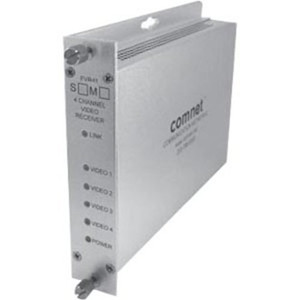
Comnet FVR1C1BM1 Digitally Encoded Video Receiver and Contact Closure
Overview
The Comnet FVR1C1BM1 is a single-channel digitally encoded video receiver designed to recover baseband video and contact closure signals transmitted over a single multimode fiber strand. Built for surveillance installations where coax distance limits force migration to fiber, the FVR1C1BM1 delivers video signal integrity and low-latency relay control over 4 km of 62.5/125µm multimode fiber — significantly extending your camera-to-headend distance without active repeaters or intermediate electronics.
Key Features
- 1-Fiber Bidirectional Transport: Single multimode strand carries both video receive and contact closure signaling, eliminating the need for dual-fiber runs and cutting fiber count by 50% compared to separate transmit and receive fibers. Meaningful cost savings on fiber plant and termination labor in long-haul surveillance backbone designs.
- 4 km Maximum Optical Distance: 12 dB optical power budget over 62.5/125µm multimode fiber at 1310 nm wavelength. This range covers warehouse perimeters, multi-building campuses, and remote facility links where coax-based 300 ft (100 m) extenders would require intermediate amplifiers or signal regeneration.
- Video Bandwidth 10 Hz – 6.5 MHz: Supports composite video recovery with <2% differential gain and <0.7° differential phase — the specs that prevent halo artifacts and color shift in composite signals. Critical if your analog camera plant predates IP migration and you're extending legacy CCTV over longer distances.
- Contact Closure Response 0.5 msec: Relay contact output rated for 0.5 A — fast enough for door strike triggers, alarm panel acknowledgments, and gate control signaling. No perceptible latency between a sensor event at the camera end and lock/gate activation on the receiver side.
- Automatic Solid-State Protection: Resettable overcurrent protection eliminates nuisance fuse replacements during short-circuit faults. Particularly valuable in outdoor installations where wildlife contact or moisture ingress can cause intermittent shorts.
- Wide Operating Range -40°C to +75°C: Handles arctic freezer plants, desert rooftop enclosures, and unheated warehouses without performance degradation. MTBF >100,000 hours (>11 years mean time between failures) suggests reliability in mission-critical backbone infrastructure.
- Low Power Draw 2W @ 8–15 VDC: Single receiver draws minimal current, allowing daisy-chain powering from a modest 24 VDC supply or integration into existing fiber-multiplexed power distribution schemes. No separate power conditioning needed.
- Single Rack Slot Form Factor: 1U-equivalent mounting footprint fits standard 19-inch surveillance racks alongside NVRs, switches, and fiber distribution panels. Clean integration into central receive stations.
Integration & Compatibility
The FVR1C1BM1 pairs with a Comnet digitally encoded fiber transmitter (such as an FVT series module) installed at the camera site. The paired transmitter digitizes the baseband composite video, encodes the contact closure state into the optical signal, and launches it down the single fiber. The FVR1C1BM1 recovers the video output (1 volt pk-pk, 75 ohms — standard for composite video inputs) and switches the contact relay. This architecture is agnositc to your VMS — the receiver outputs raw composite video that can feed any analog capture card, hybrid DVR, or analog-to-IP converter.
Multimode fiber networks (OM2, OM3, OM4 grades) commonly used in campus backbone deployments will carry the FVR1C1BM1's 1310 nm signal over 4 km with margin. If your fiber plant is already deployed for data center links or building-to-building connectivity, fiber extenders like the FVR1C1BM1 add video transmission capacity without new fiber runs.
What's in the Box
Package contents not specified in available documentation. Contact the manufacturer directly for exact inclusion details.
Frequently Asked Questions
Q: Can I use the FVR1C1BM1 over single-mode fiber?
A: No. The FVR1C1BM1 is optimized for 62.5/125µm multimode fiber at 1310 nm. Single-mode fiber has different optical coupling characteristics and would result in signal loss and receiver malfunction. Use only the multimode fiber type specified.
Q: What is the maximum distance I can run coax from my camera to the fiber transmitter?
A: The FVR1C1BM1 itself does not impose this limit — it only receives the fiber signal. Your transmitter unit (paired with this receiver) determines the maximum coax distance. Consult the transmitter's datasheet for camera-to-transmitter coax span. Typically, composite video coax is limited to 300 ft (100 m) before signal degradation becomes visible.
Q: Does the FVR1C1BM1 output digital video or analog composite?
A: Analog composite. The receiver outputs 1 volt pk-pk at 75 ohms — standard composite video. You must use a video capture card or analog-to-IP converter to digitize the signal for VMS ingest. This is not an IP camera or network device.
Q: Can I run the FVR1C1BM1 and its transmitter on the same fiber pair?
A: Yes — the single fiber is bidirectional. The transmitter and receiver use wavelength-division multiplexing (one direction uses one wavelength, the return direction uses another) over a single strand, reducing your fiber count to one per camera-to-receiver link.
Q: What power supply do I need?
A: 8–15 VDC, 2W maximum draw. A standard 24 VDC surveillance supply can power multiple receivers. Include appropriate polarity protection and a resettable breaker or fuse upstream if powering many receivers from one supply.
Q: Is there a warranty on the FVR1C1BM1?
A: Warranty information is not available in current product documentation. Contact the manufacturer for warranty terms and support policies.
I've deployed the FVR1C1BM1 in multi-building campus surveillance networks where pushing composite video over standard coax runs would either degrade image quality beyond usability or require intermediate amplifiers every 100 meters. The 4 km optical reach at 12 dB power budget is the real lever here — it means you can span from a perimeter camera shelter to a central headend across two city blocks without active regeneration, and the single-fiber design cuts your fiber infrastructure cost in half compared to dual-fiber receiver designs.
Technical Highlights:
- 12 dB Optical Power Budget: Allows 4 km run over standard 62.5/125µm multimode fiber installed in most campuses. If your fiber plant has inline splitters, couplers, or longer patch runs, the 12 dB margin absorbs typical insertion losses without requiring additional optical amplifiers — a major operational simplification.
- Composite Video Specs (<2% Differential Gain, <0.7° Phase): These numbers prevent color shift and geometry distortion in the recovered analog signal — critical for legacy CCTV systems where even small phase errors cascade into visible artifacts on recording. For facilities still running analog cameras, this is non-negotiable fidelity.
- 0.5 msec Contact Response with 0.5 A Relay Rating: Door strikes, gate motors, and alarm panel inputs respond within human-imperceptible latency. The 0.5 A rating handles standard 24 VDC solenoid coils without a separate intermediate relay, reducing wiring complexity at the receiver end.
Deployment Considerations:
- The FVR1C1BM1 is half of a system — you absolutely need a matching Comnet transmitter unit at the camera end. Do not spec this receiver in isolation; confirm that a compatible transmitter (FVT series, typically) is available for your coax-to-fiber conversion point.
- This is a composite video device outputting analog signal, not ONVIF or IP-native. Your VMS or recording infrastructure must have analog video input capacity — either a hybrid DVR with analog BNC inputs, a dedicated analog capture card in a server, or an analog-to-IP converter bridge. If you're building a pure IP VMS, you'll need that middle-mile electronics to convert the FVR1C1BM1's analog output into IP streams.
The FVR1C1BM1 shines in retrofit scenarios on existing campuses with fiber backbone already deployed for IT. If you're extending a legacy analog surveillance network beyond practical coax limits and fiber is already in the ground, this receiver eliminates the need for a full IP camera rip-and-replace or expensive remote coax amplifier infrastructure.