
Ubiquiti U6-IW vs TP-Link EAP610-OUTDOOR: Specification Comparison
Both the Ubiquiti U6-IW and TP-Link EAP610-OUTDOOR are Wi-Fi 6 (802.11ax) dual-band access points managed via vendor-proprietary SDN controllers, so they sit in the same device class. However, they target opposite deployment environments: the U6-IW is an in-wall, indoor form factor with an integrated 4-port GbE switch, while the EAP610-OUTDOOR is a weatherproof IP67-rated unit built for exterior or harsh-environment installs. This comparison helps integrators decide which unit fits the physical location and cabling topology of a given project.

In This Guide
- Which AP delivers higher wireless throughput and how do their Wi-Fi 6 specifications compare?
- Which unit is better suited to its deployment environment in terms of enclosure, operating temperature, and mounting?
- How do the two units differ in switching capability, PoE input/output, and power architecture?
- Which should you choose: the U6-IW or the EAP610-OUTDOOR?
- Side-by-Side Specs
- FAQ
Which AP delivers higher wireless throughput and how do their Wi-Fi 6 specifications compare?
The U6-IW is rated at 4.8 Gbps on 5 GHz alone, with an additional 573.5 Mbps on 2.4 GHz, yielding a combined maximum data rate well above 5 Gbps. It supports channel bandwidths up to 160 MHz on both bands (HE 20/40/80/160) and is specified for 250+ concurrent clients.
The EAP610-OUTDOOR is rated at an AX1800 combined figure: 1,201 Mbps on 5 GHz and 574 Mbps on 2.4 GHz, for a combined 1,775 Mbps. Its channel bandwidth ceiling and concurrent-client count are not stated in the provided specifications.
On raw RF throughput the U6-IW holds a significant advantage — roughly 2.7× higher on 5 GHz alone (4,800 Mbps vs 1,201 Mbps). Buyers prioritising high-density or high-bandwidth indoor environments will find the U6-IW's headroom more useful; the EAP610-OUTDOOR's AX1800 rating is adequate for perimeter or moderate-density outdoor coverage but is not positioned as a high-throughput unit.
Which unit is better suited to its deployment environment in terms of enclosure, operating temperature, and mounting?
The U6-IW uses a plastic and aluminum enclosure designed to fit a standard in-wall cavity, mounting flush to a wall plate. It carries no IP ingress-protection rating in the provided specifications. Its operating temperature range is -30 to 60 °C, which is broad for an indoor unit and covers unheated mechanical rooms or cold-climate installs.
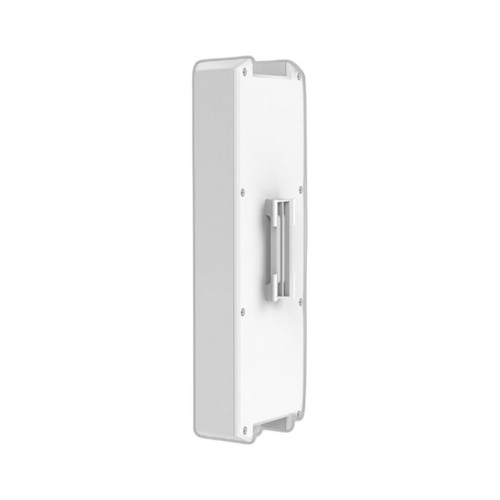
The EAP610-OUTDOOR carries an IP67 rating (dust-tight and immersion-resistant), making it suitable for rain-exposed facades, parking structures, and outdoor perimeter coverage. Its stated operating temperature is 0–40 °C — a narrower range than the U6-IW, meaning it is not specified for sub-zero outdoor environments despite its weatherproof housing. It supports wall, ceiling, and rack mounting.
The enclosure choice is the primary decision axis here: the U6-IW cannot be installed in wet or outdoor locations (no IP rating), while the EAP610-OUTDOOR's IP67 seal makes outdoor placement its core use case. Paradoxically, the U6-IW's wider temperature tolerance (-30 °C floor) may serve extreme cold better on paper, though no outdoor exposure rating accompanies it.
How do the two units differ in switching capability, PoE input/output, and power architecture?
The U6-IW integrates a 4-port Gigabit Ethernet switch with one PoE+ output port, allowing a downstream IP device (camera, phone, or thin client) to be powered directly from the AP without an additional switch at the wall. Its PoE input is 802.3at (PoE+) and its power consumption is 13 W excluding PoE output.
The EAP610-OUTDOOR has a single 10 Gbps Ethernet port (RJ45) for uplink; no downstream switching or PoE output is specified. Its power input is listed ambiguously in the provided specs — one field states 802.3at (15.4 W) and another states 802.3bt (PoE++), and it also accepts 12 V/4.5 A DC. The conflict between 802.3at and 802.3bt fields cannot be resolved from the supplied data alone; installers should verify the injector or switch port requirement directly with the datasheet.
For hospitality, classroom, or open-office wiring closet reduction, the U6-IW's integrated switch is a meaningful infrastructure simplification. The EAP610-OUTDOOR's single high-speed uplink suits point-to-point outdoor drops where no local device daisy-chaining is needed, but the PoE standard ambiguity in the spec data is a flag that warrants datasheet verification before quoting.
Which should you choose: the U6-IW or the EAP610-OUTDOOR?
Our take: The U6-IW is the stronger choice when the install location is indoors, high-density, or requires eliminating a dedicated wall switch, while the EAP610-OUTDOOR is the required choice for any weather-exposed exterior location. On RF performance the U6-IW leads substantially — 4,800 Mbps vs 1,201 Mbps on 5 GHz and support for 250+ concurrent clients vs an unspecified ceiling on the EAP610-OUTDOOR. The U6-IW also adds a 4-port GbE switch with PoE+ output, a capability entirely absent on the EAP610-OUTDOOR. Conversely, the EAP610-OUTDOOR's IP67 rating is non-negotiable for outdoor deployment; the U6-IW carries no ingress-protection rating and cannot substitute. Platform lock-in matters: the U6-IW requires Ubiquiti UniFi, the EAP610-OUTDOOR requires TP-Link Omada SDN. Mixed-vendor sites should factor controller compatibility into the decision before specifying either unit.
Side-by-Side Comparison
Spec-for-spec, from manufacturer data.
| Specification | Ubiquiti U6-IW | TP-Link EAP610-OUTDOOR |
|---|---|---|
| Wi-Fi Standard | Wi-Fi 6 (802.11ax) | Wi-Fi 6 (802.11ax) |
| 5 GHz Max Data Rate | 4,800 Mbps | 1,201 Mbps |
| 2.4 GHz Max Data Rate | 573.5 Mbps | 574 Mbps |
| Combined Throughput | Not stated as combined | 1,775 Mbps |
| Channel Bandwidth | HE 20/40/80/160 MHz | Not specified |
| Concurrent Clients | 250+ | Not specified |
| Form Factor | In-Wall | Outdoor mount |
| IP Rating | — | IP67 |
| Integrated Switch | 4-port GbE (1x PoE+ out) | — |
| Uplink Port | 1x GbE RJ45 | 1x 10 Gbps RJ45 |
| PoE Input Standard | 802.3at (PoE+) | 802.3at / 802.3bt (conflicting spec fields — verify) |
| DC Power Option | — | 12V / 4.5A |
| Power Consumption | 13W (excl. PoE output) | 15.4W |
| Operating Temperature | -30 to 60 °C | 0 to 40 °C |
| Management Platform | UniFi (cloud or on-prem) | Omada SDN |
| NDAA Compliant | Yes | Not specified |
Frequently Asked Questions
Which should you choose: the U6-IW or the EAP610-OUTDOOR?
The U6-IW is the stronger choice when the install location is indoors, high-density, or requires eliminating a dedicated wall switch, while the EAP610-OUTDOOR is the required choice for any weather-exposed exterior location. On RF performance the U6-IW leads substantially — 4,800 Mbps vs 1,201 Mbps on 5 GHz and support for 250+ concurrent clients vs an unspecified ceiling on the EAP610-OUTDOOR. The U6-IW also adds a 4-port GbE switch with PoE+ output, a capability entirely absent on the EAP610-OUTDOOR. Conversely, the EAP610-OUTDOOR's IP67 rating is non-negotiable for outdoor deployment; the U6-IW carries no ingress-protection rating and cannot substitute. Platform lock-in matters: the U6-IW requires Ubiquiti UniFi, the EAP610-OUTDOOR requires TP-Link Omada SDN. Mixed-vendor sites should factor controller compatibility into the decision before specifying either unit.
Can the U6-IW or EAP610-OUTDOOR be used in outdoor parking lots or building exteriors?
Only the EAP610-OUTDOOR is rated for outdoor use — it carries an IP67 ingress-protection rating covering dust and water immersion. The U6-IW has no IP rating in its published specifications and is designed as an in-wall indoor unit; installing it in a weather-exposed location is outside its specified use case.
Do either of these APs support powering a downstream device like an IP camera or desk phone?
Yes — the U6-IW includes a 4-port Gigabit Ethernet switch with one PoE+ output port, so it can power a single downstream PoE device without a separate switch or injector at the wall. The EAP610-OUTDOOR has a single uplink port and no PoE output capability is listed in its specifications.
Can I manage the U6-IW and EAP610-OUTDOOR from the same controller platform?
No. The U6-IW is managed exclusively through Ubiquiti's UniFi controller (cloud or on-premises). The EAP610-OUTDOOR is managed through TP-Link's Omada SDN. The two platforms are not cross-compatible, so sites standardised on one vendor's controller infrastructure would need to deploy that vendor's AP.
More Wireless Access Point Comparisons
Get a Second Opinion on Your Camera Choice
Share your site layout, coverage goals, and budget. Our team will validate the camera selection, flag anything we would change, and recommend products that match the use case.