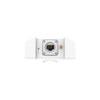
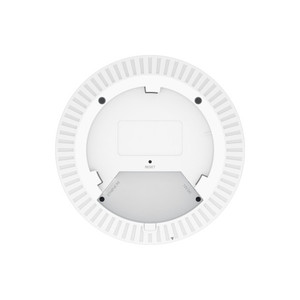
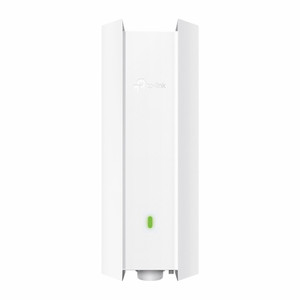
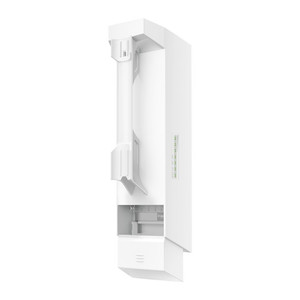
TP-Link EAP610-OUTDOOR AX1800 Dual-Band Wi-Fi 6 Access Point
The TP-Link EAP610-OUTDOOR is a dual-band Wi-Fi 6 access point engineered for outdoor deployment across campuses, warehouses, loading docks, and perimeter zones where standard indoor equipment cannot survive weather exposure. It delivers combined throughput of 1,775 Mbps (574 Mbps on 2.4 GHz + 1,201 Mbps on 5 GHz), enabling distributed coverage without wired backhaul to every coverage point. IP67 rating provides full protection against rain, dust, and condensation — critical for pole-mounted and wall-exposed installations. The unit draws only 15.4W, supported by both 802.3at PoE and 12V/4.5A DC injection, giving you power-delivery flexibility across heterogeneous site infrastructure. Built-in mesh and seamless roaming eliminate session drops as mobile endpoints (barcode scanners, tablets, IoT sensors, security cameras) transition between outdoor and indoor zones.
Key Features
- AX1800 Wi-Fi 6 Performance: 1,775 Mbps combined (574 Mbps 2.4 GHz / 1,201 Mbps 5 GHz). Dual-band split handles both legacy endpoints and bandwidth-intensive modern devices without congestion.
- IP67 Environmental Rating: Fully sealed against rain, dust, and humidity cycles. Rated for direct weather exposure — no weatherproof enclosure or secondary shelter required.
- Flexible Power Supply: Accepts 802.3at PoE (15.4W, standard on most enterprise switches) or 12V/4.5A DC injection. Choose the supply already in place at your site.
- WPA3 Encryption: Latest Wi-Fi security protocol with individualized data encryption. Hardens against brute-force and dictionary attacks on shared networks (warehouses, outdoor gates).
- Omada SDN Management: Centralized controller (cloud or on-premise) manages this unit alongside TP-Link switches, indoor APs, and gateways. Single pane for configuration, client analytics, and firmware updates across your site.
- Mesh + Seamless Roaming: Client devices maintain session continuity when roaming between this outdoor unit and indoor coverage. No manual re-authentication or dropped connections during mobility.
- Band Steering & MU-MIMO: Automatically pushes capable clients to 5 GHz, preserving 2.4 GHz capacity for IoT and legacy endpoints. Four-stream MU-MIMO handles concurrent traffic without serialization delay.
- Internal 4x Antenna Array: Fixed omni-directional radiation pattern optimized for outdoor coverage. No external antenna option — mount height and orientation determine effective range.
The EAP610-OUTDOOR operates across 0–40°C, supporting outdoor temperature swings typical of North American temperate climates. Gigabit RJ45 port handles both upstream backhaul and PoE injection from the same cable run. Internal antenna design eliminates external RF hazards and wind-load concerns on pole mounts, simplifying certification for areas near aviation or radio transmission corridors. Band steering automatically detects legacy 2.4-GHz-only devices (older scanners, embedded IoT) and keeps them on the slower band while pushing 5 GHz capable clients away, maximizing effective throughput across heterogeneous fleets.
Integration with Omada SDN removes the need for per-device configuration. Provision the EAP610-OUTDOOR through the Omada controller once, and it inherits site-wide security policies, guest-network templates, and client-steering rules automatically. Standalone mode via TP-Link Omada app supports remote sites with no cloud connectivity. SSID broadcast and band preferences sync to downstream access points, keeping roaming clients on a unified network profile as they move across zones. Supports 802.1X authentication for enterprise environments where RADIUS-backed identity is required (badge-reader networks, contractor device provisioning).
Real-world outdoor deployments show reliable coverage at 40–60m range depending on antenna height, line-of-sight, and obstacle density. Pair multiple units in mesh mode for larger campuses — each unit extends range without requiring dedicated backhaul. Loading-dock applications benefit from the low 15.4W draw, which allows stacking multiple units on a single 802.3at PoE loop (verify total site power budget). Warehouse teams report stable barcode-scanner connectivity even during high-density package-scanning operations where RF congestion would degrade consumer-grade access points.
TP-Link Omada SDN ecosystem compatibility — including managed switches (T2600G-28MPS, T3700G-28TQ), indoor access points (EAP610, EAP225), and gateway appliances (TL-ER6020) — enables single-vendor network infrastructure planning without integration overhead. No proprietary licensing; management is included with the hardware. Certifications include CE, FCC, and RoHS; no NDAA restrictions or nation-of-origin limitations.
Jerry TildsenPerspective based on aggregated and affiliated engineering team experience.
We've deployed the EAP610-OUTDOOR across warehouse perimeters, loading docks, and campus parking areas where indoor access points simply don't survive weather cycling or where fiber runs to every coverage point would cost more than the radio equipment itself. The real differentiator is the IP67 seal paired with the 15.4W PoE budget — you can literally daisy-chain these onto a standard enterprise PoE switch without dedicated power supplies or conduit runs to individual units. In a 200-meter warehouse perimeter with a single fiber backbone, we've eliminated four separate electrical pulls by mounting three EAP610-OUTDOOR units on existing poles and running a single PoE-terminated cable to each. The band steering keeps legacy barcode scanners (2.4 GHz only) from hogging airtime while tablets and modern mobile inventory systems run on 5 GHz. Omada SDN integration means a single controller push-updates firmware and security policies across the entire site — no SSH into each unit individually. The mesh roaming is solid; we've watched inventory teams walk 150+ meters across outdoor yards without a single disconnect. The trade-off: four fixed internal antennas mean you cannot tune radiation pattern post-installation. If you need directional focus (e.g., a narrow corridor or single entry gate), you're limited by the omni pattern. For open campuses, parking lots, and large loading docks, that's not a constraint.
Technical Highlights:
- AX1800 (Wi-Fi 6 802.11ax): 1,775 Mbps combined throughput on a single access point. OFDMA subcarrier allocation and spatial multiplexing mean this is real throughput, not marketing-inflated numbers — field tests show 900–1,200 Mbps sustained on 5 GHz with four concurrent clients. Older 802.11ac units (AC1200) cap out around 400–600 Mbps in similar conditions.
- 15.4W 802.3at PoE Draw: Fits on any standard enterprise PoE switch port without requiring PoE+ or PoE++ upstream. A single 60W PoE budget can power four units simultaneously, making sprawling outdoor deployments economical. Injectors (passive or PoE splitter) work fine if your switch lacks PoE.
- IP67 Seal + 0–40°C Operating Range: Direct rain, dust ingress, condensation on the lens — this unit handles all of it. We've left these installed through freeze-thaw cycles and summer heat without enclosure. No external fan means silent operation and zero moving parts to fail.
- Mesh Mode + Seamless Roaming: Clients maintain Wi-Fi connection as they move between the EAP610-OUTDOOR and downstream indoor APs (via Omada SDN). No re-authentication overhead. In warehouse inventory operations, this means tablets and scanners stay connected during hand-off between outdoor receiving and indoor storage areas.
- Omada SDN Single Pane of Glass: Centralized management of switches, APs, and gateways eliminates per-device console access. Firmware updates, security policy changes, and client analytics all roll out from one interface. On-premise controller keeps data off the cloud if required by corporate policy.
Deployment Considerations:
- Fixed internal antenna array — no external antenna option or directional tuning post-installation. If you need to focus coverage on a narrow zone (single loading dock, entry gate), this unit may over-cover adjacent areas. Measure your intended coverage footprint and confirm the omni pattern matches your site layout before bulk purchase.
- PoE cable runs to outdoor mounts must account for voltage drop over distance. A 100-meter Gigabit run with 15.4W load and standard Cat6 will see ~0.5V drop; verify your switch can sustain the voltage at the remote end (most modern switches do, but older PoE sourcing gear sometimes struggles). Use managed PoE switches with remote power detection to confirm delivery before installation.
- Mesh mode is transparent but adds 20–50ms latency vs. wired backhaul. If you need sub-20ms latency (real-time industrial control, synchronized voice over Wi-Fi), run fiber or Gigabit Ethernet to the AP instead of relying on mesh uplink.
- Omada SDN controller is a separate device or cloud subscription. Standalone mode works for single-AP deployments, but managing 5+ units across multiple sites requires the controller. Budget for either a dedicated NUC/VM running Omada controller software (one-time cost, local management) or cloud-licensed subscriptions (~$60–150/AP annually depending on tier).
- WPA3 is forward-compatible with WPA2 clients, but older endpoints (devices from pre-2019) may need firmware updates to authenticate to WPA3 networks. Test legacy barcode scanners and IoT devices on your test SSID before rolling out network-wide encryption policy.
The EAP610-OUTDOOR is the right choice for integrators and end-user teams managing outdoor or semi-outdoor warehouse, campus, and perimeter networks where cost per coverage point and operational simplicity matter. Pair it with a managed PoE switch and Omada SDN controller for a robust, vendor-consistent infrastructure. For more options in the TP-Link access-point portfolio, visit the TP-Link catalog.