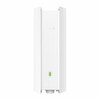
TP-Link AP8635-I OmadaPro AX1800 Indoor/Outdoor Access Point
Overview
The TP-Link AP8635-I is a dual-band Wi-Fi 6 access point built for mixed indoor/outdoor deployments where you need both weatherproofing and high client density without the cost of enterprise-grade gear. It delivers 574 Mbps on 2.4 GHz and 1201 Mbps on 5 GHz — enough aggregate throughput to handle 1000+ simultaneous wireless clients across campus, warehouse, or retail environments. The AP8635-I pairs IP67 weatherproofing with Omada SDN centralized management, making it a practical choice for deployments that span covered outdoor areas, loading docks, and interior spaces within the same fabric.
Key Features
- Dual-Band AX1800 Performance: 574 Mbps (2.4 GHz) + 1201 Mbps (5 GHz) combined throughput using Wi-Fi 6 (802.11ax). The 5 GHz band supports up to HE80 channels, delivering the bandwidth density required for video surveillance integrations, guest networks, and data-heavy IoT in the same airspace.
- IP67 Weatherproofing: Rated for direct rain, dust, and hose-down conditions. If your deployment includes outdoor undercover areas — canopies, carports, open-sided warehouse sections — the AP8635-I survives without additional housing. This eliminates radome costs and simplifies installation on exterior walls or ceiling mounts.
- 1000+ Client Capacity: Engineered to handle enterprise-scale density. Compared to consumer-grade APs (typically 50–100 clients), the AP8635-I scales to environments with thousands of IoT sensors, mobile workstations, or guest devices. Real-world scaling depends on airtime fairness and band steering tuning via Omada.
- Dual Internal Omni Antennas (4 dBi @ 2.4 GHz, 5 dBi @ 5 GHz): Omnidirectional coverage eliminates the need for external antenna arrays in most indoor/outdoor mixes. The 5 dBi gain on 5 GHz provides enough reach for mid-size open areas (parking structures, pavilions) without dedicated outdoor arrays. Swapping to external antennas is not an option — design for internal geometry upfront.
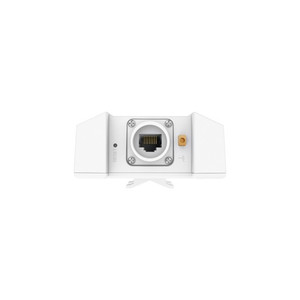
- Single Gigabit Ethernet Port (RJ45): One 1 Gbps uplink. This is the intended constraint: the AP8635-I is not a multi-uplink aggregation point. In a single-access-point deployment, one Gigabit port is sufficient; in a multi-AP campus, plan PoE injection at the switch or use injectors on each daisy-chained AP run.
- 802.3at PoE + 48V Passive PoE: Flexible power input. 802.3at (30W standard PoE) is the default; passive PoE (48V) is an alternative if your infrastructure runs legacy passive injectors. This dual-path flexibility reduces dependency on a single power standard, though 802.3at is the long-term standard. The AP8635-I draws approximately 10–12W at typical load, leaving headroom on 30W budgets.
- Omada SDN Management: Centralized provisioning, SSO/PPSK client authentication, rogue AP detection, WIDS/WIPS, and wireless isolation via the Omada Controller Pro or cloud-based Omada App. If you're already running Omada for wired infrastructure, adding the AP8635-I to the same controller fabric is straightforward; if starting fresh, plan for controller licensing cost separate from the AP hardware.
- MU-MIMO, Beamforming, Band Steering, Airtime Fairness: Standard Wi-Fi 6 efficiency features. MU-MIMO lets multiple clients use the same time slot without serialization; beamforming focuses RF energy toward individual clients rather than broadcasting omnidirectionally — real savings on airtime in high-density rooms. Band steering automatically pushes capable 5 GHz clients away from congested 2.4 GHz, reducing interference collisions.
- Mesh and Seamless Roaming: Support for mesh topology (wireless backhaul between APs) and roaming without client drop during handoff. In outdoor campus layouts, mesh allows you to extend coverage without running Ethernet to every AP location; seamless roaming keeps VoIP and real-time traffic flowing as users move between cells.
- WPA3 Encryption (Personal/Enterprise): Modern cryptography for both individual networks (WPA3-Personal) and enterprise 802.1X authentication (WPA3-Enterprise). If your organization requires government-grade security posture, WPA3 is the baseline; older WPA2 is still available for legacy clients.
- Ceiling/Wall Mounting with Kits Included: Pre-packaged ceiling and wall mounts eliminate guesswork on installation. Dimensions of 160 x 160 x 33 mm (wall form factor) keep the AP compact; ceiling drops fit standard T-bar grids in commercial spaces. The 64 mm height (ceiling mount variant) is taller but still unobtrusive for drop-ceiling environments.
Integration & Compatibility
The AP8635-I is part of the TP-Link OmadaPro access point family and requires Omada Controller Pro (on-premises or cloud) for centralized provisioning and client authentication. Standalone (controller-free) mode is not documented in the evidence; all feature-rich deployment paths assume controller access. If your environment uses third-party VMS (Milestone, Genetec, etc.) with wireless sensor networks, the AP8635-I supports standard Wi-Fi and 802.1X auth but does not include VMS-native plugins — verify integration with your VMS pre-sales team.
Backhaul via PoE-injected Ethernet or passive PoE is straightforward on standard infrastructure. If deploying mesh, plan for dedicated bandwidth on the backhaul link (the first AP uplink); mesh performance degrades as hop count increases, so limit mesh chains to 2–3 levels.
Environmental & Operational Specifications
Operating temperature range is 0–40 °C (32–104 °F), suitable for temperate climates and air-conditioned spaces. Tropical or arctic deployments may require thermal derating or supplemental climate control. IP67 rating covers dust and rain but not extreme thermal shock; avoid rapid swings (e.g., direct sunlight to spray wash). Certifications include CE, FCC, and RoHS — appropriate for North American and EU deployments but verify regional regulatory compliance for other zones.
When to Choose a Different Model
If your deployment requires higher throughput (AX3000 or AX5400 variants) or indoor-only form factors, consider the AP9635 (AX1800 ceiling mount) or AP9650 (AX3000) from the same Omada family. The AP8635-I is purpose-built for weathered outdoor conditions; if your site is fully enclosed, an indoor-only model will be more cost-effective and eliminate unnecessary IP67 design overhead.
What's in the Box
The AP8635-I ships with ceiling and wall mounting kits included, ready for immediate installation. Exact accessory counts (screws, brackets, templates) are not itemized in the evidence; contact pre-sales for a detailed packing list if your deployment requires verification of specific hardware components before installation begins.
Frequently Asked Questions
Q: Does the AP8635-I support mesh backhaul over Wi-Fi?
A: Yes. The AP8635-I supports mesh topology for wireless backhaul between APs. Seamless roaming is also included, allowing clients to move between APs without dropping connection. Plan for reduced throughput on mesh hops due to shared airtime; limit mesh chains to 2–3 levels for acceptable performance.
Q: What power options are available for the AP8635-I?
A: The AP8635-I accepts 802.3at PoE (standard 30W power sourcing equipment), 48V passive PoE, or 12V/1.5A DC power supply. 802.3at is the recommended path for modern deployments; passive PoE is supported for legacy infrastructure compatibility.
Q: Can the AP8635-I be mounted outdoors year-round?
A: IP67 rating means the AP8635-I survives rain and dust but operates within 0–40 °C (32–104 °F). Extreme heat, freezing, or rapid thermal cycles may degrade performance. For true outdoor year-round use in extreme climates, verify that local conditions fall within the operating range or plan supplemental thermal management.
Q: Does the AP8635-I require an Omada Controller?
A: Yes. Full feature deployment (PPSK, SSO, WIDS/WIPS, centralized management) requires Omada Controller Pro or the cloud-based Omada App. Standalone controller-free operation is not documented in the product specifications.
Q: How many clients can the AP8635-I handle simultaneously?
A: The AP8635-I is rated for 1000+ concurrent wireless clients. Real-world capacity depends on airtime fairness settings, band steering configuration, and data demand per client. Video surveillance and high-throughput IoT workloads will saturate the 1 Gigabit uplink faster than low-bandwidth sensor networks.
Q: Is the AP8635-I compliant with government procurement standards?
A: The AP8635-I carries CE, FCC, and RoHS certifications. NDAA Section 889 or TAA compliance is not listed in the evidence; verify with pre-sales if government procurement requirements apply.
The AP8635-I targets a specific gap in mixed indoor/outdoor deployments where you need enterprise-scale client density (1000+ devices) without sacrificing weatherproofing or centralized control. The combination of 574 Mbps on 2.4 GHz and 1201 Mbps on 5 GHz, paired with IP67 durability and Omada SDN integration, makes it practical for warehouse corridors, loading docks, and campus transitions where a single AP model needs to handle both rain and high client churn.
Technical Highlights:
- IP67 Rating: Eliminates the need for outdoor enclosures or radomes in covered outdoor areas. Rain and dust ingress are not a concern, freeing you to mount the AP8635-I on exterior walls or exposed ceiling drops without supplemental weatherproofing.
- 1000+ Client Capacity: Enterprise-grade scaling compared to consumer APs. Combined with band steering and airtime fairness, the AP8635-I handles thousands of IoT sensors or mobile endpoints in the same RF fabric — a real advantage in warehouse automation or retail environments with dense device inventory.
- Dual Internal Omni Antennas (4 dBi @ 2.4 GHz, 5 dBi @ 5 GHz): Omnidirectional coverage eliminates angle-specific dead zones common with directional antennas. The 5 dBi gain on 5 GHz is sufficient for mid-size open areas; plan accordingly if you need > 300 ft reach in a single direction.
- 802.3at + 48V Passive PoE Flexibility: Dual power input paths mean you can retrofit into legacy passive-PoE infrastructure or deploy on modern 802.3at switches without adapter churn. This flexibility reduces dependency on standardization wars in older mixed-infrastructure sites.
- Omada SDN Centralized Management: PPSK (Per-Client Pre-Shared Keys) and SSO integration simplify large-scale guest networks and contractor access. WIDS/WIPS (Wireless Intrusion Detection/Prevention) and rogue AP detection are built-in, not add-ons, reducing security gaps compared to standalone APs.
Deployment Considerations:
- Single Gigabit Uplink is the Constraint: The AP8635-I has one 1 Gbps Ethernet port. In a single-AP environment, this is adequate; in a multi-AP campus with high aggregate throughput, the backhaul becomes a bottleneck at around 700–800 Mbps aggregate user traffic. Design your uplink topology (PoE daisy-chaining, mesh backhaul) with this ceiling in mind.
- Omada Controller Dependency: All advanced features (client authentication, airtime fairness, band steering) require Omada Controller Pro or the cloud app. Standalone controller-free deployments are not supported, so plan for controller licensing and management infrastructure upfront — this is not a plug-and-play consumer AP.
- Operating Temperature Limits (0–40 °C): Suitable for temperate and air-conditioned spaces but not for unheated outdoor enclosures in cold climates or direct-sun mounting in extreme heat. Tropical deployments above 40 °C will degrade RF performance; verify local seasonal highs before committing to permanent outdoor placement.
- No External Antenna Upgrades: Internal antennas only — you cannot swap to high-gain or directional arrays. This design choice simplifies weatherproofing but locks you into omnidirectional coverage. If you need asymmetric coverage (e.g., long hallway with dead-end), consider multi-AP placement rather than antenna tuning.
Deploy the AP8635-I in warehouse fulfillment centers, retail distribution hubs, or mixed indoor/outdoor campuses where you need both robustness against weather and the ability to manage thousands of wireless endpoints from a single Omada controller. It is not a choice for fully indoor corporate offices (use indoor-only variants instead) or extreme outdoor environments requiring > 40 °C operation or year-round unheated exposure (those demand specialized outdoor APs with extended thermal ratings).