
TP-Link EAP610 vs Ubiquiti U6-MESH-US: Specification Comparison
Both the TP-Link EAP610 and Ubiquiti U6-MESH-US are Wi-Fi 6 (802.11ax) dual-band access points aimed at installers deploying managed wireless infrastructure. The comparison covers radio performance and throughput, physical deployment environment and power requirements, and management platform integration — the three axes that most directly govern which unit fits a given project. Key differentiators are aggregate throughput ceiling, indoor-vs-outdoor rating, and SDN ecosystem alignment.
In This Guide
- Which access point delivers higher aggregate throughput and how do their radio specs compare?
- Which unit is built for outdoor or harsh-environment installation, and what are the power requirements?
- How do the management platforms and ecosystem integrations differ between these two APs?
- Which should you choose: the EAP610 or the U6-MESH-US?
- Side-by-Side Specs
- FAQ
Which access point delivers higher aggregate throughput and how do their radio specs compare?
The TP-Link EAP610 is rated at AX1800 aggregate throughput across its dual 2.4 GHz and 5 GHz bands. No per-band breakdown is provided in the supplied specs. It supports 802.11a/b/g/n/ac/ax client modes, offering broad legacy compatibility.
The Ubiquiti U6-MESH-US is rated at 5.3 Gbps aggregate throughput — approximately 2.9× the EAP610's AX1800 (~1.8 Gbps) ceiling. It supports channel bandwidths of HT 20/40, VHT 20/40/80/160, and HE modes per spec. Antenna gain on the 5 GHz radio is specified at 5 dBi; no equivalent figure is provided for the EAP610. The U6-MESH-US specifies a coverage area of 140 m² (1,500 ft²); the EAP610 spec set does not include a coverage-area figure.
Which unit is built for outdoor or harsh-environment installation, and what are the power requirements?
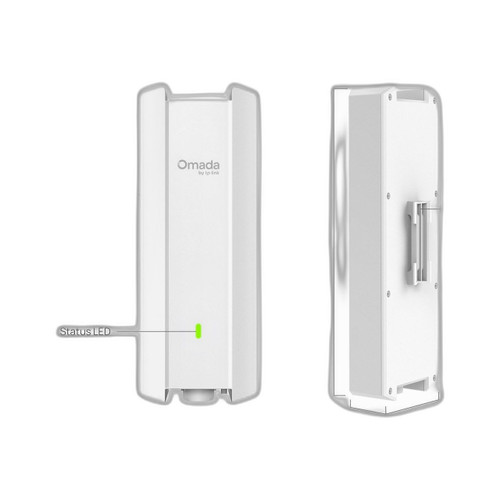
The TP-Link EAP610 is specified for ceiling and wall indoor mounting with an operating temperature of 0 °C to 60 °C. No IP or NEMA ingress-protection rating is listed in the provided specs. It accepts PoE+ (802.3at) power; the spec set also references 802.3af as a minimum and 802.3bt as an alternative, alongside a 12 V/4.5 A DC input — internal conflicts exist in the supplied data and should be verified against the datasheet.
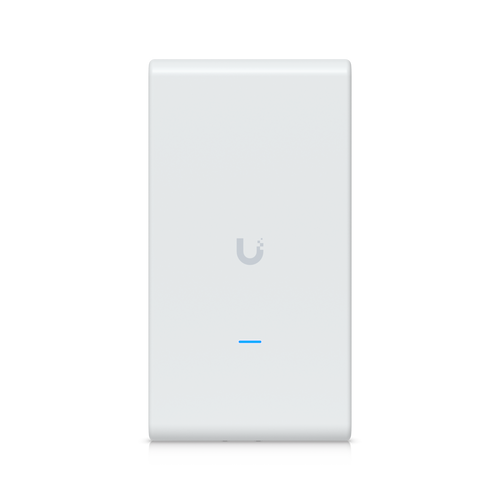
The Ubiquiti U6-MESH-US carries an IPX5 ingress-protection rating and an operating temperature range of -30 °C to 60 °C, making it explicitly outdoor-rated and suited to significantly colder ambient conditions than the EAP610. Its enclosure is polycarbonate and aluminum. It is powered by PoE at 802.3at or higher, draws 13 W, and accepts 44–57 V DC. Wall and pole mounting hardware is included. The EAP610 includes no pole-mount provision and carries no outdoor rating.
How do the management platforms and ecosystem integrations differ between these two APs?
The TP-Link EAP610 is managed via TP-Link Omada SDN, which supports centralized controller-based deployment (hardware controller, software controller, or cloud). Security options span WEP, WPA2-PSK, WPA-Personal/Enterprise, WPA2-Personal/Enterprise, WPA3-Personal/Enterprise, and WPA3 Enhanced Open (OWE). No NDAA compliance statement is present in the provided specs.
The Ubiquiti U6-MESH-US is managed through the UniFi Network web application and mobile app — Ubiquiti's UniFi ecosystem. The spec set does not enumerate the full wireless security suite for this unit. The U6-MESH-US is stated as NDAA compliant and holds CE, FCC, IC, Anatel, and SRRC certifications. No equivalent certification list is provided for the EAP610. Buyers already invested in either Omada or UniFi controllers will find no cross-compatibility; ecosystem lock-in is a primary decision factor here.
Which should you choose: the EAP610 or the U6-MESH-US?
Our take: The U6-MESH-US is the stronger choice when the deployment is outdoors, in a mixed-temperature environment, or requires higher throughput headroom. Its 5.3 Gbps aggregate rating versus the EAP610's AX1800 (~1.8 Gbps) represents a roughly 2.9× throughput ceiling advantage. Its IPX5 outdoor rating and -30 °C lower operating bound make it viable in locations the EAP610 — with no IP rating and a 0 °C floor — cannot serve. NDAA compliance on the U6-MESH-US is a hard requirement for some government or federal-adjacent projects where the EAP610 provides no equivalent attestation. Conversely, the EAP610 is the rational choice for cost-sensitive indoor deployments where AX1800 throughput is sufficient, where WPA3-OWE or granular Omada SDN policy management is valued, or where the existing infrastructure runs the Omada controller platform. Platform commitment — Omada vs. UniFi — should be resolved before unit selection, as neither AP is cross-managed.
Side-by-Side Comparison
Spec-for-spec, from manufacturer data.
| Specification | TP-Link EAP610 | Ubiquiti U6-MESH-US |
|---|---|---|
| Wi-Fi Standard | Wi-Fi 6 (802.11ax) | Wi-Fi 6 (802.11ax) |
| Aggregate Throughput | AX1800 (~1.8 Gbps) | 5.3 Gbps |
| Bands | Dual-band (2.4 GHz / 5 GHz) | Dual-band (2.4 GHz / 5 GHz) |
| 802.11 Modes | a/b/g/n/ac/ax | 802.11ax (WiFi 6) |
| PoE Standard | 802.3at (PoE+) | 802.3at or higher |
| Power Consumption | — | 13 W |
| LAN Port | 1× Gigabit Ethernet | 1× Gigabit Ethernet |
| Mount Type | Ceiling / Wall / Junction Box | Wall / Pole |
| Environment Rating | Indoor only (no IP rating listed) | Outdoor — IPX5 |
| Operating Temperature | 0 °C to 60 °C | -30 °C to 60 °C |
| Dimensions | 160 × 160 × 33.6 mm | Ø48.5 × 159.5 mm |
| Weight | — | 2.1 lb |
| Management Platform | Omada SDN | UniFi Network (web + mobile app) |
| Wireless Security | WPA3-Personal/Enterprise, WPA3-OWE, WPA2, WPA, WEP | — |
| NDAA Compliant | — | Yes |
| Certifications | — | CE, FCC, IC, Anatel, SRRC |
Frequently Asked Questions
Which should you choose: the EAP610 or the U6-MESH-US?
The U6-MESH-US is the stronger choice when the deployment is outdoors, in a mixed-temperature environment, or requires higher throughput headroom. Its 5.3 Gbps aggregate rating versus the EAP610's AX1800 (~1.8 Gbps) represents a roughly 2.9× throughput ceiling advantage. Its IPX5 outdoor rating and -30 °C lower operating bound make it viable in locations the EAP610 — with no IP rating and a 0 °C floor — cannot serve. NDAA compliance on the U6-MESH-US is a hard requirement for some government or federal-adjacent projects where the EAP610 provides no equivalent attestation. Conversely, the EAP610 is the rational choice for cost-sensitive indoor deployments where AX1800 throughput is sufficient, where WPA3-OWE or granular Omada SDN policy management is valued, or where the existing infrastructure runs the Omada controller platform. Platform commitment — Omada vs. UniFi — should be resolved before unit selection, as neither AP is cross-managed.
Can the U6-MESH-US be installed outdoors while the EAP610 cannot?
Based on the provided specs, yes. The U6-MESH-US carries an IPX5 ingress-protection rating, an operating temperature range of -30 °C to 60 °C, and includes wall and pole mounting hardware — all consistent with outdoor deployment. The EAP610 specifies no IP rating and an operating range starting at 0 °C; its spec sheet positions it for ceiling and wall indoor installation only.
Is the EAP610 or U6-MESH-US better for larger deployments requiring centralized management?
That depends on the controller platform already in use. The EAP610 integrates with TP-Link Omada SDN (hardware controller, software controller, or cloud). The U6-MESH-US integrates with Ubiquiti UniFi Network. Neither unit is compatible with the other's controller. For large indoor deployments already on Omada, the EAP610 is the fit; for deployments on UniFi — particularly mixed indoor/outdoor campus or mesh scenarios — the U6-MESH-US is appropriate. The U6-MESH-US's 5.3 Gbps aggregate throughput also provides more headroom per node in high-density environments.
Which access point is required if the project must meet NDAA compliance?
The U6-MESH-US is specified as NDAA compliant in the provided specs. No NDAA compliance statement appears in the EAP610 spec set. Installers with federal, state, or NDAA-sensitive end-user requirements should verify compliance documentation directly with TP-Link before specifying the EAP610 for those projects.
More Wireless Access Point Comparisons
Get a Second Opinion on Your Camera Choice
Share your site layout, coverage goals, and budget. Our team will validate the camera selection, flag anything we would change, and recommend products that match the use case.